

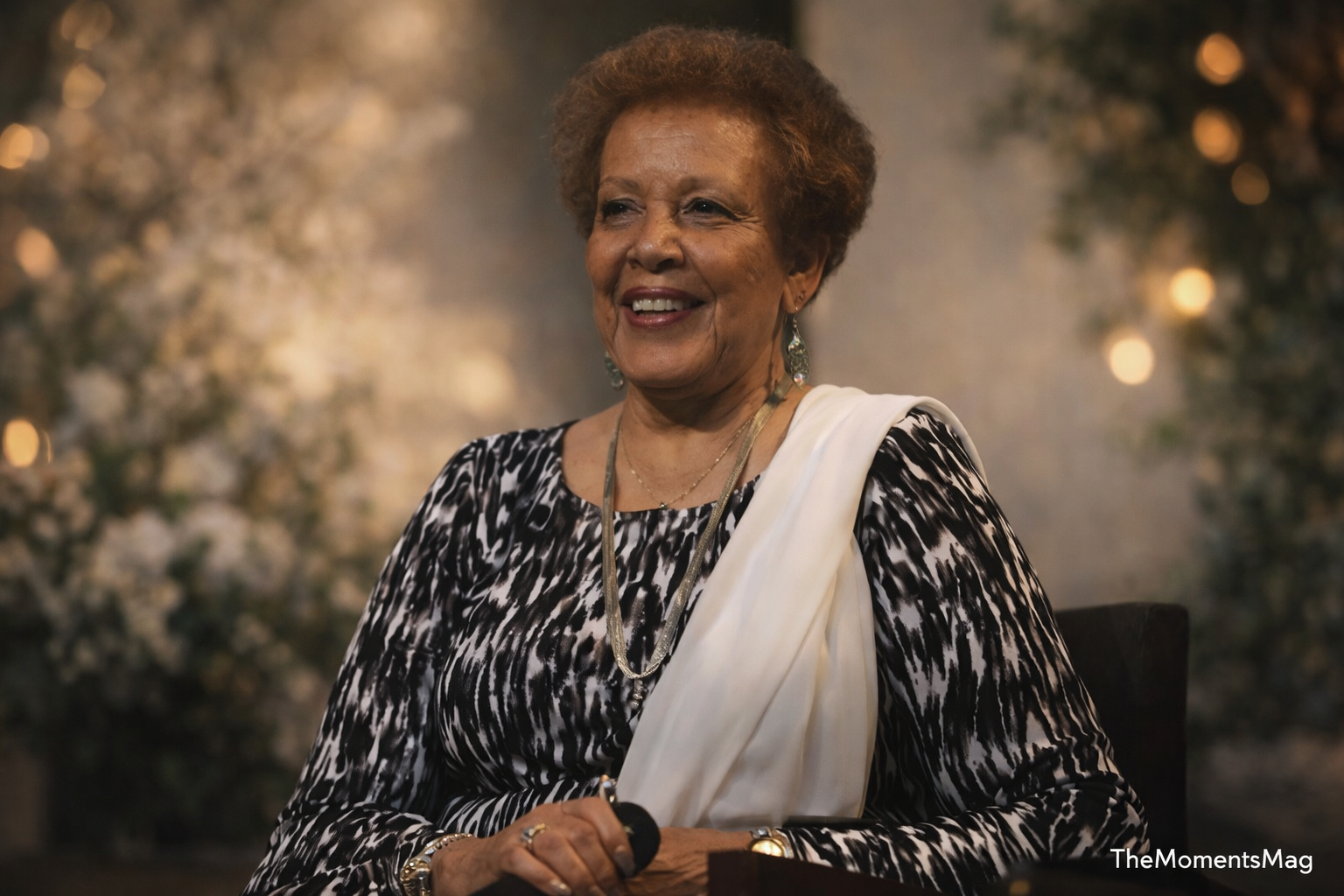
Joylette Goble is best known to the public as the daughter of Katherine Johnson, the legendary NASA mathematician whose work helped send American astronauts safely into space. Yet to describe Joylette Goble only through her mother would miss the deeper truth of her life. She is a mathematician, a technology professional, a longtime NASA contributor, and a living bridge between a hidden past and a more visible future.
Her story is not one of sudden fame or celebrity. Instead, it is a biography shaped by discipline, continuity, and responsibility. Joylette Goble’s life shows how historic achievement does not end with one generation. It continues through those who preserve it, contextualize it, and extend it forward with their own work.
Table of Contents
ToggleEarly Life and Family Roots
Joylette Goble, often referred to as Joylette Goble Hylick, was born into a household where learning was expected, not celebrated as exceptional. Her mother, Katherine Johnson, worked as a mathematician at NASA’s Langley Research Center during the height of the Cold War and the Space Race. At the time, Johnson was one of many Black women employed as “human computers,” performing complex mathematical calculations critical to aeronautics and spaceflight.
Inside the home, however, Katherine Johnson’s work was not framed as history in the making. It was simply a job done with care and excellence. Joylette grew up absorbing this mindset. Math was not treated as intimidating or elite. It was practical, useful, and deeply human.
Like many children of high achievers, Joylette did not initially understand the global importance of her mother’s contributions. Johnson rarely spoke about her work in grand terms, and the recognition she would later receive came decades after the missions themselves. This environment shaped Joylette’s outlook: achievement was something you did, not something you announced.
Education and Early Influences
Joylette Goble followed a path that reflected both her aptitude and her upbringing. She pursued mathematics academically, earning a bachelor’s degree in mathematics from Hampton University, one of the nation’s historically Black colleges and universities. She later completed a master’s degree in information systems from Drexel University.
These choices placed her squarely within the technical world her mother had navigated before her, though under very different circumstances. By the time Joylette entered the workforce, legal segregation had ended, but structural barriers still remained for women and people of color in STEM fields.
Her education prepared her not only to work with numbers, but to adapt as technology evolved. The transition from manual calculations to computer-based systems marked a defining shift in aerospace and defense industries. Joylette’s background allowed her to move with that shift rather than be displaced by it.
A Career at NASA and Beyond
Joylette Goble spent more than three decades working at NASA’s Langley Research Center in Virginia, the same institution where her mother had built her career. This continuity is striking. Few families have contributed to the same federal research center across generations, especially in highly technical roles.
At NASA Langley, Joylette worked in information technology and related systems, supporting the infrastructure that allows scientific and engineering work to happen at scale. While her role differed from her mother’s, the underlying principle was the same: precision matters, because lives and missions depend on it.
After her time at NASA, Joylette continued her career at Lockheed Martin, one of the world’s largest aerospace and defense companies. There, she applied her experience in large-scale systems and complex organizational environments. Her retirement marked the conclusion of a professional life spent largely out of the public eye, yet deeply embedded in the machinery of American science and defense.
Discovering the Full Weight of Her Mother’s Legacy
For much of her adult life, Joylette Goble understood her mother as a talented mathematician, but not as a cultural figure. That changed gradually. In the late 20th and early 21st centuries, historians, journalists, and NASA itself began to more openly acknowledge the contributions of Black women mathematicians whose work had been overlooked.
The turning point came with the publication of Hidden Figures by Margot Lee Shetterly and the subsequent film adaptation. The story transformed Katherine Johnson from a respected insider within NASA into an internationally recognized figure of scientific history.
For Joylette, this public recognition carried emotional weight. It validated work that had long gone unacknowledged, but it also placed her family into a new spotlight. Suddenly, private memories became part of a national narrative.
Rather than retreat from that attention, Joylette stepped forward as a steward of her mother’s story. She began participating in public events, lectures, and interviews, offering personal insight that no archive could provide. Her role was not to mythologize, but to humanize.
Public Appearances and Historical Stewardship
Joylette Goble’s visibility increased significantly after 2016. She spoke at museums, universities, and cultural institutions, often alongside her siblings. One of the most notable moments came at the Smithsonian’s National Museum of African American History and Culture, where she spoke during events honoring Katherine Johnson’s life and work.
In 2024, Joylette and her sister accepted the Congressional Gold Medal on behalf of their mother, awarded collectively to NASA’s Hidden Figures. The ceremony represented more than an honor. It was a formal acknowledgment by the U.S. government that critical scientific labor had been marginalized for decades.
Through these appearances, Joylette emerged not as a celebrity, but as a translator between eras. She explained what it was like to grow up in a segregated America, to watch excellence persist despite limited recognition, and to see that excellence finally receive its due.
Advocacy for STEM and Education
A central theme in Joylette Goble’s public work is education. She frequently emphasizes the importance of STEM fields for young people, particularly girls and students of color. Her message is grounded in lived experience rather than abstract theory.
She speaks not only about opportunity, but about preparation and persistence. Mathematics, in her telling, is not a gift reserved for a few. It is a skill developed through practice and support. This framing challenges stereotypes that still discourage many students from pursuing technical fields.
Joylette’s advocacy aligns with broader national concerns. Despite decades of progress, women and Black Americans remain underrepresented in many STEM professions. Her story provides a concrete example of what sustained inclusion can look like across generations.
A Life Defined by Continuity, Not Fame
Unlike many public figures associated with major historical moments, Joylette Goble has never sought personal acclaim. Her biography resists dramatic arcs and reinvention narratives. Instead, it is defined by continuity: education leading to service, service leading to stewardship.
She represents a form of leadership that is increasingly rare in public discourse. It is leadership rooted in competence, loyalty to institutions, and respect for collective effort. In a media environment that often rewards visibility over substance, her example offers a quieter model.
Joylette’s life also underscores an important truth about historical change. Breakthroughs do not occur in isolation. They require families, mentors, workplaces, and successors who carry values forward even when recognition is absent.
Personal Legacy and Ongoing Influence
Today, Joylette Goble is widely recognized as both a witness to history and a participant in it. Her personal memories enrich the historical record, while her professional career stands on its own merits.
Through her speaking engagements and public presence, she continues to influence how the Hidden Figures story is understood. Not as a single triumphant moment, but as a long struggle marked by patience, skill, and resilience.
Her biography reminds readers that history is not only shaped by those who make headlines. It is also shaped by those who preserve truth, explain context, and ensure that future generations understand where progress truly comes from.
Also Read: Chloe Holladay Net Worth: Biography, Career, and Rise
Conclusion
Joylette Goble’s life cannot be reduced to lineage alone, even when that lineage includes one of the most important mathematicians in American history. She is a product of discipline, education, and quiet determination. Her decades-long career at NASA and in aerospace technology reflect her own technical authority. Her public work reflects a deep sense of responsibility to history.
In telling her story, we see how legacy operates not as inheritance, but as action. Joylette Goble did not simply receive a historic name. She earned her place alongside it by continuing the work, telling the truth, and helping ensure that the past is neither forgotten nor misunderstood.
In that sense, her biography is not only about where we have been, but about how progress is sustained—one generation at a time.