

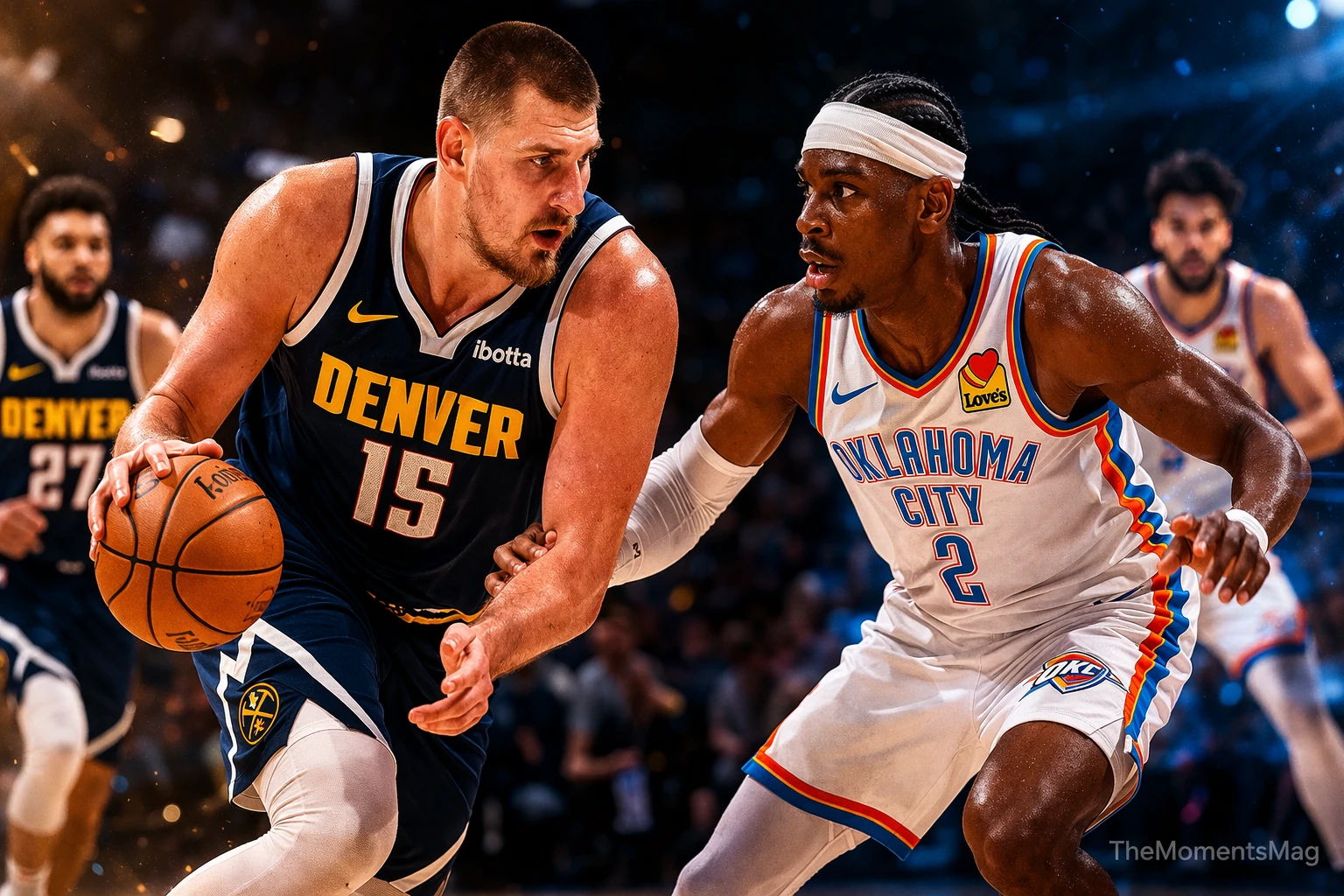
A Denver Nuggets vs Oklahoma City Thunder game rarely unfolds the way you expect. You might tune in for Nikola Jokic’s brilliance or Shai Gilgeous-Alexander’s scoring, but by the final buzzer, it’s often a third or fourth stat that explains everything. A random turnover count, an unexpected 20-point night from a role player, or a quiet assist total can swing the outcome more than the headline numbers. That’s why denver nuggets vs oklahoma city thunder match player stats have become must-read material for serious NBA fans.
If you’re trying to understand who actually controlled the game, the box score tells a richer story than the highlights ever will. These two teams don’t just compete; they clash in philosophy. Denver slows you down and executes through Jokic. Oklahoma City speeds you up and punishes mistakes. What follows is a deep look at the stats, the patterns, and what they really mean when these two teams meet.
Recent Match Player Stats and What They Reveal
The March 9, 2026 matchup is one of the clearest windows into this rivalry. Oklahoma City edged Denver 129-126 in a game that looked balanced on paper but tilted sharply in execution. Jokic delivered 32 points, 14 rebounds, and 13 assists, while Gilgeous-Alexander answered with 35 points and 15 assists. Both superstars played at an elite level, yet the Thunder still found a way to win.
Look closer and the difference becomes obvious. Oklahoma City committed just three turnovers across the entire game, while Denver had eight. That gap might sound small, but in a fast-paced, high-scoring contest, it’s massive. The Thunder also shot over 50 percent from the field and knocked down 19 three-pointers, stretching Denver’s defense to its limits.
That said, Denver didn’t play poorly. They won the rebounding battle 56-37 and still generated quality offense. But here’s the catch, though. Against Oklahoma City, good isn’t enough. If you’re not nearly perfect with possessions, the Thunder will turn that edge into points quickly.
Nikola Jokic’s Dominance — and Its Limits
Nikola Jokic remains the most reliable engine in this matchup. During the 2024-25 season, he averaged nearly 30 points, 12 rebounds, and over 10 assists per game. Those numbers aren’t just impressive; they reflect total offensive control. Every possession flows through him, and against most teams, that’s enough to dictate the outcome.
Against Oklahoma City, things get more complicated. Jokic can dominate statistically and still end up on the losing side. In the 2025 playoff series, he posted 42 points in Game 1 and 44 in Game 5, yet Denver didn’t always convert those performances into wins. The Thunder found ways to absorb his scoring and disrupt everything around it.
Here’s what most people get wrong. Jokic scoring 30-plus isn’t the key indicator of success against OKC. His assist numbers and how he distributes under pressure matter more. If he’s creating easy looks for teammates and controlling tempo, Denver has a chance. If he’s forced into scoring-heavy nights with limited support, Oklahoma City is usually comfortable with that trade-off.
And you can see it in the data. Jokic’s triple-doubles often coincide with closer games, while his high-scoring, lower-assist games tend to reflect Denver chasing the flow rather than controlling it.
Shai Gilgeous-Alexander’s Impact on the Game
Gilgeous-Alexander doesn’t just score; he reshapes the game. His stat lines against Denver consistently hover in the 30 to 40-point range, but the assist numbers are just as telling. In that March 2026 win, his 15 assists showed how completely he manipulated Denver’s defense.
His style forces decisions. He drives just enough to pull help, then waits. Defenders hesitate, rotations break down, and suddenly a shooter is open. That patience doesn’t always show up in highlights, but it dominates the box score over four quarters.
And there’s consistency. During the 2024-25 season, he averaged over 32 points per game, and he’s carried that scoring pressure into every matchup with Denver. He also tied and then broke a Wilt Chamberlain record for consecutive 20-point games around that stretch, which tells you how rarely he dips below elite production.
Not everyone agrees that he’s harder to defend than Jokic, but the numbers against Denver suggest he might be. Jokic controls structure. Shai disrupts it. Against a disciplined offense like Denver’s, that disruption becomes the deciding factor more often than you’d expect.
Role Players Who Quietly Decide the Outcome
Fans love star duels, but these games are often decided by the third scorer, not the first. That’s been especially true in recent meetings between these teams. In the March 2026 game, Oklahoma City got 29 points and 12 rebounds from Jaylin Williams and another 24 from Ajay Mitchell. Those contributions weren’t just helpful; they were necessary.
Denver had answers, too. Aaron Gordon added 23 points, and Tim Hardaway Jr. chipped in 28. But the Thunder’s supporting cast played cleaner basketball, moved the ball more efficiently, and capitalized on Denver’s defensive lapses.
Go back to the 2025 playoff series and you’ll see the same pattern. Jalen Williams had a 32-point explosion in Game 3. Jamal Murray answered with 27 for Denver. But across the series, Oklahoma City’s depth proved more reliable from night to night.
Here’s where it gets interesting. Oklahoma City doesn’t need the same player to step up every game. One night it’s Williams, the next it’s a bench guard. Denver, on the other hand, relies more heavily on a consistent core. That difference shows up clearly in the stat sheets across a seven-game series.
Team Stats That Explain the Bigger Picture
If you really want to understand denver nuggets vs oklahoma city thunder match player stats, you have to zoom out to team-level data. Individual brilliance matters, but team efficiency often decides these games.
During the 2024-25 season, Oklahoma City averaged over 10 steals and nearly six blocks per game, reflecting a defense built on pressure and disruption. Denver, by contrast, leaned on ball movement and rebounding, averaging around 31 assists per game and controlling the glass more effectively.
So what does this actually mean? It means Oklahoma City thrives on chaos, while Denver thrives on control. When the Thunder force turnovers and speed up the pace, they usually win. When Denver keeps possessions clean and runs through Jokic without disruption, they have the edge.
The March 2026 game is the perfect case study again. Oklahoma City shot better, turned the ball over less, and hit more threes. Denver rebounded better and still lost. That’s the difference between efficiency and volume.
Even in lower-scoring playoff games, the pattern holds. In a 92-87 Thunder win during the 2025 series, both teams shot poorly, but Oklahoma City stayed more organized and made fewer mistakes. Defense and decision-making carried them when offense disappeared.
How to Read Player Stats Like an Analyst
Most fans look at points first, and that’s understandable. But in this matchup, points alone rarely tell the full story. You have to read the stat sheet like a coach would.
Start with Jokic and Gilgeous-Alexander, because their numbers set the tone. Then shift immediately to turnovers. If Oklahoma City has a clear edge there, it’s usually a sign they controlled the pace. After that, check three-point shooting. The Thunder’s ability to stretch the floor often turns close games into wins.
Then look at the third scorer. Not the star, not the co-star, but the unexpected contributor. If someone outside the main duo crosses 20 points, that often explains the final margin better than anything else.
Here’s what I’ve noticed watching these games closely. When Jamal Murray is forced into high-volume scoring just to keep pace, Denver is reacting instead of dictating. When Jokic is distributing freely and Denver’s offense flows naturally, the game usually tilts back in their favor.
Understanding these layers turns a simple box score into a story. And once you start reading it that way, you won’t look at stats the same again.
Frequently Asked Questions
Who usually leads in scoring in Nuggets vs Thunder games?
Nikola Jokic and Shai Gilgeous-Alexander almost always lead their teams in scoring. Recent matchups show both regularly scoring 30 or more points, often in the same game.
Why do the Thunder often win despite Jokic’s big numbers?
Oklahoma City wins the possession battle more often. They commit fewer turnovers, force mistakes, and get stronger contributions from multiple players, which offsets Jokic’s individual dominance.
Which role players matter most in this matchup?
Players like Jalen Williams, Jaylin Williams, Jamal Murray, and Aaron Gordon frequently swing games. Their scoring bursts and defensive contributions often decide close contests.
What stat matters most in this rivalry?
Turnovers are usually the deciding factor. When Oklahoma City protects the ball and forces mistakes, they gain a clear advantage regardless of rebounding or scoring totals.
How did the 2025 playoff series play out statistically?
The Thunder won 4-3, with strong defensive numbers and balanced scoring. Jokic had huge games, but Oklahoma City’s depth and efficiency made the difference.
How should fans analyze these matchups?
Focus on more than just points. Look at assists, turnovers, three-point shooting, and the third scorer to understand who truly controlled the game.
Also Read: Oklahoma City Thunder vs Denver Nuggets Player Stats
Conclusion
Denver and Oklahoma City aren’t just playing basketball; they’re testing two different ways to win. One side builds through precision and structure, the other through pressure and speed. That tension shows up clearly in every stat line.
If you only follow the stars, you’ll miss the story. The real answer is buried in the margins — turnovers, secondary scoring, and efficiency under pressure. That’s where games are won and lost.
Looking ahead, this matchup isn’t going anywhere. Both teams are built to contend, and every meeting feels like a preview of something bigger. So next time you check the box score, slow down and read between the lines, because that’s where the truth usually lives.
The numbers don’t just describe the game. They explain it, and they hint at what’s coming next.