

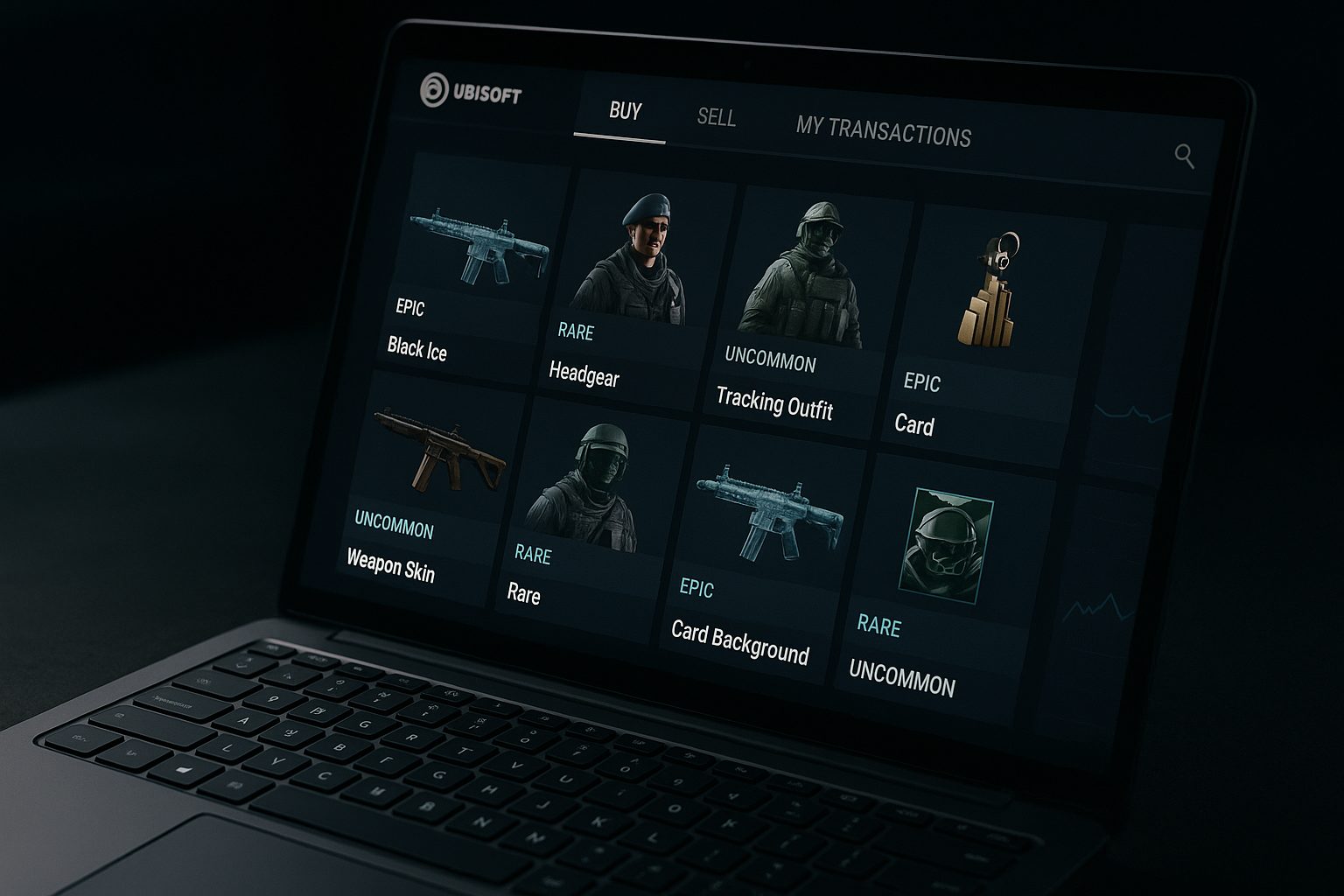
The arrival of the R6 Marketplace—Ubisoft’s official trading platform for Rainbow Six Siege cosmetics—marks one of the most significant changes to the Siege ecosystem in years. For a long time, the Siege community admired games like CS2 and Dota for their thriving cosmetic economies, quietly wondering if Ubisoft would ever allow players to trade items directly. The answer arrived gradually in 2024 and matured through 2025: a fully integrated, web-based marketplace where players exchange skins, uniforms, charms, weapon cosmetics, and more using R6 Credits, all under the safety of Ubisoft’s regulated system.
In its simplest form, the R6 Marketplace lets you turn unwanted skins into currency and currency into cosmetics you actually care about. Yet the deeper you explore, the more it feels like a strategic sub-game running parallel to Siege itself—a place where timing, patience, rarity, and market psychology matter just as much as mechanical skill does inside the game. Understanding how this new economy works can dramatically improve your experience, whether your goal is to complete a dream collection or simply convert unused items into something more meaningful.
What the R6 Marketplace Actually Is
The R6 Marketplace is Ubisoft’s official hub where Siege players buy and sell cosmetics using R6 Credits. Every transaction takes place inside Ubisoft’s infrastructure. No real money ever changes hands directly in the marketplace; instead, you work entirely with credits, which creates a closed-loop economy designed for stability and safety. The system operates through a bid–ask model similar to stock trading. Buyers set the maximum they are willing to pay, sellers set the minimum they are willing to accept, and Ubisoft handles the matching.
You won’t find every cosmetic in the game available for trade. Only certain categories—usually weapon skins, headgear, uniforms, charms, card backgrounds, drone skins, operator portraits, and attachment skins—appear in the marketplace. This is intentional. Ubisoft restricts some items for game-balance, promotional, or licensing reasons, and newer items often become tradable only after a season has passed. If a cosmetic you own never shows up in your “Sell” tab, the reason is simple: Ubisoft has marked it as non-tradable.
Who Can Use the Marketplace and Why Access Matters
Not every player gains access by default. Ubisoft requires any marketplace participant to reach Clearance Level 25 in Rainbow Six Siege, enable Two-Factor Authentication (2FA), and maintain an account in good standing. These conditions reduce fraud, protect user inventories, and ensure that only active, legitimate players contribute to the economy. If you meet these requirements but still can’t access the trading hub, playing a single XP-granting match will often synchronize your profile. Occasionally, Ubisoft restricts access temporarily for testing or regional adjustments, but those instances are rare.
This eligibility system isn’t just about protection; it creates a healthier marketplace. When only engaged, secure accounts participate, the market becomes less vulnerable to bots, hacked accounts, or automated price manipulation. In other words, Ubisoft wants the R6 Marketplace to feel like a community-driven exchange rather than a chaotic open bazaar.
How the R6 Marketplace Works Behind the Scenes
Every transaction on the marketplace revolves around R6 Credits rather than real money. Ubisoft takes a 10% fee from every successful sale, a deduction applied after the sale price is finalized. If you list an item for 100 credits, you receive 90. This fee is essential because it discourages artificial inflation and keeps trading purposeful rather than exploitative.
Orders remain active for 30 days, and players may have up to five buy orders and five sell orders active at the same time. Completed transactions are also capped at twenty buys and twenty sales per 24 hours. The limitations are deliberate: Ubisoft wants the marketplace to support genuine collectors and casual traders rather than allow high-frequency flipping that destabilizes prices.
A particularly important rule is the 15-day cooldown. Any item you purchase cannot be resold until 15 days have passed. The cooldown prevents rapid arbitrage—buying something cheaply and instantly reselling it for profit—and helps stabilize the economy during periods of sudden demand.
Everything about the marketplace is designed to slow down rash decisions and encourage thoughtful trading. It is not meant to feel like a Wall Street simulator; it is meant to be a long-term tool for collection management.
Accessing the R6 Marketplace
Although Rainbow Six Siege references the marketplace inside certain menus, the system itself lives on the web. You visit the official marketplace website, log into your Ubisoft account, verify 2FA when prompted, and gain entry to tabs including Buy, Sell, My Transactions, and sometimes a personal inventory overview. In effect, you’re browsing a digital storefront built specifically for your cosmetic library.
Some regions and builds also provide links through Ubisoft Connect or through in-game buttons that redirect you to the browser platform. Regardless of how you enter, the interface remains the same: clean, structured, and focused on price transparency.
How Buying Works in the Marketplace
Buying cosmetics is not as simple as clicking “purchase.” Instead, you create a Buy Order, stating the maximum amount of credits you are willing to spend on a specific item. If a seller currently has an asking price at or below that amount, the system completes the sale instantly. If no such seller exists, your order waits in the queue until a matching sell order appears or until the 30-day window expires.
Each item page provides enormous context: current minimum sell price, current maximum buy price, and increasingly detailed price history visualizations. These graphs help you determine whether a skin is experiencing a momentary spike, a long-term decline, or a seasonal plateau. Many players rely on external analytics platforms to deepen their understanding, especially when evaluating rare or high-demand items such as certain Black Ice skins.
Browsing the marketplace becomes a kind of treasure hunt, a mix of emotional desire and economic strategy. Once you place your order, the waiting begins. Some items fill instantly. Others take hours, days, or weeks. Patience becomes part of the experience.
How Selling Works in the Marketplace
Selling follows the same logic. You choose a cosmetic from your tradable inventory, set an asking price, and submit it as a Sell Order. If a buyer already has a buy order at your price or higher, the sale is automatic. Otherwise, your listing waits in the marketplace queue until someone bids enough to match your minimum.
Your item leaves your inventory as soon as the listing is created and only returns if you cancel the order before a match occurs. You may adjust the asking price at any time, although doing so resets the listing’s “age,” which can affect placement within the market.
Every completed sale adds the appropriate number of R6 Credits to your account—minus the 10% fee. These credits can immediately be used to acquire new cosmetics or to place additional buy orders.
Why Timing, Rarity, and Demand Decide Everything
Trading cosmetics in Siege is less about textbook economics and more about cultural momentum. Some skins become valuable because they are visually distinctive, tied to significant events, or associated with popular streamers. Others gain prestige simply because they were removed from circulation or because players connect them to nostalgia.
A Black Ice weapon skin carries a reputation that transcends rarity. Esports team sets often surge when a team performs well on the global stage. Seasonal cosmetics sometimes explode in value when new players join the community and discover that older exclusives are now out of reach.
Understanding demand requires watching the game’s cultural heartbeat. A skin featured prominently in a major creator’s loadout can suddenly attract enormous interest. Conversely, some cosmetics look beautiful yet never achieve cult status, causing their value to remain modest even years after release.
Timing matters too. When a season ends and cosmetics from the previous one become tradable, the marketplace experiences a burst of supply that lowers prices temporarily. Smart buyers wait for the initial excitement to fade before placing orders, while patient sellers may choose to hold their items until scarcity naturally elevates demand.
The Risks of Overpaying and the Psychology of Trading
Because the system allows you to set a maximum buy price, it’s easy to let emotion override reason. Many players enter numbers far above recent averages simply because they want a skin now. Immediate gratification has a cost. A wiser approach is to study recent price movements, place a reasonable offer slightly above the norm, and allow the marketplace to do its job. Siege is not a market where rushing leads to consistent advantage; instead, it rewards the patient and punishes the impulsive.
Why Third-Party Markets and Account Trading Are Dangerous
Before the R6 Marketplace existed, the only way to acquire rare cosmetics outside the in-game store was by purchasing entire accounts from unauthorized third-party sellers. This practice was and remains a direct violation of Ubisoft’s Terms of Use. Many players have had their accounts banned or reclaimed after attempting it. With a sanctioned marketplace now available, these risks are both unnecessary and unwise.
Beyond violating rules, account trading is plagued by scams, chargebacks, stolen credentials, and lost progress. Ubisoft’s legitimate marketplace eliminates these dangers by offering a controlled, secure, credit-based economy. Because you never exchange real cash directly with another player, fraudulent listings and financial disputes are nearly impossible.
Protecting Your Account and Staying Within Ubisoft’s Rules
Security is the quiet foundation of the entire marketplace. Ubisoft requires 2FA not as a formality but as a shield against hijacking. Anyone who gains access to your account could list and sell your entire inventory in minutes, converting your years of cosmetic collection into a pile of credits you may never recover. Maintaining password hygiene, avoiding suspicious links, and refusing to share credentials are essential habits.
Equally important is avoiding unofficial R6 Credit sellers. Many of the cheapest offers online originate from stolen cards, regional exploitation, or refund fraud. Accounts that interact with shady credit sellers often trigger Ubisoft’s fraud detection systems and can be sanctioned or permanently banned. The safest and only legitimate way to obtain credits is directly through Ubisoft or platform-approved storefronts.
Ubisoft also monitors unusual behavior within the marketplace itself. Artificially inflating prices, transferring credits between accounts, or conducting coordinated manipulation will eventually trigger automated safeguards or manual reviews. The system rewards honest trading and punishes the rest.
The R6 Marketplace FAQ
The marketplace is free to use, although each sale includes a 10% fee deducted from the seller’s payout. R6 Credits cannot be converted into real money or withdrawn; they exist solely to be used inside Siege. If a skin does not appear in your inventory’s sell section, it means Ubisoft has not designated it as tradable or the item is still under a cooldown period. Orders that vanish after a month are simply expiring due to the 30-day listing limit. And while holding certain cosmetics can occasionally produce better long-term value, the best strategy depends on community trends and your own goals. Using the marketplace as intended will never result in a ban, but breaking Ubisoft’s rules—whether through credit laundering, exploit abuse, or third-party purchases—can lead to sanctions or account termination.
The Marketplace as a Second Game Mode
What makes the R6 Marketplace compelling isn’t only the cosmetics themselves but the mindset it encourages. Just as Siege teaches patience, map awareness, and adaptability, the marketplace cultivates strategic thinking in a different arena. You begin to understand the rhythms of supply and demand, the emotional value of iconic skins, and the subtle way community culture shapes price movement. You also discover the satisfaction of transforming forgotten items into something meaningful—a uniform you’ve wanted for months, a charm that completes your favorite loadout, or a skin that carries emotional weight from Siege’s competitive history.
The marketplace becomes an extension of personal expression. Every trade nudges your collection toward an identity that feels uniquely yours. And unlike third-party markets of the past, this system rewards long-term honesty, consistency, and engagement rather than reckless gambling or opportunistic exploitation.
Also Read: Zach Justice Age: How Old Is the TikTok and Podcast Star
Final Thoughts: Building a Collection That Reflects You
The R6 Marketplace is more than an economic feature; it is a narrative tool that lets you shape the story of your Siege identity. Some skins remind you of the first operator you mastered. Some represent the excitement of opening your earliest Alpha Packs. Others symbolize triumphs, friendships, or seasons where Siege meant a little more than usual. Trading through the marketplace turns those memories into decisions—decisions that refine your inventory, express your playstyle, and mirror the player you have become.
If you approach the marketplace with patience, curiosity, and a sense of personal preference rather than obsession with price charts, you will find far more joy than frustration. And if you treat your account with care, respect Ubisoft’s rules, and make thoughtful choices, the R6 Marketplace can become one of the most rewarding additions to the entire Rainbow Six Siege experience.
In the end, collecting isn’t about owning the rarest or most expensive skin. It’s about curating a set of cosmetics that feel right, that elevate your connection to the game, and that remind you why Siege has remained such a compelling world for so many years. If the gameplay is where you test your aim, the marketplace is where you discover your style—and together, they form a more complete version of what Rainbow Six Siege has always been: a game that rewards mastery, identity, and passion.