

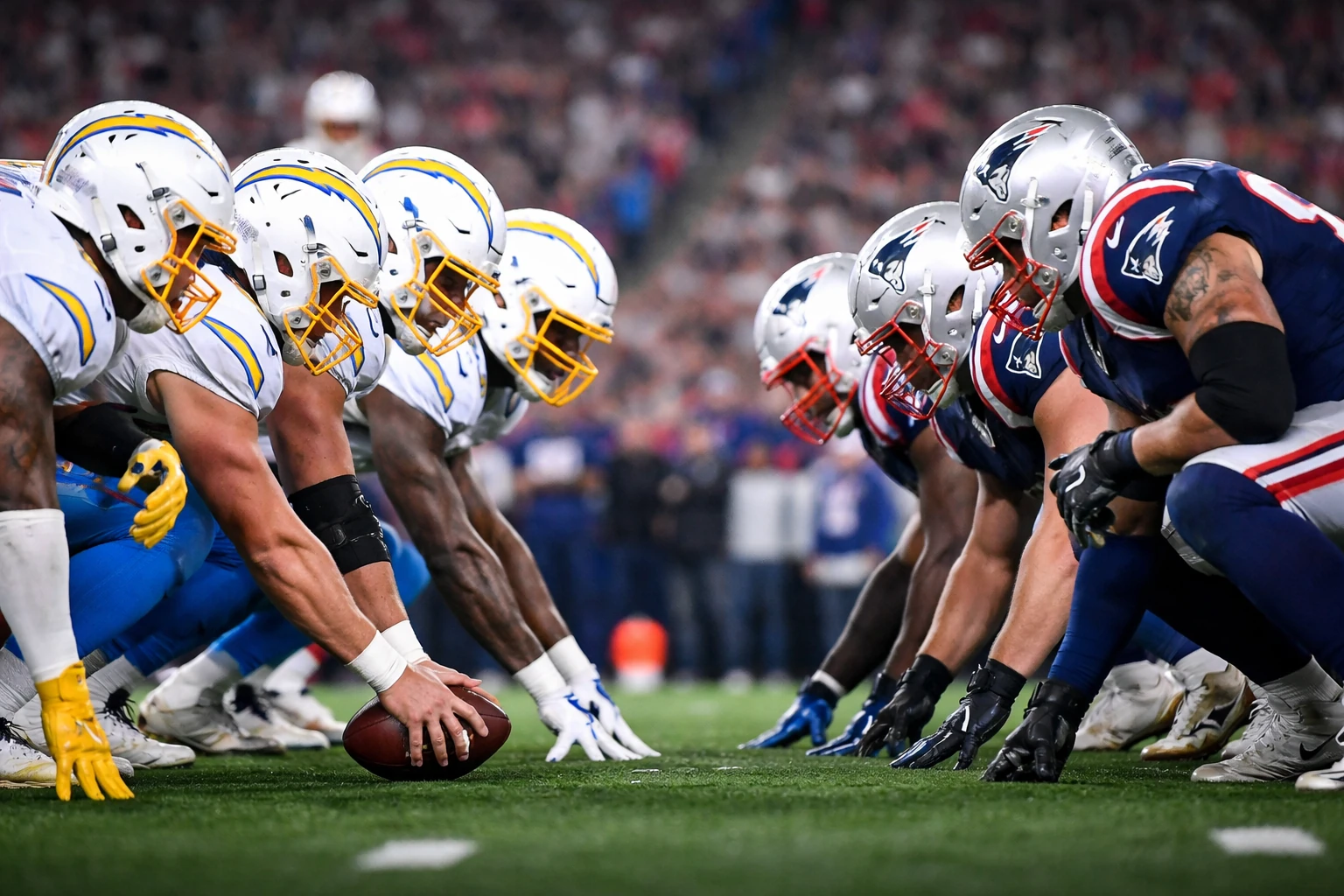
Few interconference matchups have swung so dramatically in recent seasons as the Chargers vs New England Patriots. On paper, these teams have produced games that look unrelated: a 40–7 blowout, a 6–0 defensive slog, and a 16–3 playoff grinder. Yet when you study the chargers vs new england patriots match player stats closely, a pattern emerges.
The numbers reveal more than winners and losers. They expose pressure points, quarterback resilience, explosive plays, and the thin margins that define modern NFL football. Across three recent meetings—December 3, 2023; December 28, 2024; and January 11, 2026—the stat sheets tell a story about protection, disruption, and how a single matchup can flip based on control at the line of scrimmage.
The 2026 AFC Wild Card Game: Patriots 16, Chargers 3
The most meaningful recent clash came on January 11, 2026, in the AFC Wild Card round. The final score read Patriots 16, Chargers 3, and the box score showed why.
Quarterback Performance Under Pressure
Justin Herbert finished 19 of 31 for 159 yards with no touchdowns and no interceptions. At first glance, that stat line looks steady. There were no turnovers through the air and no catastrophic mistakes.
But context matters. Herbert averaged just 5.1 yards per attempt and absorbed six sacks for 39 lost yards. Those sacks didn’t just cost yardage. They killed drives and shifted field position.
Across the field, Drake Maye delivered a more explosive outing. He completed 17 of 29 passes for 268 yards with one touchdown and one interception. His 9.2 yards per attempt reflected chunk gains, not checkdowns.
Both quarterbacks faced pressure. Maye was sacked five times for 33 yards. Yet he found ways to stretch the field, particularly in high-leverage moments.
Rushing Impact: Quarterbacks as Dual Threats
One of the most telling stats from that playoff matchup was who led each team in rushing. Herbert carried the ball 10 times for 57 yards. Maye ran 10 times for 66 yards.
When quarterbacks lead in rushing during a playoff game, it usually signals collapsing pockets or designed mobility. In this case, it was both. Defensive fronts dictated terms, and both quarterbacks had to escape.
For the Patriots, Rhamondre Stevenson added 53 yards on 10 carries. The Chargers’ Kimani Vidal managed 31 yards on 11 attempts. Neither ground attack dominated, but New England’s run game complemented its vertical passing better.
Receiving Production and Explosives
The Chargers’ receiving numbers reflected constraint. Ladd McConkey led the team with three receptions for 32 yards. Keenan Allen caught three passes for 25 yards on eight targets.
The Patriots generated more impact per catch. Stefon Diggs hauled in three receptions for 75 yards, including a 48-yard gain that flipped field position. Jack Westover contributed three catches for 64 yards and a touchdown.
Those explosive plays separated the teams. While Los Angeles accumulated modest gains, New England produced fewer but far more meaningful completions.
Special Teams and Field Goals
In tight playoff games, kickers often carry disproportionate weight. Cameron Dicker accounted for the Chargers’ only points with a single field goal.
Andy Borregales converted three field goals and an extra point for New England. That consistency turned stalled drives into scoreboard pressure.
The result was a game defined by patience and pressure. New England didn’t overwhelm statistically in total plays, but it maximized its opportunities.
The 2024 Regular-Season Blowout: Chargers 40, Patriots 7
If the 2026 playoff meeting showed the Patriots’ defensive formula, the December 28, 2024 matchup revealed the Chargers at full throttle. Los Angeles dominated 40–7 in a game that highlighted what happens when Herbert operates clean.
Herbert’s Command Performance
Herbert completed 26 of 38 passes for 281 yards and three touchdowns. Most importantly, he wasn’t sacked once.
Zero sacks tells the real story. With time in the pocket, Herbert controlled tempo and read the field without hesitation.
His three touchdown passes came in rhythm, often targeting Ladd McConkey, who emerged as the offensive star that afternoon.
Ladd McConkey’s Breakout
McConkey caught eight passes for 94 yards and two touchdowns. He consistently won inside leverage and stretched the Patriots’ coverage schemes.
Those touchdowns weren’t cosmetic scores in garbage time. They came at pivotal moments, breaking New England’s defensive structure.
When a receiver forces safeties to adjust, everything else opens up. The run game becomes lighter, play-action grows sharper, and quarterbacks grow more confident.
Ground Game and Control
J.K. Dobbins added 76 rushing yards and a touchdown on 19 carries. The Chargers didn’t rely solely on the pass.
Time of possession heavily favored Los Angeles. The Chargers controlled the ball for more than 40 minutes and outgained New England 428 to 181 in total yards.
That imbalance wasn’t just about offense. It reflected sustained drives, manageable third downs, and protection stability.
Patriots Struggles
Drake Maye completed 12 of 22 passes for 117 yards with one touchdown. He absorbed four sacks and rarely found rhythm.
The Patriots’ offense never built momentum. Drives stalled early, and the scoreboard forced predictable passing situations.
When New England couldn’t apply pressure or create negative plays, the Chargers offense looked unstoppable.
The Defensive Duel: Chargers 6, Patriots 0 (December 3, 2023)
The December 3, 2023 meeting stands apart from the others. The Chargers won 6–0 in a game that resembled a throwback defensive showcase.
Quarterback Efficiency Without Payoff
Herbert threw for 212 yards on 22 completions, but the Chargers failed to score a touchdown. The red zone became a barrier.
Bailey Zappe completed 13 of 25 passes for 141 yards and took five sacks. New England struggled to cross midfield consistently.
There were no interceptions and no explosive touchdowns. Instead, the game unfolded through punts and field position.
Rushing Stagnation
The Chargers rushed for just 29 yards on 24 carries. That inefficiency should have doomed them.
Yet the Patriots’ offense couldn’t capitalize. Defensive containment outweighed offensive shortcomings.
Two field goals decided the contest. In a league averaging around 23 points per team per game in recent seasons, a 6–0 finish felt almost surreal.
Patterns Across the Matchups
When you align the three games side by side, certain themes stand out.
The first is pass protection. In the 2024 blowout, Herbert faced zero sacks. In the 2026 playoff loss, he absorbed six.
Quarterback comfort directly correlated with scoring output. The more protected Herbert was, the more explosive the Chargers became.
The second pattern involves explosive plays. New England’s 2026 playoff victory hinged on chunk gains from Diggs and Westover. The Chargers’ 2024 dominance relied on McConkey’s big receptions.
Explosives change everything. They shorten fields, tilt defensive alignments, and shift momentum.
The third pattern centers on situational efficiency. Field goals defined the 2023 and 2026 games. Touchdowns defined 2024.
In tight contests, red-zone conversion separates contenders from frustrated offenses.
Quarterback Comparisons: Herbert vs Maye
Justin Herbert’s raw arm talent remains among the league’s best. His 281-yard, three-touchdown performance in 2024 showcased his ceiling.
Drake Maye, meanwhile, demonstrated growth in the 2026 playoff game. Despite heavy pressure, he delivered 268 yards and a touchdown, stretching coverage when it mattered.
The matchup highlights how quarterback evaluation goes beyond touchdowns and interceptions. Yards per attempt, sack avoidance, and situational awareness matter more.
When Herbert’s yards per attempt dipped to 5.1 in the playoff loss, it signaled a compressed field. When it rose above 7 in 2024, the Chargers thrived.
Defensive Impact and Turnover Dynamics
Across modern NFL analysis, turnover differential strongly correlates with winning. While none of these recent meetings featured wild interception totals, sacks functioned as hidden turnovers.
A six-sack performance can be as damaging as two interceptions. It erodes field position and confidence.
The Patriots’ defensive front dictated the 2026 playoff game through disruption. The Chargers’ front did the same in 2023, sacking Zappe five times and suffocating drives.
Pressure remains the quiet constant in every meaningful Chargers–Patriots result.
The Broader NFL Context
These games unfolded during a period when the NFL continues to dominate American sports viewership. Regular-season games in 2025 averaged 18.7 million viewers, reflecting sustained national interest.
League scoring averages have hovered around 23 points per team in recent seasons. Against that backdrop, a 6–0 game or a 16–3 playoff scoreline stands out.
Such results underscore how specific matchups override league-wide trends. Style clashes and tactical preparation can override offensive norms.
Statistical Snapshot of Recent Meetings
In the 2026 Wild Card game, Herbert posted 159 passing yards with no touchdowns and six sacks. Maye threw for 268 yards and a touchdown.
In the 2024 regular-season meeting, Herbert totaled 281 yards and three touchdowns without being sacked. Maye managed 117 yards.
In the 2023 defensive duel, Herbert threw for 212 yards but no scores, while Zappe managed 141 yards and absorbed five sacks.
The swing between dominance and struggle depended on protection, explosive plays, and red-zone execution.
Also Read: Johnny McClain Biography: Boxer and Promoter
Conclusion
The chargers vs new england patriots match player stats reveal more than shifting scores. They expose a rivalry shaped by pressure and protection.
When Justin Herbert stands upright and confident, the Chargers can overwhelm even disciplined defenses. When New England collapses the pocket and forces shorter throws, the balance tilts.
Explosive plays and red-zone precision define the margins. Field goals, sacks, and situational awareness often matter more than raw yardage totals.
Across three distinct games—2023’s defensive grind, 2024’s offensive showcase, and 2026’s playoff chess match—the data converges on a simple truth. Control the quarterback, and you control the game.
Frequently Asked Questions (FAQs)
What were Justin Herbert’s stats in the 2026 playoff game against the Patriots?
Herbert completed 19 of 31 passes for 159 yards with no touchdowns or interceptions. He was sacked six times, which significantly disrupted the Chargers’ offensive rhythm.
How did the Chargers win 40–7 in 2024?
In that game, Herbert threw for 281 yards and three touchdowns without taking a single sack. Ladd McConkey caught eight passes for 94 yards and two scores, while the Chargers controlled time of possession and total yardage.
Why was the 2023 game so low scoring?
The December 3, 2023 game ended 6–0 because both offenses struggled to finish drives. The Chargers rushed for only 29 yards, yet New England’s offense couldn’t capitalize due to five sacks and limited efficiency.
Who led the Patriots in receiving during the 2026 playoff game?
Stefon Diggs led the Patriots with three receptions for 75 yards, including a key 48-yard gain that shifted field position and momentum.
What role did sacks play in these matchups?
Sacks proved decisive. Herbert faced six sacks in the 2026 loss but none in the 2024 win. Quarterback protection directly influenced scoring outcomes.
How do these games reflect broader NFL trends?
While the NFL averages around 23 points per team per game in recent seasons, these matchups show how defensive pressure and situational football can override league-wide scoring patterns. Specific tactical battles often outweigh overall offensive trends.

