

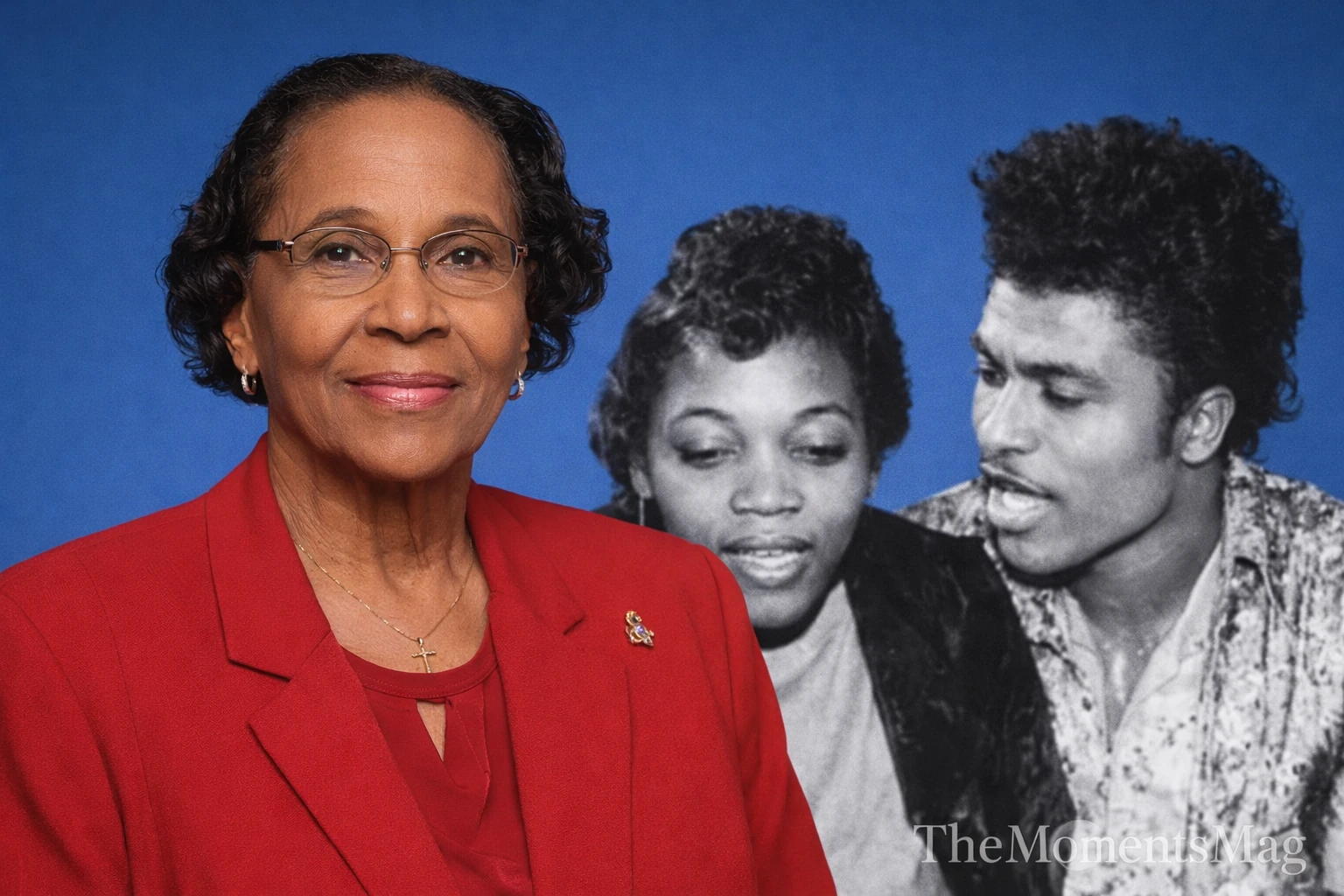
The name Ernestine Harvin rarely appears in the bright lights of music history, yet her story sits quietly beside one of the loudest figures rock and roll ever produced. Her former husband, Richard Wayne Penniman—better known to the world as Little Richard—spent decades shouting, pounding piano keys, and turning American pop culture upside down. Harvin lived a very different life. She preferred privacy, routine, and distance from celebrity spectacle. Their marriage lasted fewer than five years, yet it has remained a fascinating chapter in the story of a man who helped shape modern music.
Most biographies of Little Richard focus on the stage persona: the flamboyant suits, towering pompadour, and voice that seemed built for stadium walls. Ernestine Harvin represents the other side of that life. She experienced the quieter hours, the complicated conversations, and the strain that comes when public myth collides with private reality. By all accounts, she never chased attention or celebrity status. In fact, the limited public record surrounding her life tells a story of someone who stepped away from the spotlight as soon as the marriage ended.
Understanding Ernestine Harvin means understanding the era she lived in and the complicated world she entered through marriage. The late 1950s and early 1960s were turbulent years for both American music and American culture. Rock and roll had only recently burst into mainstream popularity, and artists like Little Richard were redefining how performers looked, sounded, and behaved. Harvin, who reportedly worked as a secretary before meeting him, suddenly found herself attached to a cultural force that few people truly understood at the time.
| Attribute | Details |
|---|---|
| Full Name | Ernestine Harvin (also associated with Ernestine Campbell in some records) |
| Date of Birth | Exact date uncertain; estimates range from the mid-1930s |
| Age | Deceased (age varies depending on reported birth year) |
| Place of Birth | Believed to be Washington, D.C., United States |
| Nationality | American |
| Profession | Secretary and private citizen |
| Famous For | Being the only known wife of rock-and-roll legend Little Richard |
| Marital Status | Divorced; formerly married to Little Richard (1959–1964) |
| Children | Adopted son, Danny Jones |
| Estimated Net Worth | Not publicly documented |
Early Life and Family Background
The earliest chapters of Ernestine Harvin’s life remain mostly private, which has led to years of confusion online. Several biographies and archival references describe her as being born in Washington, D.C., sometime in the mid-1930s. The exact year is unclear, largely because Harvin never lived as a public figure and few official documents circulated widely during her lifetime.
Growing up in the nation’s capital during the 1930s and 1940s would have placed her childhood squarely within a period of economic hardship and social change. Washington was expanding quickly as federal jobs grew during and after World War II. Many young women found work as secretaries, clerks, or administrative assistants in government offices or private companies that supported the city’s growing bureaucracy. According to later biographical summaries, Harvin followed that path and worked as a secretary before meeting Little Richard.
People who crossed paths with her during those years described a woman who valued routine and stability. Friends and acquaintances remembered her as reserved, polite, and thoughtful. That personality may explain why she remained largely absent from the public record later in life. Unlike many spouses of celebrities, she did not pursue interviews, public appearances, or memoir writing. Her silence, while admirable in its restraint, also left historians with limited material.
Still, the fragments that exist paint a picture of someone raised with traditional expectations about family and marriage. Harvin grew up in an era when stability and domestic life were deeply valued, particularly among women entering the workforce in administrative roles. Those expectations would soon collide with the unpredictable world of rock and roll.
Meeting Little Richard at a Turning Point in His Life
Not many people know this, but Ernestine Harvin met Little Richard in a setting that had nothing to do with nightclubs or recording studios. According to multiple biographies of the musician, the two first crossed paths in October 1957 at an evangelical rally. At that time, Little Richard had already achieved major success with hits like “Tutti Frutti,” “Long Tall Sally,” and “Good Golly, Miss Molly.” Yet he was also wrestling with intense religious convictions that periodically pulled him away from the music industry.
By the late 1950s, Richard Penniman was experiencing what he described as a spiritual awakening. During one famous moment in 1957, he reportedly abandoned a concert tour in Australia and enrolled in Bible college. The evangelical rally where he met Ernestine Harvin took place during this religious period. That detail has fascinated historians because it highlights how faith repeatedly shaped the direction of his personal life.
Their meeting reportedly sparked an immediate connection. Harvin’s calm demeanor contrasted sharply with Richard’s explosive personality. Friends later said that the relationship seemed surprisingly grounded, at least in the beginning. Harvin represented stability, something the singer had rarely experienced amid touring schedules and constant media attention.
Their relationship developed quietly over the next couple of years. Unlike many celebrity romances, it did not play out across magazine covers or gossip columns. By July 1959, the couple had decided to marry, choosing Santa Barbara, California, for their wedding ceremony. For Little Richard, who had spent years defying social norms, the marriage appeared to signal a shift toward a more traditional life.
Marriage to Little Richard
Ernestine Harvin and Little Richard married on July 12, 1959. At the time, the musician was already one of the most recognizable performers in America. His stage performances were electrifying, blending gospel rhythms with pounding piano and a style that would influence generations of artists. Offstage, however, he often spoke about wanting a quieter life.
Harvin reportedly believed that marriage could help create that stability. According to later interviews attributed to people close to the couple, their early years together were relatively peaceful. They shared a home, built routines, and even adopted a young child. For a moment, the marriage seemed like an attempt by Richard to reconcile his spiritual beliefs with his career in popular music.
But life beside a cultural icon rarely stays simple. Touring schedules, recording sessions, and the pressures of fame placed constant strain on the relationship. Harvin reportedly struggled with the attention that followed her husband wherever he went. Fans, journalists, and promoters all wanted access to Little Richard, leaving little room for a conventional domestic life.
Their marriage also existed within a larger conversation about Richard’s identity. Over the years, the singer spoke openly about his struggles with sexuality and faith. Those internal conflicts created tension within the relationship. Harvin later indicated that the pressures of celebrity life were difficult to manage, while Richard himself suggested that his own behavior contributed to the breakdown of the marriage.
By April 1964, the couple had divorced. The separation ended their five-year marriage and marked the only time Little Richard was legally married.
Family Life and Their Adopted Son
During their marriage, Ernestine Harvin and Little Richard adopted a young boy named Danny Jones. Biographical accounts describe him as a one-year-old child when the adoption took place. The decision reflected the couple’s desire to build a family, something that might have helped anchor their lives during an unpredictable period.
Danny Jones remained part of Little Richard’s life long after the marriage ended. As he grew older, he reportedly worked as one of Richard’s bodyguards during various tours and appearances. Their continued relationship suggests that the bond formed during those early years endured despite the divorce.
For Harvin, adopting a child likely represented a deep commitment to family life. Although details about her parenting style remain limited, the decision itself offers insight into the kind of future she envisioned during her marriage. Raising a child alongside a rock and roll star may have seemed daunting, yet she chose to embrace that responsibility.
Even after the divorce, Danny Jones’s connection to Little Richard kept a thread of continuity between the couple’s lives. That shared history remains one of the clearest signs that their marriage involved more than celebrity headlines.
Life After the Divorce
Once the marriage ended in 1964, Ernestine Harvin stepped away from public attention almost completely. Unlike many individuals connected to famous musicians, she never sought publicity about the relationship. She did not publish memoirs, appear regularly in interviews, or build a public career based on her connection to Little Richard.
Several sources suggest that she later remarried and used the surname Campbell, though documentation of that stage of her life remains limited. That lack of information reflects her determination to return to a private existence. For someone who had briefly been connected to the center of rock and roll culture, disappearing from the public eye was likely a deliberate choice.
Little Richard’s career continued to rise and fall across the decades following their divorce. He returned to recording music, performed in films, and eventually became recognized as one of the founders of rock and roll. His legacy expanded through awards, tributes, and inductions into halls of fame. Harvin watched that story unfold from a distance, largely outside the view of journalists.
Her absence from public discussion sometimes led to speculation online. Various websites attempted to fill the gaps with guesses about her later life, often presenting contradictory information about her age, location, or death. The truth is that Harvin’s story after the 1960s remains mostly undocumented, reflecting the life of someone who chose privacy over notoriety.
Financial Standing and Public Recognition
Because Ernestine Harvin lived outside the entertainment industry, reliable information about her personal finances remains scarce. She worked as a secretary before meeting Little Richard, and there is no clear evidence suggesting she pursued high-profile business ventures afterward. Estimates of her net worth vary widely across websites, but most appear speculative rather than based on verifiable financial records.
Little Richard, by contrast, built a career that produced millions in earnings through record sales, tours, and film appearances. Songs like “Tutti Frutti” and “Lucille” became defining tracks of the rock and roll era. Over time, his influence earned him recognition from institutions including the Rock and Roll Hall of Fame, which inducted him in 1986.
Harvin’s financial story, however, likely resembled that of many private citizens who lived ordinary professional lives. While she was briefly connected to immense fame, she did not attempt to capitalize on that connection. Instead, she returned to a quieter path that remained largely undocumented.
Lesser-Known Details About Ernestine Harvin
What’s surprising is how little reliable information exists about Ernestine Harvin despite the enormous fame of her former husband. One lesser-known fact is that she met Little Richard during a period when he was deeply focused on religion rather than music. That meeting place—a revival gathering—shaped the tone of their early relationship.
Another detail that often escapes casual readers is that she and Richard adopted their son together rather than having biological children. That choice reflects their attempt to create a stable household during a chaotic chapter of the singer’s career.
A third detail involves the confusion surrounding her name. Some records refer to her as Ernestine Campbell after a later marriage, while others maintain her maiden name. The variation has fueled much of the misinformation circulating online today.
Finally, Harvin’s refusal to seek publicity stands out in an era when many celebrity relationships become public brands. She never built a media identity based on her marriage. Instead, she quietly exited the public stage once the relationship ended.
Frequently Asked Questions
Who was Ernestine Harvin?
Ernestine Harvin was the only woman known to have been married to rock and roll pioneer Little Richard. The couple met in 1957 at an evangelical rally and married in 1959 in Santa Barbara, California. Their relationship lasted until their divorce in 1964.
Did Ernestine Harvin have children?
Yes, she and Little Richard adopted a son named Danny Jones during their marriage. Jones later maintained a relationship with Little Richard and reportedly worked as one of his bodyguards during adulthood.
Why did Ernestine Harvin and Little Richard divorce?
The exact reasons remain somewhat personal, but both individuals later suggested that the pressures of fame and personal struggles contributed to the separation. Little Richard acknowledged that his lifestyle and internal conflicts affected the marriage.
What did Ernestine Harvin do for a living?
Before meeting Little Richard, Harvin reportedly worked as a secretary in Washington, D.C. After the divorce, she lived a largely private life, and there are few public records documenting her professional activities afterward.
Is Ernestine Harvin still alive?
Information about her later years remains unclear because she lived outside the public spotlight. Some sources suggest she passed away years after the divorce, while others offer conflicting dates. The lack of confirmed records has led to ongoing uncertainty.
Also Read: Valerie Siefman Biography: Family, Career, and Life Story
Conclusion
Ernestine Harvin occupies an unusual place in the story of American music. She never recorded a song, stood under stage lights, or courted media attention. Yet her life intersected with one of the most influential figures in rock and roll history during a period of enormous cultural change.
Her marriage to Little Richard lasted only a few years, but it revealed a side of the singer that audiences rarely saw. Away from concert halls and television cameras, he was a man wrestling with faith, identity, and the responsibilities of family life. Harvin witnessed those struggles firsthand.
The truth is that Ernestine Harvin’s story is defined as much by what we don’t know as by what we do. Her decision to step away from public life after the divorce preserved her privacy, even if it left historians with fewer details to examine.
Still, the fragments that remain tell us something meaningful. They remind us that behind every larger-than-life public figure stands a circle of people who experienced the quieter, more complicated side of fame. Ernestine Harvin was one of those people, and her brief chapter beside Little Richard remains a small but revealing piece of music history.

