

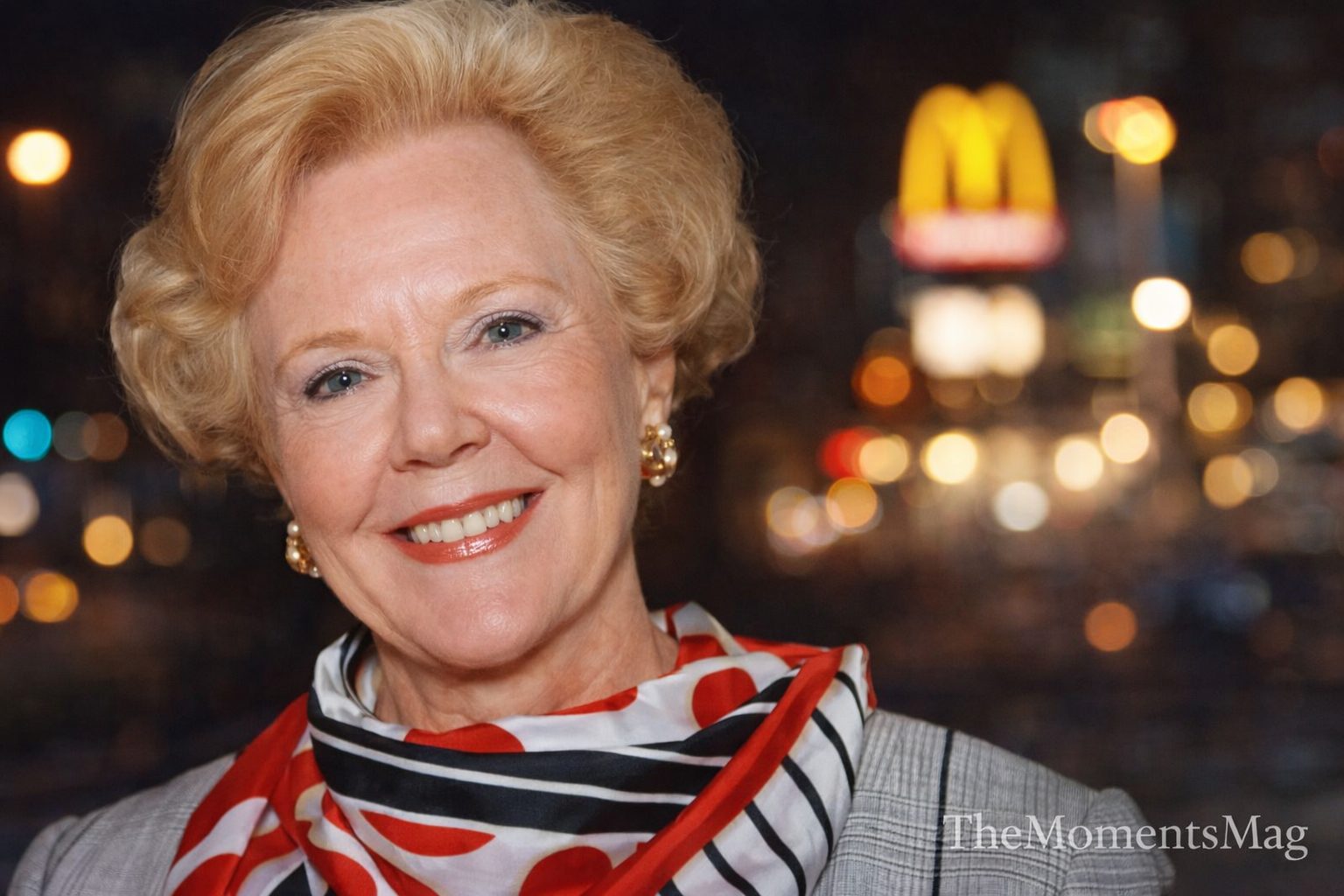
The phrase “Ray Kroc daughter net worth” often sparks curiosity for a simple reason: Ray Kroc’s name is inseparable from one of the most powerful business success stories of the 20th century. As the man who transformed McDonald’s into a global fast-food empire, Kroc became a symbol of American capitalism. Naturally, people wonder what kind of financial legacy his only child carried.
Yet behind the towering arches and billion-dollar revenues lies a quieter, more personal story. Ray Kroc’s daughter, Marilyn Kroc Barg, lived a life largely removed from the corporate spotlight. Her financial standing, unlike her father’s, was never a headline figure. To understand her net worth, one must first understand her life, her timeline, and the structure of the Kroc family fortune.
Ray Kroc’s Rise and the Creation of a Fortune
Before exploring Marilyn’s financial background, it helps to revisit how Ray Kroc built his wealth. Born in 1902, Kroc did not achieve early fame. In fact, much of his success came later in life. After working as a milkshake machine salesman, he discovered a small but efficient burger restaurant run by the McDonald brothers in California.
Seeing enormous potential, Kroc acquired franchising rights and began expanding the brand across the United States. His vision extended beyond burgers. He systematized operations, standardized processes, and built a franchise model that would become a blueprint for global food chains.
By the time of his death in 1984, Ray Kroc’s personal fortune was widely estimated at hundreds of millions of dollars. Adjusted for inflation, that figure would be worth well over a billion dollars today. His success reshaped fast food and permanently altered global consumer culture.
Marilyn Kroc Barg: A Life Away From the Spotlight
Early Years and Family Background
Marilyn Kroc Barg was born in 1924, during Ray Kroc’s first marriage. As his only child, she grew up during a period when her father was still building his career. Unlike heirs raised inside corporate dynasties from the start, Marilyn’s early years were not defined by overwhelming wealth.
When McDonald’s began to grow rapidly in the 1950s and 1960s, Marilyn was already an adult. She did not take on a visible role in the company’s expansion. There are no public records of her holding executive positions, board seats, or high-profile investments tied to the brand.
Her life appears to have been private and family-oriented. Reports suggest she struggled with health challenges, particularly complications related to diabetes. That aspect of her story adds a layer of humanity often missing from wealth-focused conversations.
Her Death in 1973
A crucial fact often overlooked in discussions about Ray Kroc’s daughter net worth is the timeline of events. Marilyn Kroc Barg died in 1973. Ray Kroc, however, lived until 1984.
This eleven-year gap changes everything. Because she passed away before her father, she did not inherit his full estate at the time of his death. Many online discussions mistakenly assume that she received the massive fortune Kroc held in the 1980s, but the chronology makes that unlikely.
Understanding this sequence is essential to forming a realistic view of her financial position.
Understanding Net Worth in Context
When people search for a specific net worth figure, they usually expect a clean number. However, in cases involving private individuals and family estates, the situation is rarely straightforward.
Financial Security Versus Public Wealth
Marilyn Kroc Barg likely enjoyed significant financial security during her lifetime. Ray Kroc’s business success was already well underway in the 1960s and early 1970s. As his only child, she would reasonably have benefited from family resources.
However, financial security does not automatically translate into a publicly documented net worth. Private assets, trusts, and estate planning arrangements are often shielded from public view. Without court records or financial disclosures, precise figures remain speculative.
It is therefore more responsible to discuss her economic environment rather than assign an unverified dollar amount.
Estate Structures and Trusts
High-net-worth families frequently use trusts to manage wealth distribution. These structures can determine how and when assets are transferred. They can also redirect funds depending on life events.
Because Marilyn died before her father, any planned inheritance could have been altered or redistributed. Wealth that might have eventually flowed to her could have been reassigned through estate planning mechanisms.
This complexity is one reason why authoritative sources do not publish a confirmed net worth for Marilyn Kroc Barg.
The Role of Joan Kroc in the Family Fortune
To fully understand the financial arc of the Kroc family, it is necessary to look at Ray Kroc’s third wife, Joan Kroc.
When Ray Kroc died in 1984, Joan inherited the majority of his fortune. She later became known for extraordinary philanthropic efforts. Her donations to charitable causes reached into the billions over time.
She contributed heavily to public radio, educational institutions, and humanitarian programs. One of her most notable bequests went to the Salvation Army, funding the development of community centers across the United States.
This philanthropic chapter shaped the ultimate destination of the Kroc fortune. Rather than becoming a multi-generational business dynasty, much of the wealth transitioned into large-scale charitable initiatives.
Why Net Worth Myths Persist
The internet often amplifies simplified narratives. When a business empire reaches global scale, people assume that immediate family members automatically inherit immense fortunes.
In the case of Ray Kroc’s daughter net worth, several misconceptions fuel the confusion.
First, many readers are unaware of Marilyn’s death date. Without that context, it seems logical to assume she inherited her father’s estate.
Second, celebrity net worth websites frequently publish estimated figures without primary documentation. These numbers are often recycled across platforms, creating an illusion of credibility.
Third, the McDonald’s brand remains enormously profitable today. Modern financial data shows tens of billions in annual revenue and a presence in over one hundred countries. When people see those numbers, they imagine similar wealth flowing directly to family members.
However, corporate growth decades after an heir’s death does not retroactively increase that heir’s net worth.
The Human Story Behind the Numbers
It is easy to reduce wealth conversations to spreadsheets. Yet biography reminds us that real lives rarely fit clean financial headlines.
Marilyn Kroc Barg’s story appears to have been marked more by privacy than publicity. She did not build a personal brand. She did not seek media attention. Instead, she lived during a time when family wealth was expanding rapidly but not yet mythologized.
Her early passing adds a poignant dimension to the Kroc family history. While Ray Kroc lived to see his empire cemented in global culture, his daughter did not witness the full extent of that legacy.
In that sense, the question of net worth becomes secondary to the reality of time, health, and family relationships.
McDonald’s Growth and the Scale of the Empire
To appreciate the magnitude of the Kroc fortune, consider the trajectory of McDonald’s.
By the early 1980s, McDonald’s had thousands of restaurants worldwide and billions in annual sales. The company pioneered the franchise model at scale, allowing rapid expansion while maintaining standardized quality.
Today, McDonald’s operates tens of thousands of locations globally and generates systemwide sales exceeding one hundred billion dollars annually. The brand’s golden arches are among the most recognized symbols in the world.
Ray Kroc’s strategic decisions created that infrastructure. Yet the wealth generated by a corporation over decades does not necessarily translate into static personal net worth for heirs, especially when life events intervene.
Separating Fact from Speculation
When evaluating claims about Ray Kroc’s daughter net worth, responsible reporting requires distinguishing between documented facts and conjecture.
The facts are clear. Marilyn Kroc Barg was Ray Kroc’s only child. She died in 1973. Ray Kroc died in 1984 with a fortune estimated in the hundreds of millions.
Beyond those points, hard numbers become uncertain. No widely recognized financial records confirm a specific figure for Marilyn’s net worth at the time of her death.
Speculation may attract clicks, but accuracy builds trust. In the absence of verifiable data, acknowledging uncertainty is the most ethical approach.
The Broader Lesson About Wealth and Legacy
The Kroc family narrative highlights an important lesson about wealth: legacy is not always linear.
Some fortunes remain tightly controlled within families for generations. Others move outward into public institutions, reshaping communities rather than dynasties.
In the Kroc case, philanthropy became the defining second act. Joan Kroc’s charitable giving redirected vast sums into educational, religious, and humanitarian efforts. That shift reframed the family’s public legacy.
Therefore, when asking about Ray Kroc’s daughter net worth, it may be more meaningful to ask how the family’s wealth ultimately influenced society.
Also Read: Sarah Muravez: Private Life Beyond Spotlight
Conclusion
The search for “Ray Kroc daughter net worth” reflects a natural curiosity about inheritance and power. Yet the answer is more nuanced than a single number.
Marilyn Kroc Barg lived a largely private life and passed away in 1973, before her father’s death. Because of that timeline, she did not inherit the full estate Ray Kroc left in 1984. While she likely benefited from significant financial security during her lifetime, no authoritative public record confirms a specific net worth figure.
Ray Kroc’s fortune eventually flowed primarily to Joan Kroc, whose philanthropic efforts transformed much of that wealth into public good. The Kroc legacy, therefore, extends beyond family balance sheets and into institutions that continue to serve communities today.
In the end, the real story is not about a precise dollar amount attached to one individual. It is about how ambition built an empire, how time altered inheritance paths, and how wealth ultimately reshaped society far beyond the boundaries of a single family.
The golden arches may symbolize commercial success, but behind them lies a quieter narrative about family, loss, and the evolving meaning of legacy.

