

Peggy Sheeran is one of the most enigmatic figures connected to modern American crime lore—not because of what she did, but because of what she refused to say. Known primarily as the daughter of Frank Sheeran, Peggy Sheeran entered public consciousness through Martin Scorsese’s 2019 film The Irishman. Yet the fascination with her life extends far beyond cinema. It touches on family loyalty, moral distance, and the quiet consequences of proximity to power.
Unlike many figures associated with organized crime history, Peggy Sheeran never sought publicity. She did not give interviews, publish memoirs, or appear in documentaries. Instead, her absence from the public record has become part of her story. In a culture obsessed with confession and exposure, Peggy Sheeran stands out for choosing privacy—an act that, over time, has felt almost radical.
This biography traces what is known about Peggy Sheeran, separates documented fact from dramatized portrayal, and explains why her life continues to resonate with audiences decades after the events that made her family name famous.
Early Life and Family Background
Peggy Sheeran, whose given name is widely reported as Margaret Regina Sheeran, was born into a working-class Irish-American family in the mid-20th century. She was one of the daughters of Frank Sheeran, a truck driver who rose through the ranks of labor unions and, according to his later claims, became involved with organized crime figures connected to the Teamsters.
Her childhood unfolded during a volatile era in American labor history. The postwar decades were marked by the growing power of unions, intense federal scrutiny, and blurred lines between legitimate labor activity and criminal influence. Frank Sheeran worked closely with the International Brotherhood of Teamsters, whose president, Jimmy Hoffa, was one of the most powerful—and controversial—labor leaders in the country.
Accounts suggest that Peggy grew up observing this world from close range. Family acquaintances, union meetings, and sudden changes in atmosphere were part of her normal environment. Even as a child, she was described as perceptive and emotionally attuned, noticing tensions and undercurrents that adults around her often ignored.
Relationship With Her Father, Frank Sheeran
Peggy Sheeran’s relationship with her father is central to both her real-life narrative and her cultural legacy. Frank Sheeran was known publicly as a disciplined, reliable union man. Privately, he later claimed to have acted as a hitman for organized crime—a claim that remains deeply disputed by historians and investigators.
What is less disputed is that Peggy was emotionally distant from her father later in life. According to Frank Sheeran’s own accounts, the relationship fractured following Jimmy Hoffa’s disappearance in 1975. Frank asserted that Peggy believed he had knowledge of, or involvement in, Hoffa’s fate. Whether Peggy truly believed this specific claim remains unclear, but multiple sources agree that the relationship never recovered.
Peggy’s withdrawal was not marked by confrontation or drama. Instead, it was characterized by silence. She reportedly limited contact with her father and focused on building a life separate from his reputation. That decision, understated as it may seem, became one of the most powerful moral statements associated with the Sheeran family.
The Disappearance of Jimmy Hoffa and Its Impact
The disappearance of Jimmy Hoffa on July 30, 1975, remains one of the most enduring mysteries in American history. Hoffa vanished after heading to a meeting near Detroit and was never seen again. Despite decades of investigations, tips, and excavations, no body was found and no definitive account has been legally established.
For the Sheeran family, Hoffa’s disappearance was not an abstract mystery. Hoffa had been a familiar presence in their lives, visiting the family home and interacting with Frank’s children. In dramatized accounts, Peggy is shown having a particular fondness for Hoffa, perceiving him as more emotionally transparent than her father’s other associates.
When Hoffa disappeared, the silence that followed carried weight. Peggy’s emotional response, as described by Frank Sheeran years later, marked a turning point. Whether she suspected her father of direct involvement or simply recognized the moral gravity of the situation, she chose distance over denial.
Peggy Sheeran in The Irishman
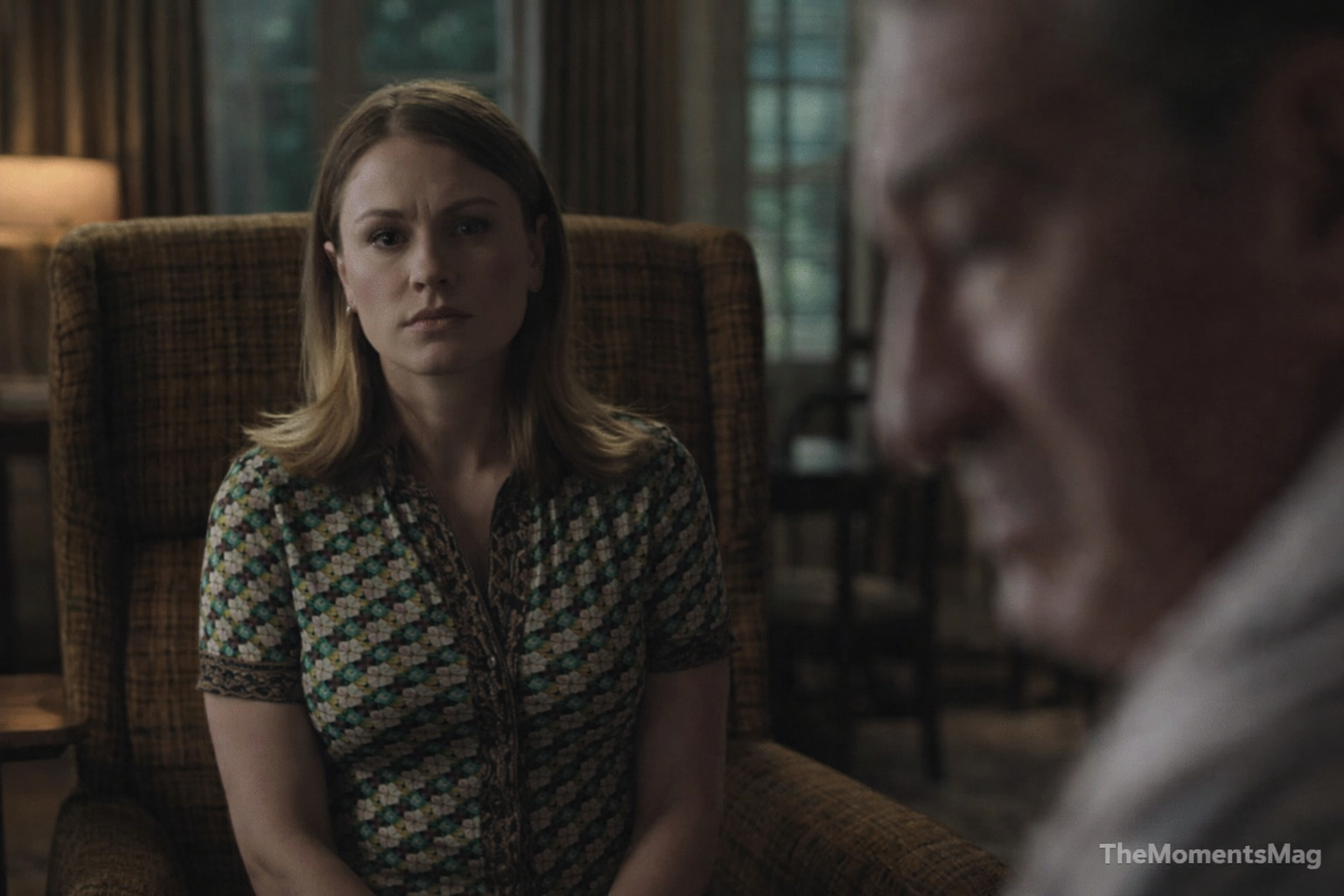
Peggy Sheeran became a widely discussed figure after her portrayal in The Irishman, where she was played as an adult by actress Anna Paquin. The character speaks very few lines, a creative choice that sparked debate among critics and audiences.
In the film, Peggy functions less as a conventional character and more as a moral counterweight. She observes, remembers, and ultimately withdraws. Her silence contrasts sharply with the talkative, self-justifying men around her. Director Martin Scorsese has indicated that this was intentional, positioning Peggy as the emotional conscience of the story.
While the film is based on Frank Sheeran’s version of events as presented in Charles Brandt’s book I Heard You Paint Houses, it is important to note that the book’s claims—particularly regarding Hoffa—are heavily contested. Journalists and legal scholars have questioned the credibility of Frank Sheeran’s confessions, citing inconsistencies and lack of corroborating evidence.
As a result, the Peggy Sheeran portrayed on screen should be understood as a thematic representation rather than a verified biographical account. Her emotional truth may resonate even where factual certainty does not.
Life Away From the Public Eye
Unlike many relatives of notorious figures, Peggy Sheeran did not monetize her family history. Available information suggests she pursued a conventional professional life, reportedly working for decades as an executive assistant. She avoided media attention and did not publicly respond to the release of The Irishman or the renewed interest in her father’s claims.
This absence has often fueled speculation, but it can also be read as a deliberate boundary. Peggy Sheeran did not attempt to correct the record, defend her father, or condemn him publicly. Instead, she allowed the story to unfold without her participation.
In biographical terms, that choice is as defining as any documented action. It reflects a person who understood the cost of proximity to notoriety and chose stability over spectacle.
Public Curiosity and Cultural Meaning
Why does Peggy Sheeran continue to attract attention? Part of the answer lies in modern true-crime culture, which often seeks emotional anchors amid sprawling narratives of violence and corruption. Peggy offers that anchor. She represents the human cost that exists outside courtrooms and headlines.
Her story also resonates because it challenges traditional narratives of loyalty. In crime mythology, family loyalty is often portrayed as unbreakable. Peggy’s life suggests something more nuanced—that moral clarity can require distance, and that silence can be a form of resistance.
In this sense, Peggy Sheeran has become a symbol, even unintentionally. She embodies the perspective of those who grow up near power but refuse to inherit its values.
Also Read: Dan Clancy Net Worth: Inside the Life of the Twitch CEO
Conclusion
Peggy Sheeran’s life resists easy conclusions. She is not a heroine, a villain, or a whistleblower. She is a woman who grew up adjacent to history’s darker corridors and chose a different path. Her biography is less about events than about responses—how one person reacted to moral ambiguity with restraint rather than justification.
That is why her name continues to surface. Not because she explained everything, but because she didn’t. In the long echo of American crime history, Peggy Sheeran reminds us that sometimes the most powerful legacy is the life lived away from the noise.