

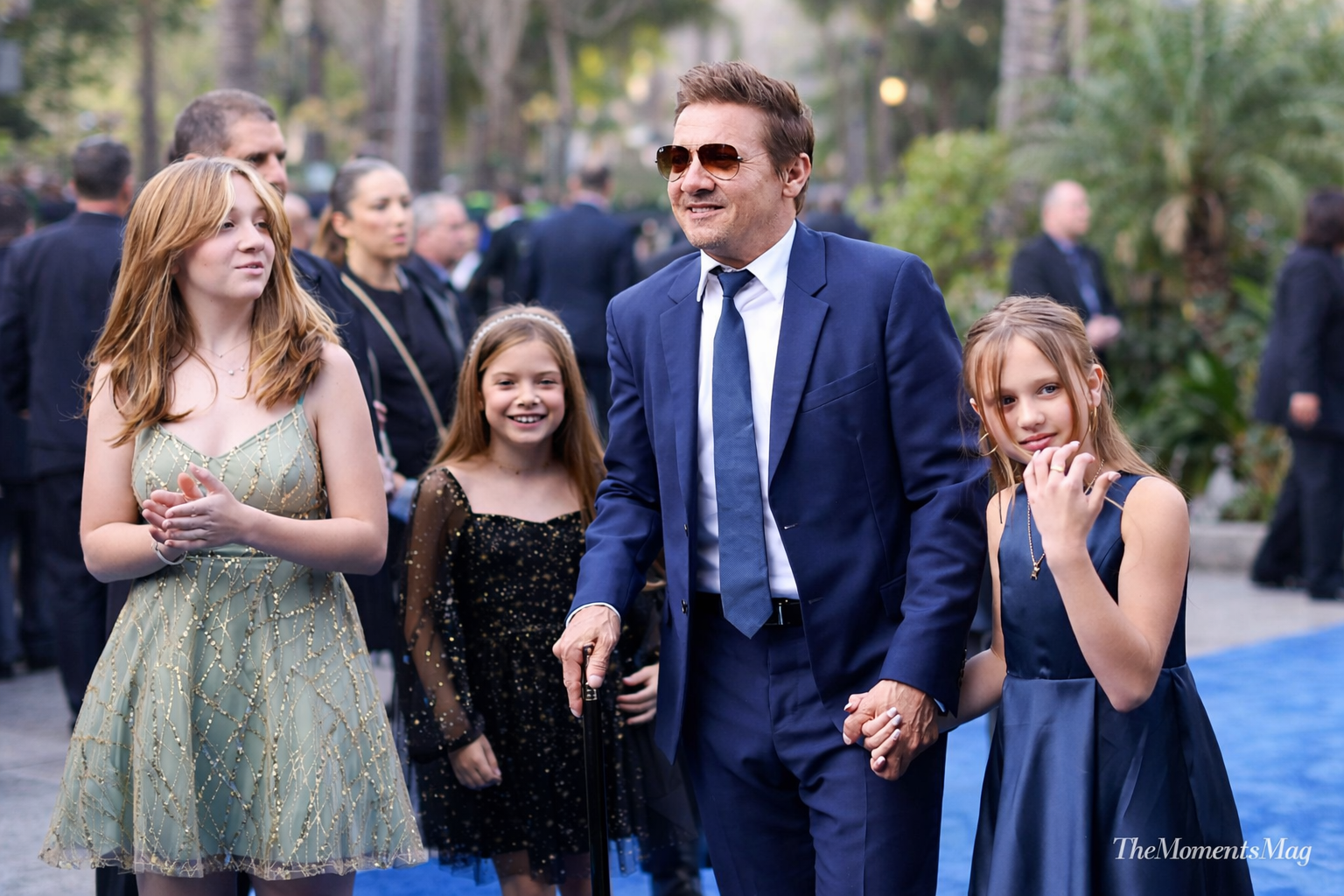
Search phrases can say a lot about the moment we live in. When people type “Jeremy Renner daughter cancer,” it usually isn’t idle curiosity. It’s concern. It’s confusion. And often, it’s the result of seeing a headline or social media post that feels alarming but frustratingly vague.
Jeremy Renner’s life over the last few years has unfolded partly in public and partly behind carefully drawn lines. He is a global movie star, an Oscar-nominated actor, and a Marvel icon. He is also a father who has repeatedly said that his most important role exists far from cameras and red carpets. When a rumor touches that private space, especially involving a child’s health, it spreads fast. It also deserves careful handling.
This article looks at the claim implied by the search term, what is actually known from reliable reporting, and why stories involving celebrity children so often drift into misinformation. It is written in a biographical style, grounded in public facts, and shaped by the understanding that not every personal detail of a famous life is public property.
Jeremy Renner: Fame, Discipline, and a Carefully Guarded Personal Life
Jeremy Renner built his career the slow way. Born in Modesto, California, he worked his way from indie films to major studio projects, earning Academy Award nominations for The Hurt Locker and The Town. By the time he became Clint Barton, also known as Hawkeye, in the Marvel Cinematic Universe, Renner had a reputation for intensity, discipline, and focus.
What he never cultivated was the image of a celebrity who trades in oversharing. Even at the height of his fame, Renner kept his private life deliberately contained. That instinct sharpened after he became a father.
Renner shares one daughter, Ava, born in 2013. Her arrival marked a clear shift in how he spoke about life, work, and priorities. In interviews over the years, he has described fatherhood as grounding and transformative. He has also been consistent about one thing: his daughter did not choose fame, and he intends to protect her from it.
That context matters when evaluating any claim about her health.
Fatherhood in the Public Eye, Privacy in Practice
Jeremy Renner’s approach to fatherhood has always been selective in its visibility. He acknowledges Ava’s importance openly, yet limits details. On social media, he often obscures her face or avoids posting her image entirely. In interviews, he speaks about her impact on him rather than her day-to-day life.
This balance became even more visible after January 2023, when Renner suffered a near-fatal accident involving a snowplow at his Nevada home. The incident left him with multiple broken bones and internal injuries. His survival and recovery became major news.
During rehabilitation, Renner spoke candidly about pain, perseverance, and motivation. He repeatedly referenced his daughter as a driving force behind his recovery. He has said that thinking about her gave him clarity during moments when giving up might have been easier.
These remarks were widely reported. They were emotional. They were human. They were also, crucially, not coded messages about illness or tragedy involving his child. They were the words of a parent who nearly died and returned with a sharpened sense of what matters.
The Origin of the Cancer Rumor
Despite the absence of any verified reporting, the phrase “Jeremy Renner daughter cancer” continues to circulate online. Its persistence says less about Renner and more about the mechanics of modern media.
Celebrity health rumors often follow a familiar pattern. A vague post appears, usually without sourcing. It may reference “insiders,” “close friends,” or “unconfirmed reports.” Other sites copy it, rephrase it, or inflate it. Search algorithms notice engagement and amplify it further. Before long, a claim with no factual foundation looks, to an untrained eye, like established news.
In this case, no reputable entertainment outlet, no mainstream newsroom, and no verified statement from Renner or his representatives has reported that his daughter has cancer. Coverage of Renner’s family life in recent years has focused on his recovery, his reflections on fatherhood, and his creative work. None of it supports the rumor implied by the search term.
The absence of confirmation is not a gap waiting to be filled. It is the story.
Why Silence Is Not Suspicion
A common mistake in celebrity rumor culture is treating privacy as evidence. When a public figure does not comment on a claim, some assume the silence hides truth. In reality, silence often signals boundaries.
Jeremy Renner has a documented history of drawing those boundaries around his daughter. He has been open about his own injuries, his mental health, and his fears during recovery. He has not been open about his child’s medical life, because there is no obligation to be.
Parents of famous children face a unique tension. Speaking publicly about a child’s illness can raise awareness and support, but it can also strip a child of anonymity and autonomy. Many choose privacy, especially when the child is young.
In Renner’s case, the consistent pattern of limiting personal detail suggests that if his daughter were facing a serious medical condition, it would not become public knowledge through leaks or anonymous posts. It would either come directly from him, or not at all.
A Memoir That Brought His Daughter’s Voice, Not Her Medical History
In 2025, Renner released his memoir, My Next Breath, a reflection on survival, recovery, and the lessons of nearly dying. The book attracted attention not only for Renner’s own account, but for the inclusion of a contribution from his daughter.
Ava’s note, shared as part of the audiobook, was widely described as tender and grounding. It offered a child’s perspective on fear, love, and relief after her father’s accident. It did not reference illness. It did not hint at ongoing medical crises. It was, by all accounts, a moment of connection and healing.
The decision to include her voice was notable precisely because Renner so rarely brings her into public view. That makes the absence of any mention of cancer or serious illness even more telling. Memoirs are often where public figures choose honesty. When something that significant is missing, speculation should stop, not accelerate.
The Emotional Cost of False Health Narratives
It is easy to dismiss celebrity rumors as harmless gossip. When the subject involves a child and a life-threatening disease, the harm is more tangible.
False cancer narratives do not exist in a vacuum. They intersect with real families facing real diagnoses. They muddy understanding. They can trivialize experiences that involve months or years of treatment, fear, and uncertainty.
For the subject of the rumor, there is also a cost. Imagine being a child old enough to read, or to hear whispers at school, about a disease you do not have. Imagine being a parent forced to manage not only your child’s privacy, but the internet’s imagination.
This is why responsible journalism treats health information, especially involving minors, with restraint and verification. It is also why readers have a role to play in slowing the spread of unverified claims.
Childhood Cancer Is Real, Even When a Celebrity Rumor Is Not
Acknowledging that the rumor about Jeremy Renner’s daughter lacks factual basis does not minimize the reality of childhood cancer. It remains one of the most emotionally devastating diagnoses a family can face.
Worldwide, hundreds of thousands of children are diagnosed with cancer each year. Outcomes vary dramatically depending on access to healthcare, early detection, and resources. In high-income countries, survival rates have improved significantly over the last few decades. In lower-income regions, survival remains far lower, not because cancers are different, but because systems are.
This contrast is important. When celebrity names are attached to false stories, attention is diverted from the real work of improving outcomes, funding research, and supporting families navigating treatment and survivorship.
There is nothing wrong with caring about a famous person’s child. There is something wrong with turning that concern into click-driven fiction.
Jeremy Renner Today: Recovery, Work, and Fatherhood
As of early 2026, Jeremy Renner continues to recover physically while returning selectively to creative projects. He has spoken about lasting limitations and a new relationship with his body. He has also spoken about gratitude, patience, and presence.
His public narrative now is less about relentless momentum and more about sustainability. Fatherhood remains central to that shift. He has described wanting to be present, healthy, and emotionally available for his daughter as she grows.
Nothing in his recent public life suggests a hidden family medical crisis. What it suggests is a man who has survived one very visible trauma and is unwilling to invite unnecessary scrutiny into his child’s world.
Why This Story Keeps Being Searched
The persistence of the search term says something important about modern information habits. People are often not looking to spread rumors. They are looking to check them.
That impulse is healthy. The problem is that the internet does not always reward accuracy. It rewards speed, emotion, and repetition. A false claim can generate thousands of searches before a single credible article addresses it directly.
In that sense, this story is not just about Jeremy Renner. It is about how easily concern can be manipulated, and how careful writing and reading can push back.
Also Read: Casey Beane: Life, Family, and the Moneyball Legacy
Conclusion
The phrase “Jeremy Renner daughter cancer” reads like a tragedy waiting to be confirmed. In reality, it reflects a familiar cycle of rumor amplified by algorithms and anxiety. Based on all reliable, publicly available information, there is no evidence that Jeremy Renner’s daughter has cancer.
What does exist is a consistent portrait of a father who values privacy, a man who survived a catastrophic accident, and a family that chose healing over spectacle. There is also a broader reminder that childhood cancer is a serious global issue that deserves attention rooted in truth, not conjecture.
In an era where searches can turn whispers into apparent facts, restraint becomes a form of respect. Sometimes the most responsible answer is also the simplest one: if a claim cannot be verified, it should not be believed.