

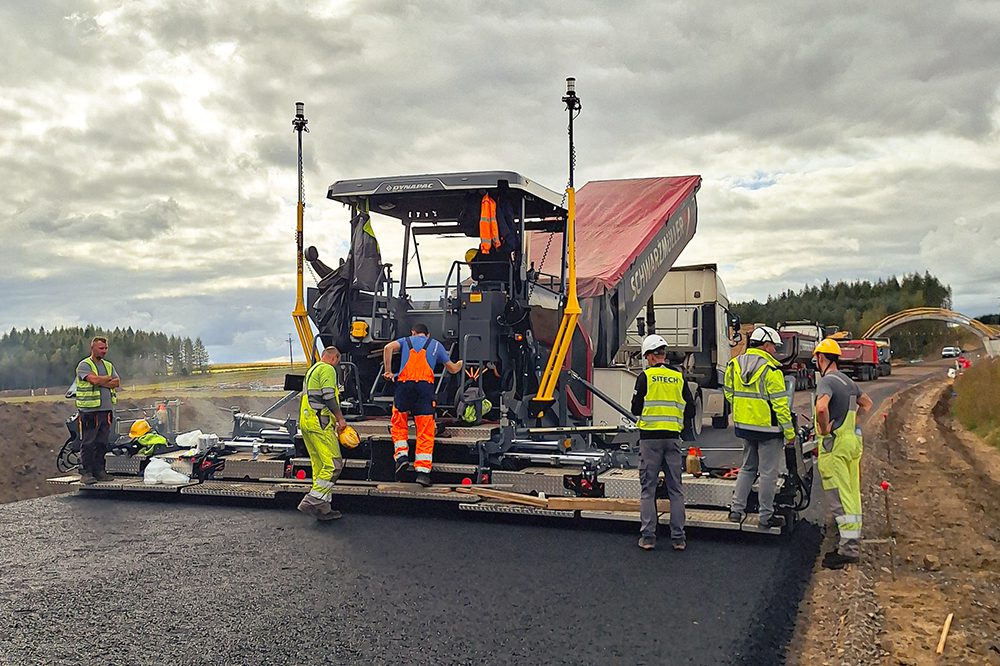
Road construction no longer allows room for approximation. Each stage demands control and clarity, especially at ground level, where the structure begins to take form. A road roller does more than press material into place. It defines how well the surface will hold under repeated stress. If compaction lacks uniformity, the road begins to show weakness far earlier than expected. Contractors who focus on this stage tend to avoid premature failures. They understand that strength does not come from the material alone. It develops through how the material settles and bonds under controlled pressure.
What Distinguishes Precision Paving from Routine Layer Placement?
Routine placement follows a straightforward path. Material spreads across a surface, and the process moves forward without close adjustment. Precision paving takes a different approach. It relies on measured control at every stage. The thickness of each layer remains consistent across the entire stretch. The alignment follows a defined path rather than visual estimation. Operators do not rely on chance. They observe the material behavior and respond to minor variations as they appear. This level of attention creates a surface that performs evenly instead of showing weak sections over time.
Efficient Material Flow Keeps the Work Moving Without Disruption
A paving operation depends on continuity. Once the process begins, interruptions begin to affect the surface almost immediately. Material must arrive at the right moment and in the required volume. A thwaites dumper supports this flow by moving loads across the site without delay. It allows teams to maintain a steady pace without forcing the paving crew to wait. When supply remains consistent, the surface forms without gaps or irregular cooling. Delays tend to leave visible joins and weak transitions. Contractors who manage material movement well often produce smoother and more durable results.
Equipment Reliability Drives Project Consistency and Deadlines
Construction schedules rarely allow extended pauses. Equipment must perform as expected throughout the working period. When a machine fails, the entire sequence begins to lose structure. Crews wait, material cools, and progress slows. Reliable equipment prevents this chain reaction, as it allows the contractors to maintain rhythm across each phase of the project. Consistent performance also reduces the need for repeated adjustments. Teams can focus on execution rather than recovery. Over time, this reliability becomes a defining factor in how contractors manage both quality and delivery.
Why Does Controlled Machine Operation Matter for Site Safety?
Machines are usually set up in areas where even a small movement can impact others nearby. The operator must stay fully aware of both the machine and the people working around it. This awareness does not come from routine alone. It develops through careful attention and steady handling.
When a machine moves in a controlled manner, it avoids sudden shifts that could create confusion or danger. Each movement follows a clear purpose instead of reacting to uncertainty. This makes the working environment easier to understand for everyone on site.
Workers begin to trust the movement of the equipment. The entire site feels more stable when machines operate with control. In this way, safety improves through consistency rather than chance.
Consistent Results Strengthen Contractor Credibility
Most clients keep their judgement simple. They look at the finished road and decide how it feels under use. A surface that remains even and firm after some time gives them confidence in the work. When faults appear early, that impression changes quickly and tends to stay with them.
A contractor who delivers the same standard across different projects begins to stand out. The result feels dependable rather than occasional. Clients start to recognize that the outcome comes from a clear and repeatable way of working. They do not need long explanations. The consistency becomes easy to notice on its own.
Conclusion
The final stage brings all earlier efforts into view. Surface accuracy reveals whether each step followed a clear standard. A vogele paver plays a central role in this phase by laying material with uniform depth and alignment. It ensures that the surface reflects precision rather than correction. When the finish holds consistency, it confirms that the entire process remains controlled from start to end. Contractors who rely on this level of accuracy continue to raise expectations across the industry.