

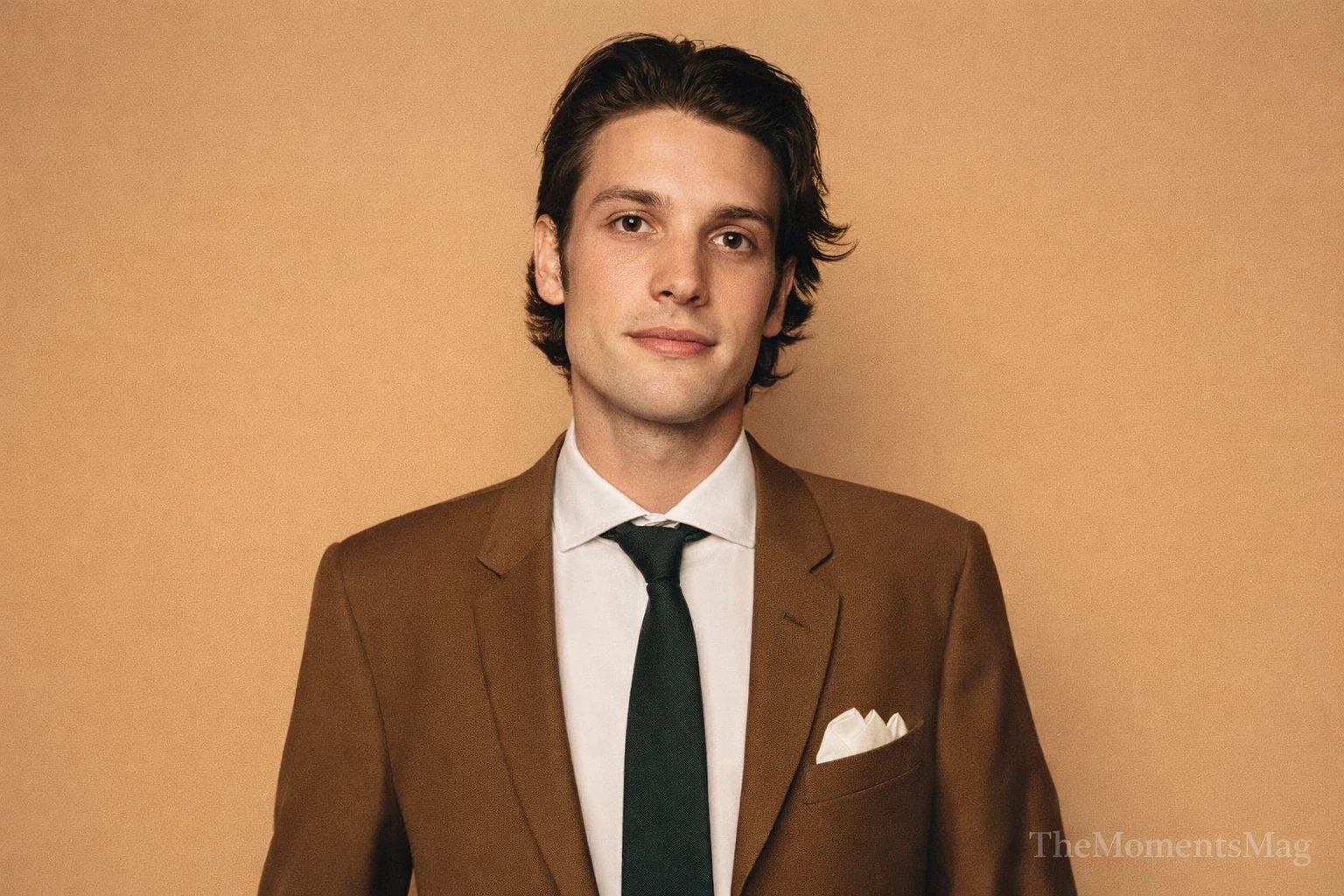
Some names enter public conversation because of relentless self-promotion. Others surface quietly, carried by family legacy and cultural proximity to fame. Dylan Thomas Andrews belongs to the second category. Though not a celebrity in the conventional sense, his name continues to generate curiosity. That interest stems largely from his connection to one of the most recognizable faces of the 1990s supermodel era, Stephanie Seymour.
Yet beyond the headlines and online speculation lies a more nuanced story. Dylan Thomas Andrews represents a generation shaped by fame but not necessarily defined by it. His life illustrates what it means to grow up adjacent to the spotlight while choosing a path that remains mostly private. In an era dominated by oversharing and digital exposure, that choice feels increasingly rare.
This biography-style account explores what is publicly known about Dylan Thomas Andrews, his family background, the environment that shaped him, and the broader cultural context surrounding his name.
Early Life and Family Background
Dylan Thomas Andrews was born into a world already familiar with cameras and magazine covers. He is the son of supermodel Stephanie Seymour and musician Tommy Andrews. Seymour rose to international prominence in the late 1980s and early 1990s, becoming one of the defining faces of the supermodel era. Her work with brands such as Victoria’s Secret and appearances in high-profile fashion campaigns cemented her status as a cultural icon.
Tommy Andrews, Dylan’s father, was a guitarist, and although less publicly visible than Seymour, he brought his own creative background into the family dynamic. The marriage between Seymour and Andrews was relatively brief, but it resulted in the birth of Dylan, their only child together.
Growing up with a mother who was frequently in the public eye inevitably meant exposure to fashion shows, media attention, and elite social circles. However, Dylan’s early life remained largely shielded from constant press coverage. Unlike many celebrity children today, whose childhoods unfold across social media platforms, Dylan’s formative years took place before the era of Instagram and TikTok documentation.
This difference in timing shaped his experience significantly. The 1990s were glamorous, but they were not yet digitally invasive. Privacy was easier to maintain, and that distinction continues to define Dylan’s public persona today.
Growing Up in a Blended Family
After her relationship with Tommy Andrews ended, Stephanie Seymour went on to marry businessman and art collector Peter Brant. Together, they built a family that included several children, making Dylan part of a larger blended household.
The Brant family has long been associated with high society, the art world, and philanthropy. Peter Brant is known for his involvement in art collecting and publishing, placing the family at the crossroads of fashion, culture, and fine art. Growing up in this environment meant that Dylan was surrounded not only by fashion industry influence but also by contemporary art, business discussions, and cultural conversations.
Being the eldest child in such a family often carries unique responsibilities. Older siblings frequently occupy a transitional space between generations. In Dylan’s case, that meant witnessing both his mother’s enduring legacy and his younger siblings’ navigation of modern social media visibility.
While some members of the extended family have embraced public platforms, Dylan has remained notably reserved. This contrast only increases intrigue around him, as audiences often project expectations onto the children of public figures.
The Influence of the Supermodel Era
To understand Dylan Thomas Andrews’ context, it helps to revisit the cultural moment that defined his mother’s career. The supermodel era of the late 20th century was unlike today’s influencer-driven landscape. Models such as Cindy Crawford, Naomi Campbell, and Stephanie Seymour were global icons who transcended fashion.
They appeared on magazine covers worldwide, starred in music videos, and commanded multimillion-dollar contracts. Fashion was not just an industry; it was spectacle. These women became household names, representing both aspiration and glamour.
Growing up around that level of fame can be both empowering and complicated. On one hand, it offers exposure to creativity, ambition, and opportunity. On the other, it introduces scrutiny and comparison. Children of public figures often navigate questions about whether they will follow similar paths or carve entirely different ones.
In Dylan’s case, there has been no widely documented pursuit of modeling or entertainment on the scale of his mother’s career. Instead, his relative absence from headlines suggests a deliberate separation from the machinery of fame.
Education and Personal Development
Publicly available information about Dylan Thomas Andrews’ education and career remains limited. This absence should not be interpreted as insignificance. Rather, it highlights a conscious boundary between public interest and personal life.
Many individuals raised in high-profile families pursue education away from media attention. Private institutions, international exposure, and travel often shape their worldview. While specific details about Dylan’s academic background are not extensively documented, it is reasonable to infer that he benefited from a culturally rich environment.
Exposure to art collections, fashion events, and global travel can provide a unique education in itself. Children raised in such households often gain fluency in aesthetics, branding, and social navigation. Whether or not they translate those experiences into public careers varies widely.
In an age when personal branding dominates career paths, choosing discretion can itself be a form of self-definition.
Public Curiosity and Internet Speculation
The digital era has created a phenomenon where even limited information can generate extensive speculation. Search engines often amplify curiosity around names connected to celebrities. As a result, Dylan Thomas Andrews frequently appears in online queries despite maintaining a low public profile.
This pattern reflects broader cultural dynamics. The public is fascinated by legacy. Children of famous figures carry narratives that audiences want to complete. Will they inherit talent? Will they rebel against expectations? Will they redefine the family image?
Without direct statements or visible projects, speculation tends to fill the gap. However, credible reporting on Dylan remains minimal, reinforcing the idea that his life operates outside the typical celebrity cycle.
This restraint stands in contrast to contemporary celebrity culture, where personal milestones are often shared instantly. Dylan’s quieter presence underscores how different the experience of fame-adjacent individuals can be depending on personal choice.
The Art World Connection
Through his mother’s marriage to Peter Brant, Dylan became connected to one of the most influential art collecting families in the United States. The Brant Foundation, known for supporting contemporary art, has hosted exhibitions featuring major international artists.
Growing up in proximity to serious art collections can shape perspective in subtle ways. Art environments encourage observation, interpretation, and creative thinking. They also cultivate an understanding of legacy beyond immediate visibility. Fine art often gains value over decades, not days.
This slower, long-term view of culture contrasts sharply with the rapid cycle of social media fame. If Dylan absorbed that perspective, it may partly explain his distance from the influencer model of public life.
Cultural Legacy and Identity
Legacy can be both asset and shadow. Being the son of Stephanie Seymour links Dylan Thomas Andrews to a distinct chapter in fashion history. That association alone ensures periodic public interest.
However, identity is built over time through personal choices. While some celebrity children embrace entertainment careers, others pursue business, philanthropy, academia, or entirely private endeavors.
The absence of widespread media coverage suggests that Dylan has not positioned himself as a public-facing personality. Instead, he appears to embody a quieter dimension of legacy, one that honors background without amplifying it for spectacle.
In many ways, this approach aligns with a broader cultural shift. As audiences become more aware of the pressures of fame, there is growing respect for those who opt out.
The Enduring Interest in His Name
Why does Dylan Thomas Andrews continue to attract attention? The answer lies in human nature. People are drawn to stories about lineage and possibility. A recognizable surname sparks imagination.
Additionally, the supermodel era continues to influence fashion retrospectives and documentaries. Whenever Stephanie Seymour’s career is revisited, curiosity about her family resurfaces.
Search behavior reflects this pattern. Interest tends to spike when broader conversations about 1990s fashion or art-world families trend online. Even without active public engagement, proximity to iconic figures sustains relevance.
A Life Defined by Choice
Ultimately, Dylan Thomas Andrews’ biography is less about public achievements and more about positioning. In an era when visibility is often equated with value, choosing a quieter existence is significant.
He stands as an example of how proximity to fame does not require participation in it. While his mother’s career remains part of fashion history, Dylan’s path appears intentionally understated.
That distinction may be the most defining element of his story.
Also Read: Evelyn Melendez: Life Beyond the Spotlight
Conclusion
Dylan Thomas Andrews occupies a unique place in contemporary cultural narratives. As the son of supermodel Stephanie Seymour and musician Tommy Andrews, and as part of a prominent art-connected family, he was born into environments shaped by creativity and public attention.
Yet rather than transform that inheritance into a visible brand, he has largely remained outside the spotlight. His biography illustrates how identity can develop quietly, even when surrounded by spectacle.
In a time defined by digital amplification, his story offers a different perspective. It reminds us that not every life connected to fame must unfold publicly. Sometimes, the most compelling aspect of a person’s journey is the deliberate choice to remain beyond the glare of constant visibility.
Dylan Thomas Andrews may never become a headline-making figure. Still, his name continues to spark curiosity because it represents intersection, legacy, and restraint. And in today’s culture, restraint can be just as powerful as fame itself.