

The growing appeal of Image to Video AI is not just about novelty. In many content environments, a still image is no longer the final form of expression people expect. It may still be the most important visual asset in the workflow, but audiences increasingly encounter ideas through movement, pacing, and sequence rather than through a single frozen frame. That creates a practical tension.
Many creators already have strong images, clear concepts, and specific goals, yet they still struggle to translate those assets into motion content without entering a full editing workflow. The problem is not always lack of creativity. More often, it is the gap between having a good visual and having a publishable moving result.
What makes this kind of platform interesting is that it reduces that gap without pretending to eliminate creative judgment. In my observation, the strongest value is not that a photo can be animated in seconds. It is that users can describe motion, choose a few meaningful settings, and arrive at a workable draft without building a traditional production stack around it. That changes who can participate in motion content creation and how quickly ideas can move from concept to distribution.
A useful way to understand the shift is through asset reuse. Many teams already own strong visuals, but those visuals are often underused because they remain trapped in static formats. When a platform can turn an existing image into a short moving sequence, it changes how people think about the value of a finished visual. Instead of treating the image as a final stop, they begin to treat it as the opening frame of a broader content workflow.
That is where Photo to Video becomes especially practical. The point is not simply to create movement for its own sake. The point is to adapt already-useful visual material into a form that feels more native to present-day feeds, product pages, and attention patterns. In my testing of this category, that kind of translation often matters more than dramatic visual effects.
Why Static Images No Longer Always Feel Complete
A strong still image can carry tone, composition, and identity. But in many modern channels, it also competes with moving content that can guide attention more actively.
Attention Often Favors Temporal Information
A static image presents a single moment. A short video introduces progression. That progression can shape how viewers read the scene, where they focus first, and what emotional rhythm they experience.
Motion Adds More Than Decoration
Motion can imply depth, shift emphasis, or create atmosphere. A subtle push-in on a portrait can change how intimate it feels. A moving product shot can suggest material, scale, and intended use more clearly than a single still.
The Cost Of Traditional Editing Remains High
Conventional video tools are powerful, but they also assume time, skill, and a certain comfort with layers, timelines, and post-production logic.
Many Users Want Direction, Not Complexity
A large share of users do not want to become editors. They want to define what should move, how it should feel, and what kind of output they need. That is a different kind of task, and platforms like this are designed around that distinction.
How The Platform Is Structured Around Real Inputs
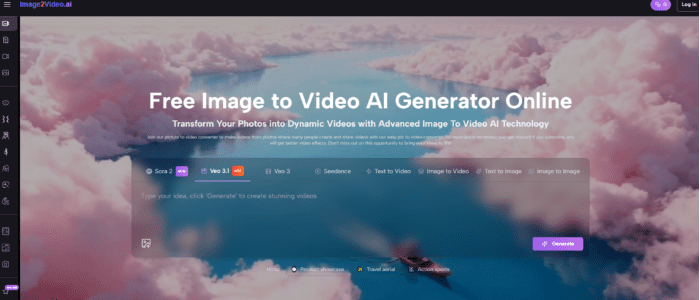
The site does not behave like a single-purpose demo. It presents several creation routes that reflect different starting points.
The Homepage Works As A Multi-Entry Workspace
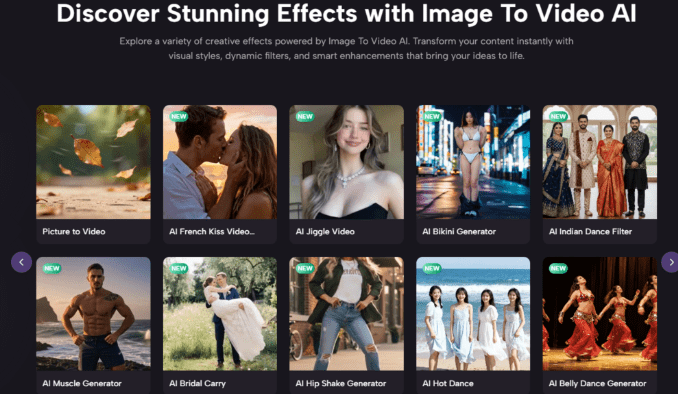
The visible categories include image-to-video, text-to-video, AI video generation, AI image generation, and a group of effect-oriented tools. That structure suggests the platform is trying to serve users who arrive with different kinds of material and different levels of intent.
This Matters For Workflow Flexibility
Some users already have a finished image. Others only have an idea described in words. Others want faster experimentation through themed effect pages. A platform that organizes around those differences is more practical than one that forces everyone into the same path.
The Image-Led Route Feels Most Grounded
For users who already possess a strong visual asset, the image-based path is the clearest. It starts with something concrete rather than something imagined from scratch.
The Source Image Carries Identity
Once an image is uploaded, much of the composition, subject structure, lighting, and color logic is already defined. That makes the next step less about inventing a scene and more about extending it into time.
What The Official Workflow Actually Looks Like
Based on the website flow, the process remains compact. That simplicity is one of the platform’s main strengths.
Step One Starts With Image Upload
Users upload a source image using standard formats such as JPG, JPEG, PNG, or WebP. This is the foundation of the workflow, because the uploaded visual determines much of the final clip’s identity.
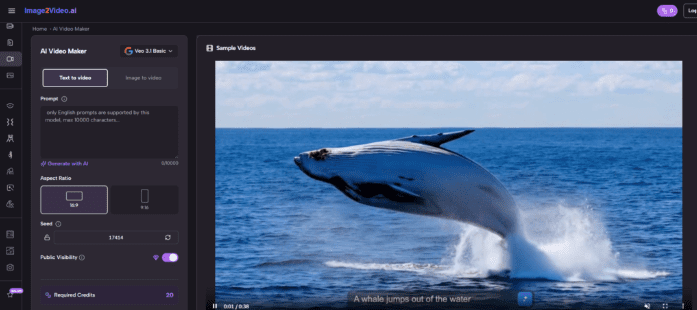
Step Two Adds Prompt And Output Choices
The user then describes what should happen and selects the visible settings shown on the page, including model, aspect ratio, resolution, frame rate, seed, and visibility. In my testing of tools in this category, this step matters more than many people expect because it shapes not only visual motion but also the practical use of the result.
Step Three Generates And Delivers The Video
After generation, the result can be reviewed, downloaded, and shared. This confirms that the platform is built around usable output rather than around endless browser-side experimentation.
Why The Settings Matter More Than They Appear
One reason this workflow feels useful is that it offers limited but meaningful control. It does not overwhelm the user, but it also does not reduce everything to a single button.
Aspect Ratio Reflects Distribution Intent
A vertical format may fit mobile-first publishing better, while a wider one may feel more cinematic or more appropriate for presentations and landing pages.
Format Is Part Of Meaning
The same motion sequence can feel casual, premium, dramatic, or social depending on how it is framed. That is why ratio is not just a technical option. It shapes perception.
Resolution And Frame Rate Affect Experience
Higher resolution raises expectations around detail. Frame rate changes the perceived feel of motion. These are not abstract settings. They influence whether a video feels smooth, stylized, soft, or more polished.
The User Still Shapes The Outcome
The system may generate the clip, but the user decides the delivery conditions. That keeps creative responsibility partly human, which is important for credibility.
A Better Way To Think About Prompting
Many people overcomplicate prompts by trying to describe every visual property. In image-led generation, that often misses the point.
The Prompt Should Describe Behavioral Change
Because the image already defines so much, the prompt is usually more effective when it explains what changes over time.
Useful Prompt Components Often Include
- subject movement
- camera behavior
- environmental response
- emotional pacing
- what should remain visually stable
The Best Prompts Respect The Source Image
The goal is not to override the image’s identity. The goal is to guide how that identity behaves as motion unfolds.
This Is Why Image-Led Video Feels Accessible
A user does not need to imagine the entire world in text. The image already does much of that work. The prompt only needs to add intention to it.
Where This Kind Of Tool Fits Best
The platform can support many creative tasks, but some use cases are especially natural.
Product And Brand Presentation
A strong product image can gain more persuasive force when motion helps reveal texture, angle, or premium feel. This is useful for commerce, advertising, and campaign support.
Social Publishing Workflows
For creators who already maintain a large image library, turning select stills into short motion clips can extend the value of existing assets without requiring constant new shoots.
Memory And Portrait Content
Portraits and archive photography often gain emotional resonance when motion is added carefully. This is especially true when the movement is restrained and works with the original atmosphere rather than against it.
Teaching And Visual Explanation
Some educational visuals are easier to understand when motion guides attention instead of leaving the viewer to decode everything from one frame.
How The Platform Differs From A Traditional Video Mindset
The deeper difference here is not just automation. It is the structure of the creative decision.
Traditional Editing Begins With Assembly
In a conventional workflow, the user gathers assets, opens an editor, places clips on a timeline, adjusts pacing, and exports later.
This Workflow Begins With Intent
Here, the user starts from a source image, writes directional language, chooses a few delivery settings, and generates first. That means decision-making happens earlier.
That Changes The User Experience
For many people, it is easier to decide what they want before a video exists than to fix a half-constructed sequence after the fact. The platform benefits from that shift.
A Practical Comparison Of The Product Logic
| Consideration | What The Platform Emphasizes | Why It Matters |
| Input type | Image-led and text-led creation | Supports both asset reuse and concept generation |
| Workflow length | Short generation flow | Reduces production overhead |
| Output control | Ratio, resolution, frame rate, seed, visibility | Makes output more purpose-specific |
| Access model | Browser-based use | No heavy local setup required |
| Product structure | Core generators plus effect routes | Useful for both focused work and experimentation |
| Final use | Downloadable short-form output | Built for actual publishing needs |
Where The Limits Become Clear
A restrained article should acknowledge that this is not a magic system.
Prompt Quality Still Influences Results
Even with a good source image, weak prompting can lead to motion that feels generic, too busy, or emotionally mismatched.
Iteration Is Part Of The Workflow
In my observation, first outputs in this category often function as directional drafts. Users usually improve results by refining the prompt rather than assuming the initial generation is the final answer.
It Does Not Replace Every Editing Need
If a project requires precise timing, layered narrative construction, or custom scene-by-scene control, a full editing or production workflow may still be necessary.
Credits Encourage Intentional Use
Because generation is tied to credits, users have a reason to think before they generate. That can improve discipline, but it also means experimentation is not entirely frictionless.
Why This Category Matters Beyond One Product
The larger story is that images are increasingly treated as starting frames rather than finished endpoints. That shift is visible across social content, commerce, personal storytelling, and even lightweight education.
Motion Has Become A Reuse Strategy
Instead of replacing an image archive, tools like this reactivate it. Existing visuals become raw material for new forms of communication.
This Broadens Creative Participation
People who are visually literate but not technically trained in editing can now build motion assets more directly. That is not a small change. It alters who gets to work with video at all.
The Bridge Between Image And Output Keeps Shrinking
As these workflows become more familiar, more users will start treating motion as a normal extension of still-image work rather than as a separate discipline.
Why The Shift Feels Important Right Now
The strongest way to understand this platform is as a bridge between image quality and video usability. It does not remove the need for judgment, and it does not guarantee that every image should become motion content. But it does make the transition from static asset to short publishable video much easier than it used to be.
For users who already think in images but increasingly need movement, that is not just a convenience. It is a meaningful change in how content gets made, adapted, and understood.