

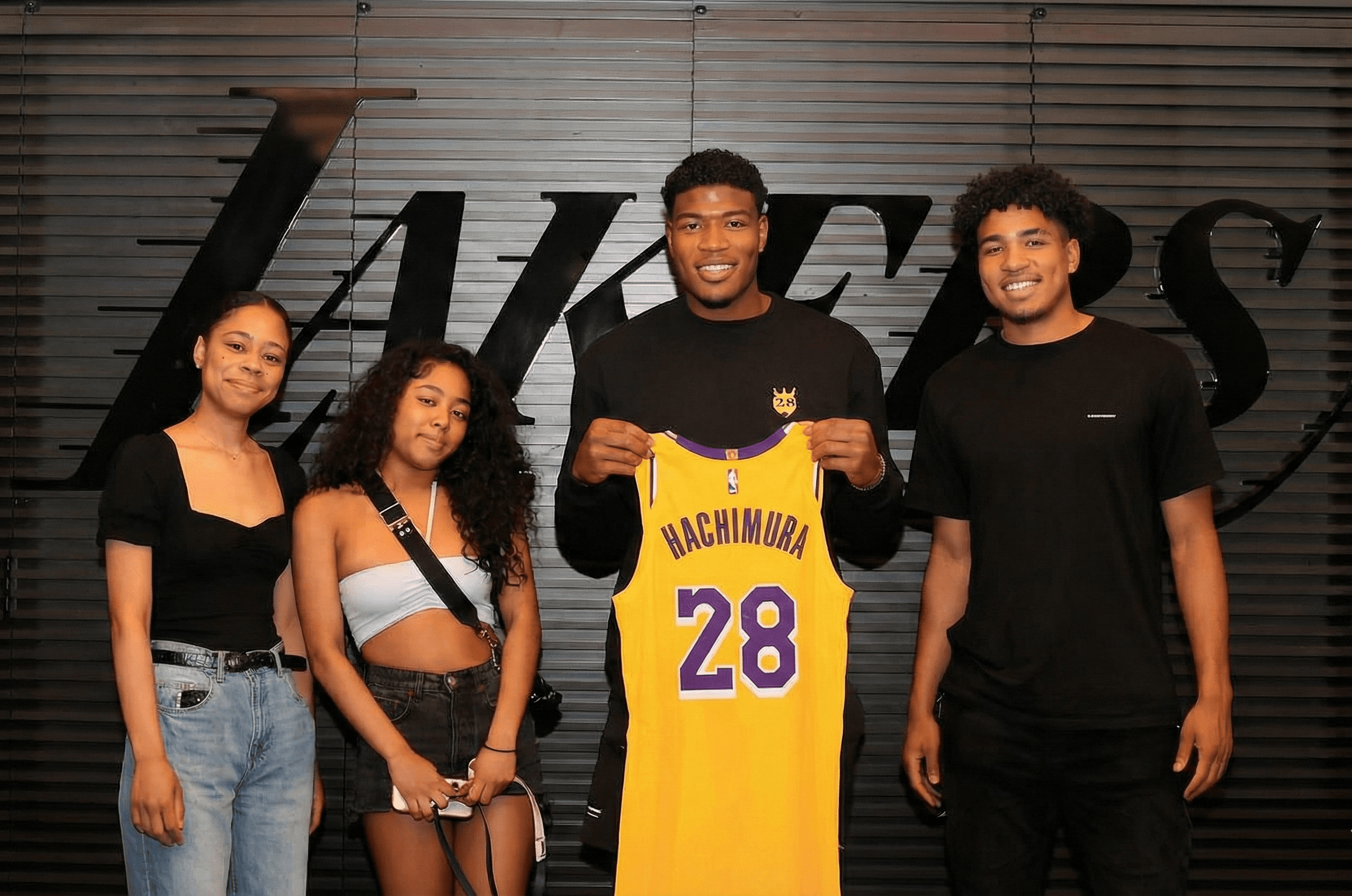
The name Amina Hachimura appears across the internet with surprising frequency for someone who has chosen a life away from fame. Much of that attention comes from her connection to Rui Hachimura, the Japanese NBA forward whose multicultural identity and athletic rise have drawn global media interest. Yet Amina’s own story is often overshadowed by conflicting online profiles, repeated assumptions, and thinly sourced claims that blur the line between fact and speculation.
A responsible biography of Amina requires patient reconstruction—keeping what is consistently reported, removing what is clearly fabricated, and acknowledging the privacy she maintains. This approach results in a clearer, more human portrait: a young woman rooted in two cultures, shaped by family and sport, and committed to building her life outside the pressures of celebrity.
Early Life and Family Roots
Amina Hachimura is widely known as the younger sister of Rui Hachimura. She grew up in Japan in a mixed-heritage household, with a Japanese mother and a Beninese father. The Hachimura family’s cultural blend has long been part of their public narrative, particularly as Rui became a symbol of multicultural representation in modern Japanese sports.
Growing up as a mixed-race child in Japan is an experience shaped by both connection and contrast. For the Hachimura siblings, it meant navigating environments where they stood out physically while still being deeply integrated into Japanese school and community life. Those who follow Rui’s interviews know he often speaks about the discipline, structure, and humility instilled by his mother, combined with the strength and physical gifts inherited from his father. That foundation benefited all the siblings, including Amina.
While Rui became the breakout figure in global basketball, other members of the family—such as their brother Aren—also pursued the sport professionally in Japan. Amina shared that sporting environment early in life, absorbing the family’s work ethic, athletic culture, and cross-cultural identity.
Growing Up in the Shadow of Fame
Although she is not a public figure, Amina has grown up around one. Rui’s ascent—from high-school standout in Sendai to Gonzaga University to his NBA career—brought constant attention to the family. Media reports often highlight the racism and stereotyping the Hachimura siblings encountered, especially online, where Rui and Aren have spoken openly about receiving derogatory messages.
Amina’s own experiences remain private, but it is reasonable to imagine how such an environment influences someone who chooses a quieter path. The contrast between her low profile and her brother’s global visibility underscores one of the core themes in her story: the intentional choice to build a life defined by personal passions rather than public attention.
Education in Japan: Foundations at Meisei High School
Many reliable biographies link Amina to Meisei High School in Sendai, the same institution where Rui developed into one of the most dominant high-school players in Japanese history. Meisei is known for its disciplined basketball program, strong coaching culture, and commitment to developing well-rounded student-athletes.
Amina is reported to have played on the women’s basketball team there. Even without public statistics or match reports, this level of involvement reveals a great deal about her adolescent years. Basketball at Meisei is demanding, requiring early-morning practices, structured team routines, and a competitive environment that forces students to balance academics with athletics.
This period of her life appears to have played a central role in shaping her character: disciplined, resilient, and used to managing multiple commitments at once.
Transition to the United States: Student-Athlete Experience
After graduating from high school, Amina is reported to have moved to the United States to continue both her studies and her athletic pursuits. The school most consistently associated with her is Lewis-Clark State College in Idaho, a respected NAIA institution known for small class sizes and rigorous programs in the sciences.
She is frequently described as having completed a Bachelor of Science degree in Biology. A program of this nature typically includes foundational coursework in molecular biology, organic chemistry, genetics, ecology, anatomy, and upper-division electives that require detailed lab work. Students in such programs spend long hours in laboratories, research settings, and group projects—time-intensive commitments that leave little room for outside noise.
Balancing a science degree with collegiate basketball is no small feat. The NAIA schedule involves significant travel, conditioning, games, and team meetings. Student-athletes must maintain academic standards while functioning within a team culture that demands consistency and discipline. This combination suggests that Amina’s college experience was rooted in responsibility and time management.
Even though her name does not appear prominently in modern athletics archives, this is not unusual. Student-athletes who do not pursue professional careers often fade from public rosters once they graduate, especially at smaller schools where archival systems evolve over time. What stays consistent in her biographical narrative is the picture of a scholar-athlete who valued both physical and intellectual growth.
A Life Beyond Sport: Creativity, Art, and Personal Expression
One of the more interesting aspects of Amina’s public profile is the frequent connection to creative work. Several independent biographies describe her as someone who has participated in art exhibitions, photography, or small-scale modeling projects.
Although details are limited—partly due to her conscious privacy—these portrayals consistently frame her as a person who expresses herself through multiple mediums rather than through a single career identity. In that sense, Amina mirrors many young adults who explore different passions simultaneously, integrating academic training, athletic discipline, and creative expression.
Art, for many individuals from multicultural backgrounds, becomes a language for identity. Without speculating on motivation, it is reasonable to interpret her artistic interest as part of a wider journey of personal meaning, especially for someone living between cultures and continents. Such expressions often develop organically rather than as public-facing careers, which aligns with her low-key lifestyle.
Staying Out of the Spotlight: A Deliberate Choice
Perhaps the most defining trait of Amina Hachimura’s public identity is her intentional absence from public life. Unlike many siblings of famous athletes, she does not appear in media interviews, magazine features, or social platforms designed to grow a following. Her online presence is either extremely limited or non-existent, and the accounts bearing her name are often fan-created, unverified, or impersonations.
This privacy is not a passive by-product of obscurity—it is a choice. In an era where public exposure is the norm and privacy is rare, choosing quietude requires discipline. It aligns with the broader value system often associated with Japanese culture, where humility and discretion are more valued than personal promotion. It also reflects an understanding of the challenges that come with fame, challenges her brothers have experienced firsthand.
Her silence should not be misinterpreted as lack of achievement. Rather, it reinforces the idea that success can be deeply personal, away from public measurement or online attention.
The Problem of Online Misinformation About Amina
One of the striking challenges when writing about Amina Hachimura is the volume of contradictory online information. Some articles exaggerate her life details. Others mistakenly refer to an entirely different person with the same name, including reports of a media artist born decades earlier. Several pages repeat speculative numbers for her age, height, net worth, or relationship status—with no sources provided.
This clutter is a classic example of the modern search landscape, where limited verified information about a private individual gets drowned beneath auto-generated content. For responsible journalism, respect for privacy and accuracy requires stepping back from sensational claims and focusing only on consistent, plausible, non-intrusive facts.
Avoiding speculation protects both the subject and the credibility of the content. It aligns with user-first SEO principles and the values behind today’s search quality guidelines, which reward accuracy, transparency, and expertise rather than volume or keyword density.
Connection to Rui Hachimura’s Story
Even though Amina does not seek attention, she inevitably becomes part of Rui’s broader narrative. Rui often speaks about his family’s influence on his work ethic, confidence, and grounding. The stability he attributes to his upbringing, and the pride he expresses in his multicultural heritage, suggests a home environment that supported all children equally.
The Hachimura family has also faced challenges surrounding race, belonging, and visibility in Japan, and those pressures likely affected every sibling. Rui and Aren have openly addressed the discrimination they faced, especially online. Amina’s choice to remain private may partially reflect a desire to shield herself from the harsher elements of public scrutiny.
Still, her presence is felt around her brother’s milestones—from his selection as the highest-drafted Japanese player in NBA history to his cultural impact on Japanese-American identity. In stories about Rui, family is not a background note; it is part of the foundation that enabled his success.
Why Her Story Matters Today
The fascination with Amina Hachimura is not merely because she is related to an NBA star. It stems from a deeper cultural moment. As Japan becomes more openly diverse, stories of mixed-heritage individuals gain new relevance. Rui’s career sparked conversations about representation, identity, and belonging, both in Japan and globally. His siblings naturally become part of that evolving narrative.
Amina’s story—quiet, multidimensional, and shaped by personal choice—represents another version of multicultural Japanese identity. It speaks to young people who feel caught between cultures, and to women who wish to pursue multiple interests without being pushed into the public eye. Her life reflects the idea that identity is expansive, not singular, and that one can build a meaningful path without fame.
Frequently Asked Questions About Amina Hachimura
Is Amina Hachimura a public figure?
No. She maintains a private, low-profile life and does not engage in public media or influencer culture.
Did she play basketball like her brothers?
Yes, she is consistently reported to have played basketball in high school and college, though she does not appear to have pursued a professional career.
What did she study?
Most accounts associate her with a Biology degree earned in the United States.
Does she have social media?
There are no widely verified accounts. Profiles using her name are often unofficial.
Why is her online information inconsistent?
A combination of privacy, search-driven content duplication, and misidentification contributes to conflicting information.
Also Read: Tacoma Simmons: Life, Career, and DMX Family Background
Final Thoughts
Amina Hachimura’s life cannot be distilled into a list of public achievements or easily searchable milestones. Her story is shaped less by fame and more by intention, identity, and personal depth. She is the sister of a globally recognized athlete, but she is also an individual who has consciously chosen her own rhythm—balancing sport, education, creativity, and privacy.
In the modern digital landscape, where every personal detail can become public property, her choice to remain largely unseen is a reminder that fulfillment does not always require visibility. Her role within the Hachimura family, her bicultural heritage, her academic and athletic commitments, and her creative pursuits all contribute to a quiet yet compelling narrative.
For readers seeking the truth behind the name, the most meaningful portrait of Amina Hachimura is one that respects her boundaries while acknowledging the significance of her story. She stands as a symbol of self-defined identity, cultural richness, and the strength to stay grounded in a world that constantly pushes people toward exposure.