

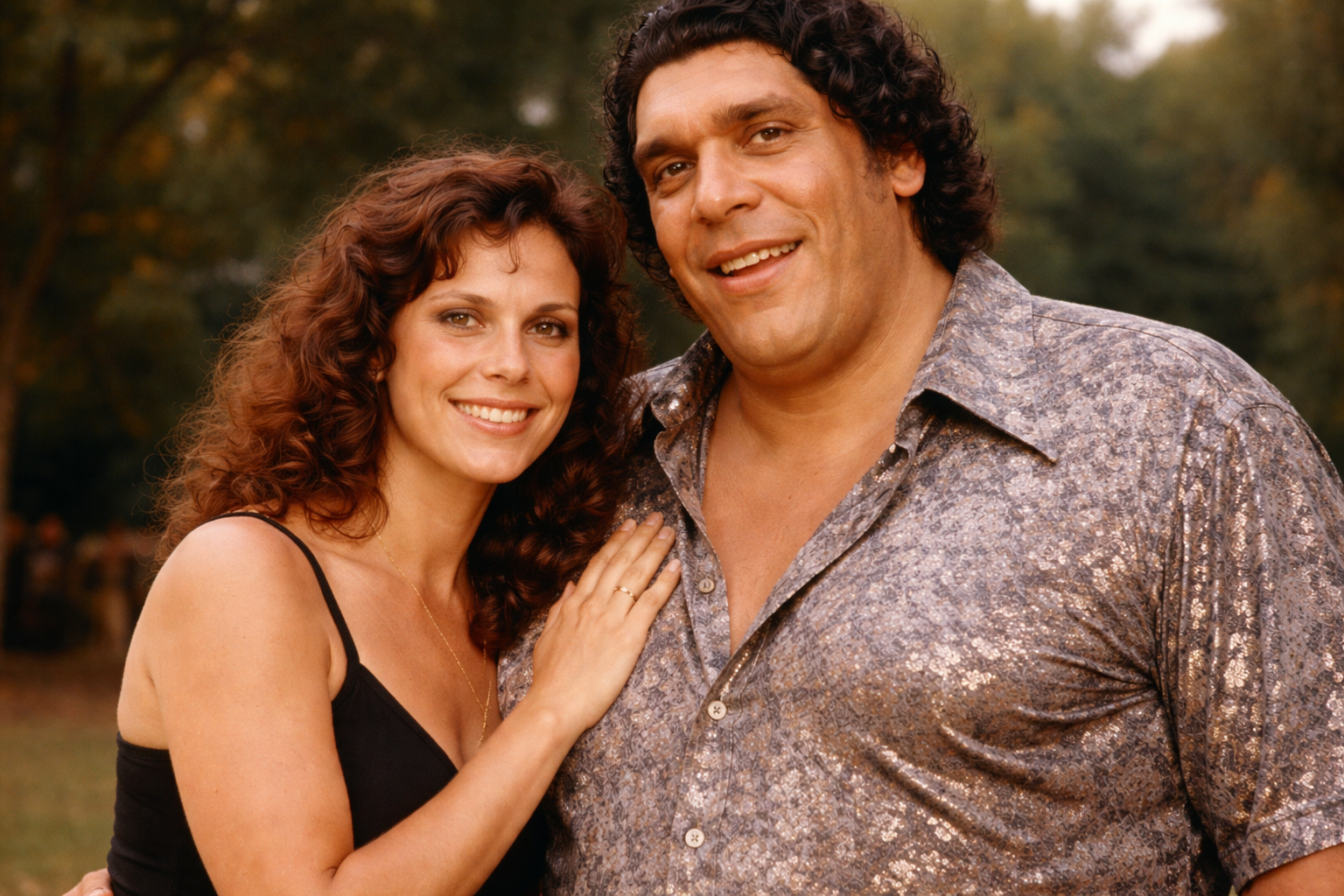
Jean Christensen is a name that often appears quietly in discussions about professional wrestling history, celebrity legacy, and the private lives that exist behind public myths. Unlike performers or promoters whose careers were defined by visibility, Christensen’s story is notable precisely because of its restraint. She did not seek fame, interviews, or public validation, yet her life intersected with one of the most recognizable figures in sports entertainment: André the Giant. Over time, that single connection has made her a subject of curiosity, speculation, and sometimes misunderstanding.
This biography-style article explores Jean Christensen’s life as it can be responsibly understood today. Rather than sensationalizing rumors, it focuses on verified context, historical setting, and the human dimensions of a woman whose name became linked to global fame without her consent. The goal is not to mythologize her, but to explain why her story continues to matter.
Early Life and Background
Public records and reputable biographies offer limited detail about Jean Christensen’s early life. This absence is important in itself. Unlike celebrities who build a public narrative from childhood onward, Christensen lived most of her life outside media attention. Her upbringing, education, and early career are not widely documented, which suggests a life grounded in normalcy rather than performance.
What can be inferred is that she was an adult by the early 1970s and professionally connected, in some capacity, to the world of professional wrestling. At that time, wrestling was not the polished global entertainment brand it would later become. It was a fragmented network of regional promotions, traveling shows, and behind-the-scenes labor that relied heavily on local organizers, public relations staff, and administrative support. People like Jean Christensen existed within that ecosystem without being part of the spectacle.
Her anonymity before and after her brief public association speaks to a deliberate choice to remain private. In an era where proximity to fame often becomes a lifelong identity, Christensen’s background reflects a different value system, one rooted in personal boundaries.
Connection to the Wrestling World
Jean Christensen’s place in wrestling history is tied to her professional proximity to the industry during the early 1970s. Multiple reputable summaries note that she met André René Roussimoff, later known worldwide as André the Giant, through wrestling-related work around 1972 or 1973. This was a period when André was transitioning from regional attraction to international phenomenon.
At that stage in his career, André traveled constantly. Wrestling territories across North America and Europe relied on his presence to draw crowds. The lifestyle was physically exhausting and socially isolating. Relationships formed in that environment were often intense but difficult to sustain, shaped by distance, inconsistent communication, and the demands of performance.
Christensen’s connection to André emerged from this context. It was not a celebrity romance played out in public view. Instead, it unfolded largely off-camera, within an industry that blurred the lines between real life and scripted persona. This distinction matters, because much of the confusion surrounding her story comes from later attempts to retrofit a private relationship into a public narrative.
Relationship With André the Giant
The nature of Jean Christensen’s relationship with André the Giant has been widely discussed and frequently mischaracterized. Some online sources have referred to her as his wife, while others state clearly that André never married. The most consistent and credible biographies support the latter claim. André is widely documented as having never been legally married.
What is not disputed is that Jean Christensen and André had a relationship that resulted in the birth of their daughter, Robin Christensen-Roussimoff. This single fact anchors Christensen permanently in André’s personal history. Beyond that, details become sparse, not because they are hidden, but because they were never made public.
This lack of clarity has led to myth-making. Wrestling culture has long thrived on exaggerated storytelling, and fans often seek emotionally satisfying narratives. A private woman becomes labeled as a secret wife. A complicated relationship becomes simplified into a tragic love story. These interpretations say more about audience expectations than about Christensen herself.
From a biographical standpoint, it is more accurate to describe Jean Christensen as someone who shared a meaningful personal relationship with André during a pivotal period of his life, without assigning titles that cannot be verified.
Motherhood and the Birth of Robin Christensen-Roussimoff
Jean Christensen’s most enduring role is that of mother to Robin Christensen-Roussimoff, André the Giant’s only child. Robin was born in the mid-1970s, at a time when André’s fame was accelerating rapidly. His physical condition, acromegaly, made his health fragile, and his schedule kept him constantly on the road.
Motherhood, in this context, came with unique challenges. Raising a child whose father was one of the most recognizable men in the world, yet rarely physically present, required emotional resilience and practical independence. Accounts suggest that Robin’s contact with André was limited, shaped by distance, legal complexities, and his lifestyle rather than by lack of care.
Jean Christensen, as the primary parent, bore the responsibility of providing stability. She did so away from cameras, interviews, and fan conventions. That decision likely protected her daughter from being defined solely by her father’s fame, even as that fame inevitably shaped Robin’s identity.
The mother-daughter relationship remains one of the most human elements of this story. It highlights the contrast between public legacy and private responsibility, and it explains why Jean Christensen’s name continues to surface whenever André’s life is revisited.
Life Away From the Spotlight
After her brief intersection with public attention, Jean Christensen returned fully to private life. There are no verified interviews, memoirs, or public statements attributed to her. This absence has sometimes been misinterpreted as secrecy, but it is more accurately understood as intention.
Many individuals connected to famous figures choose to leverage that connection. They write books, appear in documentaries, or build personal brands around proximity to fame. Christensen did none of these things. Her silence suggests a clear boundary between her life and the entertainment industry’s appetite for stories.
Living privately in a world that increasingly rewards exposure is not an easy choice. It often means allowing others to tell your story imperfectly, or not at all. Yet it also preserves autonomy. Jean Christensen’s post-wrestling life demonstrates that legacy does not require visibility.
Why Public Interest Persists
Interest in Jean Christensen has grown in recent years, not because of new revelations about her, but because of renewed attention to André the Giant. Streaming platforms, documentaries, and corporate expansion have reintroduced André to younger audiences. As his story circulates, so do the names connected to him.
Modern search behavior also plays a role. Search engines surface names without context, flattening complex lives into keywords. “Jean Christensen” becomes a query detached from nuance, inviting speculation and repetition. Each retelling slightly distorts the original facts.
There is also a cultural shift underway. Audiences today are more interested in the human cost of fame. They want to understand what it meant to love, parent, or work alongside someone larger than life. Jean Christensen represents that perspective. She embodies the quieter consequences of celebrity, the lives shaped indirectly by global attention.
Separating Fact From Assumption
A responsible biography must acknowledge uncertainty. In Jean Christensen’s case, speculation has often filled gaps left by her privacy. Claims about her career, personality, or long-term relationship with André beyond what is documented should be treated cautiously.
What can be stated with confidence is limited but meaningful. She was connected to the wrestling world in the early 1970s. She had a personal relationship with André the Giant. She is the mother of his only child. She chose not to pursue public recognition based on that connection.
These facts are enough to understand her significance. Anything beyond them risks turning a real person into a fictional character.
Cultural and Historical Significance
Jean Christensen’s story holds value beyond individual curiosity. It reflects broader themes in entertainment history, particularly the way women’s roles in male-dominated industries are recorded or erased. In wrestling’s territorial era, many women contributed behind the scenes without acknowledgment. Their stories survived only when linked to famous men.
Christensen’s continued presence in public discourse highlights how legacy works. It is not only built by those who perform, but also by those who support, raise families, and manage life offstage. Her biography challenges the assumption that importance must be loud or visible.
In a time when personal branding is often seen as essential, her life offers a counterexample. Significance can exist without self-promotion. Influence can be indirect yet lasting.
Also Read: Lexie Wiggly Biography: Life, Marriage, and Private Journey
Conclusion
Jean Christensen remains an elusive figure not because her story lacks meaning, but because she chose privacy over recognition. Her life intersected briefly but profoundly with one of the most famous wrestlers in history, resulting in a daughter who carries that legacy forward. Beyond that intersection, she lived on her own terms.
As interest in André the Giant continues to grow, so too will curiosity about those closest to him. Jean Christensen’s biography reminds us that not every important story is fully documented, and not every meaningful life seeks an audience. In understanding her, we gain a deeper appreciation for the unseen lives that exist alongside fame, shaping it quietly and enduring its consequences long after the spotlight moves on.

