

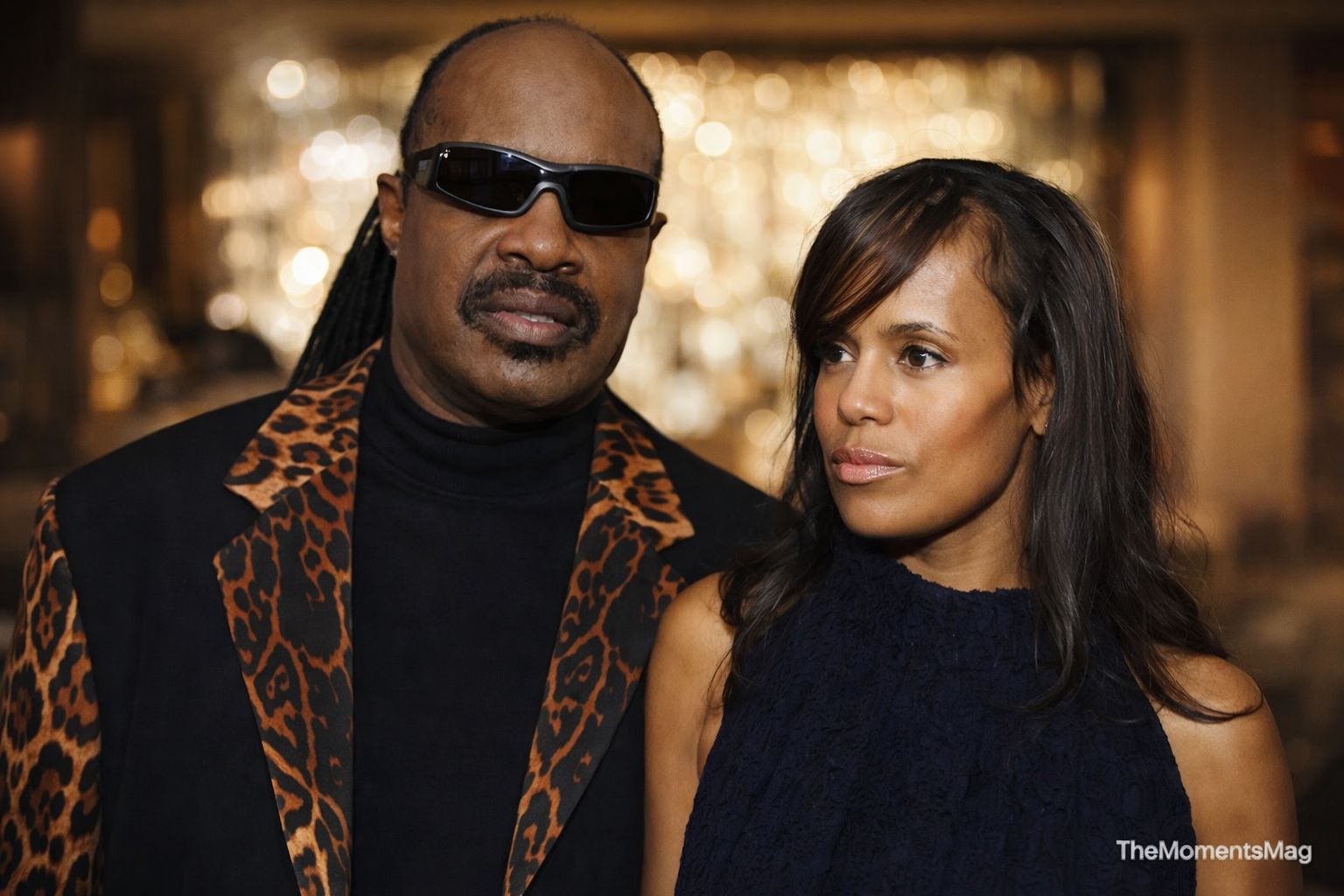
Kai Millard Morris is a name that often appears in public conversation through association, yet her life story stands on its own terms. Known professionally as Kai Milla, she is an American fashion designer, creative strategist, and cultural figure whose career has unfolded quietly but deliberately across art, fashion, and public life. While popular interest has frequently focused on her former marriage to Stevie Wonder, Morris’s biography reveals a more layered narrative—one shaped by artistic training, persistence in a difficult industry, and the challenge of maintaining identity under public scrutiny.
This is the story of a woman who has spent decades creating, evolving, and redefining herself, often away from the headlines that once framed her as someone else’s muse.
Early life and artistic foundations
Kai Millard Morris was born in the United States and raised with a strong exposure to art and culture from an early age. While many biographical details about her childhood remain private, what is clear from interviews and professional profiles is that her creative direction was shaped early. She pursued formal art education at the Corcoran School of Art & Design in Washington, D.C., an institution known for emphasizing fine art fundamentals such as form, composition, and spatial awareness.
This background would become central to her later work in fashion. Rather than approaching clothing as seasonal trends or surface-level aesthetics, Morris developed an interest in how fabric interacts with the human body. Draping, structure, and silhouette fascinated her more than embellishment. These concerns aligned more closely with sculpture and architecture than with fast-moving fashion cycles, and they gave her design work a distinctive identity from the beginning.
During her studies, Morris encountered high fashion not merely as consumer spectacle but as a form of applied art. She has cited exposure to couture design—particularly European houses known for structural innovation—as a turning point that convinced her fashion could be both wearable and intellectually rigorous. From that moment, fashion became her chosen medium.
Entering the fashion world
After completing her studies, Kai Millard Morris began the slow, often unglamorous process of establishing herself as a designer. She adopted the professional name Kai Milla and focused on building collections rooted in drape, tailored lines, and sculptural form. Her early designs reflected her fine art background, favoring restraint over excess and construction over decoration.
In the early 2000s, her work began to appear in New York fashion circles. She presented collections during New York Fashion Week seasons and attracted attention for designs that felt timeless rather than trend-driven. Industry coverage from that period described her work as elegant, disciplined, and informed by historical references, particularly mid-20th-century silhouettes.
This phase of her career coincided with one of the most challenging realities of independent fashion: visibility does not guarantee sustainability. Morris was not operating as a mass-market brand. Instead, she positioned her label in the space between art fashion and accessible luxury, a difficult category that requires loyal customers rather than viral moments. Nevertheless, she persisted, refining her aesthetic and continuing to show work publicly.
Marriage, public attention, and private complexity
In 2001, Kai Millard Morris married Stevie Wonder, one of the most influential musicians of the 20th century. The marriage brought her into a level of global visibility few designers ever experience. Red-carpet appearances, media coverage, and public curiosity followed, often overshadowing her professional identity.
The couple had two sons together, and for several years, Morris balanced family life with creative work. However, public narratives frequently reduced her role to that of a celebrity spouse, despite her ongoing career. This tension between public perception and personal reality would become a recurring theme in her life.
The marriage began to unravel years later. The couple separated in 2009, divorce proceedings were initiated in 2012, and the divorce was finalized in 2015. Throughout this period, Morris remained largely private, avoiding public commentary and focusing instead on her personal life and creative pursuits. The experience reinforced a truth familiar to many women connected to high-profile figures: visibility does not always translate into agency over one’s narrative.
Reinvention after the spotlight
Following the end of her marriage, Kai Millard Morris entered a period of reinvention. Rather than retreating from creative life, she recalibrated it. Her fashion work continued under evolving brand expressions, including projects that reflected a broader lifestyle and cultural orientation. She appeared at fashion-related events, including presentations connected to New York Fashion Week, sometimes under new conceptual frameworks that emphasized clarity, simplicity, and personal expression.
Morris also expanded her public identity beyond fashion design alone. She began to be described in cultural media as a creative strategist and tastemaker, someone operating at the intersection of art, fashion, and cultural philanthropy. This shift reflected both personal growth and a realistic assessment of the modern creative economy, where designers often occupy multiple roles simultaneously.
Her approach remained consistent, however. Whether designing garments or engaging in broader creative initiatives, Morris emphasized intention, form, and authenticity. She avoided the noise of trend cycles and instead positioned herself as someone invested in long-term creative relevance.
Identity, perception, and the challenge of being labeled
One of the most persistent challenges in Kai Millard Morris’s biography is the way public labels have followed her. Terms like “muse,” “socialite,” or “celebrity wife” have often been applied, sometimes dismissively, sometimes romantically. Yet none of these labels fully capture her lived experience or professional output.
In reality, Morris has consistently operated as a maker rather than an accessory to creativity. Her work ethic, education, and sustained engagement with fashion demonstrate agency and intention. The disconnect between perception and reality speaks to broader cultural patterns, particularly how women associated with powerful men are framed in media narratives.
Over time, Morris has appeared increasingly comfortable defining herself on her own terms. Her public statements, limited though they are, emphasize creativity, culture, and continuity rather than reinvention for spectacle’s sake. This restraint has become part of her identity.
Personal life and values
Despite decades of public exposure, Kai Millard Morris has maintained a relatively private personal life. She has prioritized her role as a mother and has avoided the oversharing that often accompanies celebrity-adjacent status in the social media age. When she does appear publicly, it is usually in contexts connected to art, fashion, or cultural events rather than gossip-driven spaces.
Her values appear rooted in discipline, creativity, and independence. Those who have worked with her describe her as focused and detail-oriented, with a strong sense of aesthetic direction. These traits echo the fine art foundations that shaped her early years and continue to inform her work today.
Legacy and continuing relevance
Kai Millard Morris’s biography does not fit neatly into conventional success narratives. There is no single breakout moment or viral ascent. Instead, her story is one of continuity—of choosing to remain creative across changing personal circumstances and industry transformations.
In an era when fashion is increasingly driven by speed, algorithms, and spectacle, Morris represents a quieter model of creative life. She embodies the idea that relevance does not always require constant visibility, and that craft can exist independently of hype.
Her legacy, still unfolding, lies in the example she sets rather than the headlines she generates. As a designer trained in fine art, a woman who navigated public scrutiny with restraint, and a creative figure who continues to evolve on her own terms, Kai Millard Morris occupies a distinct place in contemporary cultural history.
Also Read: Kali Woodruff Carr: Biography of a Neuroscientist and Researcher
Conclusion
Kai Millard Morris is more than a name connected to fame. She is a designer shaped by art, a woman who navigated public life without surrendering her private self, and a creative professional who chose persistence over performance. Her biography reflects the realities faced by many artists whose work unfolds outside the spotlight, even when their lives occasionally fall within it.
To understand her fully is to look beyond association and toward intention. In doing so, Kai Millard Morris emerges not as a footnote, but as a figure whose quiet resilience and creative integrity continue to define her story.