

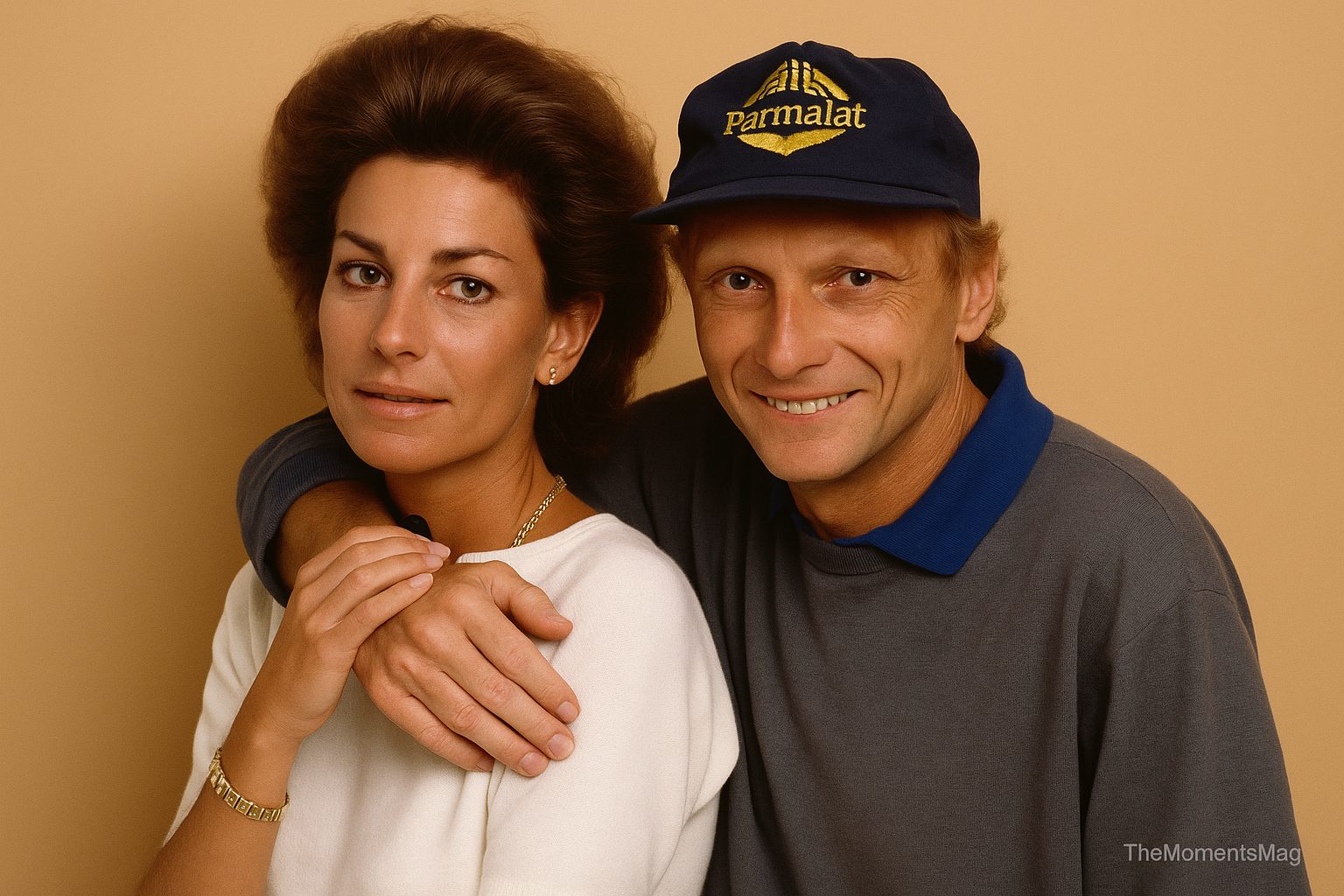
Marlene Knaus occupies a distinctive place in the history of Formula 1—an elegant and quietly influential figure whose life unfolded alongside one of the sport’s most celebrated champions, Niki Lauda. Yet her identity extends far beyond that association. Before the racing world ever knew her name, she had already become a fashion icon, admired for her refined beauty, minimalist style, and unwavering authenticity. Her presence carried a softness that contrasted beautifully with the boldness of the era, and her character emerged as a stabilizing force in every environment she entered.
Over the decades, Marlene’s life evolved from the bright lights of fashion studios to the high-stakes atmosphere of Formula 1 paddocks, and ultimately to the peaceful stillness of Ibiza. Through each chapter, she carried the same quiet dignity that defined her story. Her journey is one of resilience, loyalty, artistic intuition, and the courage to live life on her own terms.
Early Life and Modeling Career
Born in 1956 in the United States to Venezuelan parents, Marlene grew up within a vibrant cultural landscape that shaped her artistic sensibilities. From a young age, she gravitated toward aesthetics, design, and understated beauty—traits that blossomed when she entered the modeling world as a teenager.
Her rise in the industry was swift. In a fashion world driven by bold expressions and dramatic looks, Marlene introduced a breath of calm sophistication. Her natural features, paired with her iconic high-top-knot bun, made her instantly recognizable. The hairstyle became more than a signature; it became a trend, imitated by women across continents and featured repeatedly in editorial spreads.
She worked throughout New York, Paris, Vienna, and London with renowned fashion houses and publications. Yet fame never reshaped her demeanor. She remained grounded, expressive, and intent on maintaining authenticity in an industry that often demanded personas. Her collaborations reflected mutual respect rather than spotlight chasing, and her work resonated because it felt genuine rather than manufactured.
By the late 1970s, Marlene began transitioning into interior design—a shift that revealed the depth of her creative instincts. Her ability to craft harmonious, elegant spaces mirrored the refined taste she brought to fashion. Rather than seeking public recognition, she focused on the quiet satisfaction of creating beauty in everyday environments.
Meeting Niki Lauda: A Love Story Born Amid Complexity
Her meeting with Niki Lauda in 1975 marked the beginning of one of Formula 1’s most memorable love stories. They encountered each other at a dinner party, both involved in other relationships at the time—Marlene with actor Curt Jurgens and Niki with Mariella von Reininghaus. Despite the circumstances, their connection was immediate and profound.
What drew Niki to her was unlike anything he had encountered in his fast-paced, fame-driven world. Marlene showed no interest in his status, nor was she impressed by the attention that followed him. Her calm presence and refusal to be swayed by celebrity fascinated him. He admired her independence, her quiet self-assuredness, and her ability to remain unaffected by the noise surrounding professional racing.
Their relationship evolved quickly. Both ended their previous commitments, and by 1976 they were married. With their union, Marlene embraced Austrian citizenship and stepped into a life shaped not only by glamour but by the constant risks and pressures inherent to Formula 1.
Life as the Partner of a Racing Legend
Living alongside a Formula 1 champion meant inhabiting a world of extremes. Races carried equal measures of thrill and danger, and every season introduced new emotional terrain—victories, losses, intense rivalries, and the ever-present possibility of tragedy. Despite this, Marlene navigated the environment with remarkable composure.
She attended races across the globe, supporting Niki while maintaining her own quiet identity within the high-energy atmosphere. Observers often noted the balance between them: Niki’s sharp focus and analytical mind paired with Marlene’s measured elegance. Together, they embodied a sophistication that captivated fans and the media alike.
Her understated fashion sense soon became a paddock hallmark. She appeared effortlessly refined, with simple silhouettes, clean lines, and her iconic bun. But beyond aesthetics, her loyalty and emotional steadiness played a vital role in Niki’s life. She offered grounding in moments when the demands of racing threatened stability, becoming a consistent, reassuring presence.
The Nürburgring Crash: A Defining Chapter
Everything changed on August 1, 1976. During the German Grand Prix at Nürburgring, Niki Lauda suffered a devastating crash that left his Ferrari engulfed in flames. His injuries were severe—extensive burns, damaged lungs, and long-term trauma that threatened not only his career but his life.
For Marlene, the hours that followed were harrowing. The man she had married only months earlier lay in critical condition, and the future was uncertain. Yet her response was marked not by fear, but by extraordinary strength. Niki later recalled how she never flinched upon seeing him in his injured state. Her calm, unwavering presence became a source of profound comfort.
Throughout his recovery—multiple surgeries, grueling treatments, and the emotional turmoil that accompanied them—Marlene remained steadfast. Her support helped fuel Niki’s astonishing return to racing a mere six weeks after the crash, an act still revered as one of the most remarkable comebacks in sports history.
Their bond during this period revealed the depth of their partnership. It showed a devotion that extended far beyond glamour, illustrating resilience in the face of unimaginable adversity.
Family Life and Challenges
The couple welcomed two sons: Lukas in 1979 and Mathias in 1981. Their home life was shaped by warmth, structure, and Marlene’s commitment to raising emotionally grounded children despite the intensity of Niki’s profession. Mathias later pursued a career in racing, while Lukas became his manager—both paths shaped by the values they witnessed growing up.
However, the marriage encountered significant challenges. In 1982, it became public knowledge that Niki had fathered another son, Christoph, outside the marriage. The revelation was deeply painful and placed considerable strain on the relationship. Yet Marlene met the moment with dignity, shielding her sons from the turmoil and maintaining composure despite public scrutiny.
Although they continued together for several years, the emotional distance eventually became insurmountable. In 1991, they divorced—quietly, respectfully, and without public recriminations. Their separation did not erase the years of shared history, and they maintained amicable ties long afterward.
Life After Divorce: Choosing Privacy
After the divorce, Marlene chose a markedly private path. She moved to Ibiza, where the pace of life was slower, the community respectful, and the natural surroundings peaceful. The island provided the retreat she needed after years in the public sphere.
Her life in Ibiza became defined by simplicity and intention. She cooked, cared for animals, spent time with family, and nurtured a lifestyle grounded in quiet joy rather than external validation. Friends describe her as gentle, thoughtful, and deeply authentic—a woman who embraced a life shaped by meaning rather than display.
In 2014, she closed her social media accounts, reinforcing her desire for privacy. Her absence from the public eye became part of her narrative, a reflection of her commitment to living truthfully and quietly.
Niki Lauda’s Passing and the Estate
When Niki passed away in 2019, Marlene was among those who stood beside him during his final days. Their connection, shaped by profound experiences, endured long after their marriage had ended.
His passing initiated a complex settlement of his estimated $200 million estate. Because his will had not yet been updated to include his second wife, Birgit, and their twins, legal proceedings followed. Birgit ultimately secured a 16% share of the inheritance.
Marlene retained significant assets, including the Ibiza home that had become her sanctuary. Her net worth, estimated at around $50 million, allowed her continued independence and privacy—a lifestyle she deeply valued.
Marlene Knaus Today: A Life Defined by Authenticity
Today, Marlene continues to live a quiet, intentional life in Ibiza. She avoids public appearances and interviews, but her influence persists. Admirers still reference her timeless style, her graceful presence during pivotal moments in Formula 1 history, and the strength she displayed during Niki’s most difficult chapters.
Those who know her speak of sincerity, emotional depth, and a strong sense of personal identity. While her life may seem understated from the outside, it is one carefully crafted around her values—a life of peace, gratitude, and artistic appreciation.
Legacy and Cultural Influence
Marlene Knaus remains a symbol of understated elegance. In fashion, her minimalist aesthetic continues to inspire designers and stylists. In motorsport, her loyalty and resilience have become part of the emotional fabric surrounding Niki Lauda’s storied career.
Her portrayal in the 2013 film Rush reignited fascination with her life. Many noted the close physical resemblance between the actress and Marlene, though those familiar with the real woman often remarked that her beauty and presence were even more extraordinary.
Her signature bun remains iconic. Her quiet confidence endures as a reminder that influence need not be loud to be lasting. She exemplifies the power of subtlety, authenticity, and inner strength.
Conclusion
The story of Marlene Knaus is one of elegance, resilience, and an enduring authenticity that transcends the eras she lived through. From her early rise as a fashion icon to her quiet strength during Niki Lauda’s most challenging moments, she demonstrated a depth of character rarely visible in the public figures of her time. Her life unfolded not through notoriety but through unwavering loyalty, emotional intelligence, and a profound commitment to living truthfully.
In the world of Formula 1, she became a symbol of steadiness in moments defined by uncertainty and risk. In the world of fashion, she left behind an aesthetic legacy built on simplicity and natural beauty. And in her private life, she continues to embody the quiet power of choosing peace over spectacle.
Ultimately, Marlene Knaus remains an example of how influence can manifest not through volume or visibility, but through grace, conviction, and the courage to define one’s own path. Her story endures because it reflects a timeless truth: that genuine elegance lives not in what is shown to the world, but in how one moves through it.