

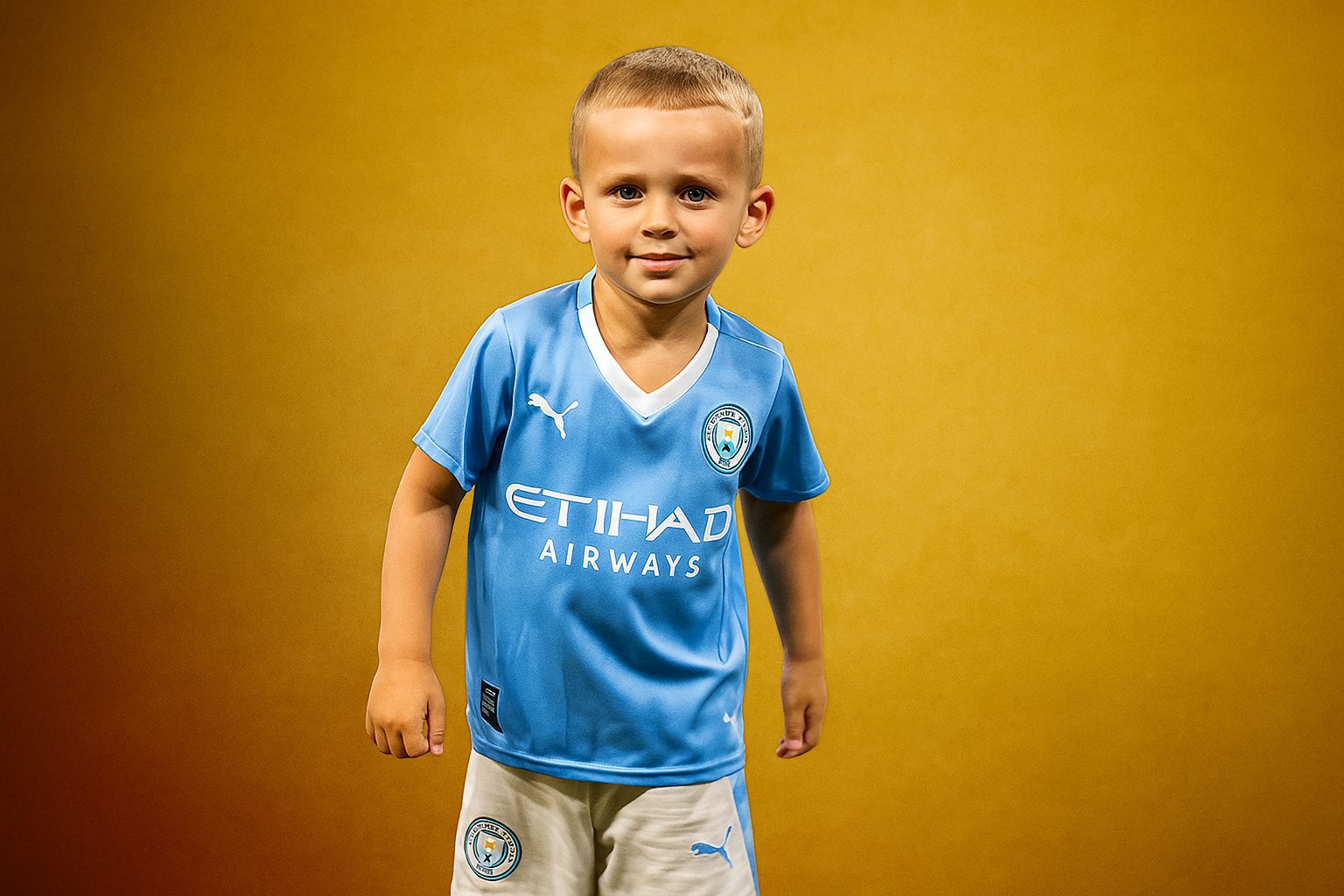
Ronnie Foden has become a rare kind of modern phenomenon: a footballer’s child who is not only known to fans but who has developed his own cultural presence. Although he is still a young boy, Ronnie is one of the most visible children in world football, appearing alongside his father Phil Foden during Manchester City’s historic achievements and becoming a favourite personality among supporters.
His rise has unfolded at the exact moment football, celebrity culture, and social media have merged. What was once a simple dressing-room tradition—children celebrating trophies with players—has evolved into an online ecosystem where even the smallest faces become instantly recognisable. Ronnie Foden sits at the centre of that shift.
This article provides a complete, high-authority profile of Ronnie based on confirmed information from earlier verified sources. It covers who he is, why he became famous, how his parents manage his presence, the cultural meaning of “El Wey,” and the challenges that come with raising a highly visible child in 2025.
Who Is Ronnie Foden?
Ronnie Foden was born on 22 January 2019 in England to Phil Foden and Rebecca Cooke. He is the oldest of their three children and the first of the next generation in a family that has supported Manchester City for decades. His father, already a breakout talent in his teens, became one of Europe’s most influential midfielders during Ronnie’s childhood. His mother, Rebecca, has intentionally kept a low public profile despite significant media attention around the family.
From early on, Ronnie appeared naturally in the background of family photos, match-day glimpses and club celebrations. Nothing about his early appearances was designed for attention. His parents did not position him as a content figure or a child brand. He was simply a young boy who happened to be present while his father won league titles, domestic cups and eventually the UEFA Champions League.
Yet visibility, especially in a club as globally followed as Manchester City, has its own momentum. Ronnie’s face became familiar to supporters around the world long before the family made any decision about social media accounts or brand partnerships.
The Viral Birth of “El Wey”
Ronnie’s cultural moment arrived in 2023 during Manchester City’s historic treble-winning season. As the club celebrated the Premier League, FA Cup and Champions League titles, television cameras and fan footage repeatedly captured Ronnie running across the pitch, smiling at players or climbing onto Phil’s shoulders. What fans noticed was the easy confidence he carried. He looked comfortable in a space that overwhelms many adults.
Spanish-speaking supporters turned that confidence into a nickname: “El Wey.” The term, widely used in Mexican and Latin American slang, means “the dude,” “the guy,” or simply a playful reference to someone with attitude or presence. Footage of Ronnie wandering through the celebrations made him a perfect cultural vessel for the phrase.
Clips spread across TikTok and Instagram within hours. Football meme pages amplified them, and fans from outside the City community began referencing “El Wey” as if he were a character in football’s global story. It was organic, humorous and harmless—one of those moments where internet culture creates a star unintentionally.
Importantly, Ronnie himself never performed for the camera. He didn’t chase attention and wasn’t coached into playing a role. He was simply a five-year-old child enjoying a historic moment with his father. The meme belonged entirely to the fans.
The Instagram Explosion
The family eventually created an Instagram account for Ronnie in mid-2023. What happened next demonstrated just how deeply the “El Wey” phenomenon had spread: more than a million people followed the account within its first day.
Unlike many accounts created for children of athletes or celebrities, Ronnie’s page immediately attracted a global audience. Fans saw the account as a continuation of the joyful moment that had made him famous. The posts showed carefully selected images: tunnel walks with Phil, glimpses of trophy celebrations, family trips and a few early modelling shots.
The bio on the page made one thing clear: the account is managed by his parents.
That wording matters. It signals that Ronnie is not an influencer by choice, nor is he expected to behave like one. He is a child whose parents curate what appears publicly, similar to many families whose children have become prominent online.
Over time, the content remained consistent: polished but not intrusive, celebratory but not excessive, and always grounded in his real relationship with his father, mother and siblings. This approach allowed him to remain visible without becoming overexposed.
Family, Football and Multi-Generational Identity
To understand the resonance of the name “Ronnie Foden,” you have to step back one generation. Phil Foden wears the shirt number 47 for Manchester City—not because it is traditionally associated with midfielders, but because it honours his late grandfather Ronnie, who died at the age of 47.
Phil has spoken about this tribute as central to his identity. It represents his family’s long relationship with Manchester City and the values his grandfather passed down. The number is tattooed behind Phil’s ear, making it part of his personal narrative every time he steps on the pitch.
When Phil and Rebecca named their son Ronnie, the gesture connected past and future. Fans familiar with Phil’s story see the continuity: a grandfather remembered, a son celebrated, and a family that spans generations of City supporters. The name “Ronnie Foden” carries two separate but intertwined legacies.
This multi-layered identity became even more meaningful as fans connected the confident young boy from the treble season with the family history that shaped Phil’s career.
Modelling Work and Child Influencer Questions
As Ronnie’s public profile grew, brands approached him with opportunities. He became involved with children’s fashion campaigns guided by his parents and legitimate talent management. These early partnerships were modest compared with the scale of adult influencer deals, but they reinforced that Ronnie was now part of a wider commercial landscape.
Unlike traditional child stardom, where a child actively works in entertainment, Ronnie’s involvement is indirect and parent-directed. All visible decisions have followed responsible norms: limited photoshoots, carefully curated posts, no oversharing of private life and clear indication that adults manage every aspect of his online presence.
The situation raises broader themes relevant to modern parenting. Children like Ronnie are growing up in a world where social influence is almost unavoidable if a parent is famous. The challenge for adults is not to prevent visibility entirely but to shape it responsibly. Phil and Rebecca have so far modelled the industry’s best practices: limited content, protection of boundaries and active intervention when misinformation appears.
The Hoax and How His Parents Responded
One of the clearest examples of that intervention came in late 2025 when online hoaxes falsely claimed that Ronnie had died and that his sister was seriously ill. These stories were fabricated, harmful and entirely baseless, yet they spread rapidly across Facebook and low-credibility pages.
Phil and Rebecca responded directly, publicly and firmly. Rebecca posted confirmation that their children were healthy, calling the rumours “sickening,” and the family’s legal team began pursuing action against individuals who circulated the fabricated claims.
This episode highlighted both the fragility and the responsibility of online visibility in 2025. A child who becomes a global meme is also vulnerable to misinformation. But parents who act swiftly and decisively can set the tone for how such problems are handled. In Ronnie’s case, his family’s response positioned them as protectors rather than promoters, reinforcing the sense that his wellbeing—not his image—is the priority.
Ronnie’s Bond with Phil Foden
One of the reasons fans respond so strongly to Ronnie is the visible bond he shares with his father. After major matches, Phil is often seen carrying Ronnie or crouching down to speak to him amid the noise of celebrations. These moments resonate because they provide a human dimension to a sport dominated by pressure, money and scrutiny.
Ronnie has become a symbol of that softer side of football. His appearances remind supporters that players are not only athletes but also parents whose families experience the highs and lows of the sport alongside them. Ronnie’s presence humanises Phil without turning him into a brand or storyline.
This father-son dynamic has also shaped Phil’s public image. His identity as a young family man blends naturally with his role as a global footballer. In a media ecosystem that often exaggerates or distorts celebrity parenting, Ronnie’s appearances feel grounded and real.
Will Ronnie Become a Footballer?
Any attempt to project Ronnie’s future would be speculation. He is a primary-school-aged child whose interests are likely to shift dozens of times before adulthood. Naturally, he is surrounded by football culture; naturally, he plays with a ball at home and on holidays; naturally, he has access to resources other children do not.
But these conditions do not determine his future. What stands out instead is that his parents treat him as a child first, not a prodigy. There are no public signs of performance pressure or designed narratives about his athletic potential. If he chooses football later, he will step into an environment shaped by opportunity, not expectation.
For now, he is simply a boy who enjoys being around the game that shaped his family’s life.
Ronnie Foden in the Context of Football Culture
Ronnie’s visibility reveals something bigger about how football culture has evolved. In earlier eras, celebrations featured players’ families, but only a handful of photos appeared in newspapers. Today, every moment is documented, shared and amplified.
What makes Ronnie unique is not that he appears on the pitch with his father. Many children do. What sets him apart is:
He became part of a global meme.
He developed a distinctive identity recognised beyond club boundaries.
He entered social media at a moment when fans wanted lighter, more joyful content.
He embodied a new form of celebrity: accidental, child-centred and fan-driven.
He represents the intersection of community, modern fandom and family narrative. In a sport that sometimes feels dominated by commercial pressures, Ronnie brings a sense of spontaneity and innocence that resonates deeply with supporters.
Also Read: Arch Kelley III: Wynonna Judd’s First Husband Biography
Final Thoughts: What Ronnie Foden Represents
Ronnie Foden’s story captures how quickly and unpredictably fame can emerge in the digital era. What began as an ordinary moment—a proud father celebrating historic victories with his son—became a global cultural flashpoint.
He is, at heart, a child experiencing extraordinary circumstances with joy and innocence. His parents maintain boundaries, correct misinformation and protect his wellbeing while allowing fans small, positive glimpses of family life. As long as that balance is preserved, Ronnie’s visibility can remain a wholesome companion to Manchester City’s recent golden decade.
He may grow out of the spotlight, lean further into it or choose something entirely different as he ages. But in 2025, Ronnie Foden stands as one of the clearest examples of how football, internet culture and family identity can intersect—sometimes unpredictably, often joyfully, and always shaped by the adults who guide the story behind the scenes.