

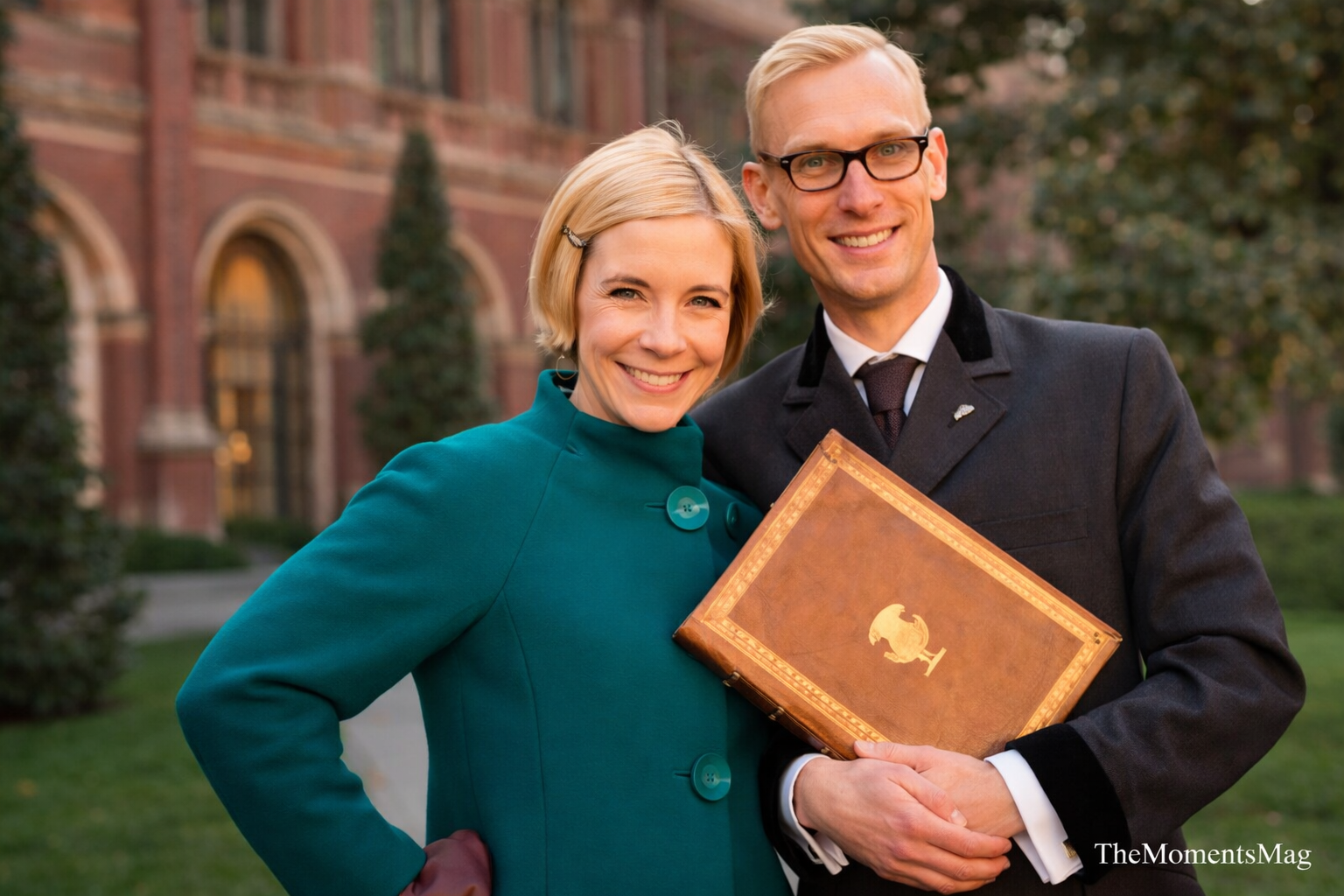
When people search for Mark Hines, they are often trying to complete a picture. They know the face and voice of historian and broadcaster Lucy Worsley, familiar from documentaries, books, and television screens. Naturally, curiosity follows: who is the person she shares her life with?
The answer is not a celebrity in the conventional sense. Mark Hines is an architect whose work and values place him firmly behind the scenes. Yet his professional focus, personal choices, and shared worldview with his wife offer a revealing counterpoint to modern public life. His story is not about fame, but about craft, restraint, and long-term thinking—qualities that increasingly matter in today’s world.
This is the biography of Mark Hines as he is publicly known: an architect, a conservation advocate, and the husband of Lucy Worsley.
Table of Contents
ToggleEarly Life and Path into Architecture
Much of Mark Hines’s early life remains private, which is consistent with how he has chosen to live as an adult. What is clear, however, is that he pursued architecture not as a route to celebrity projects or signature buildings, but as a profession rooted in responsibility and care for the built environment.
Architecture in Britain is a broad church, ranging from bold contemporary design to meticulous conservation work. Hines’s career has gravitated toward the latter. This choice often reflects temperament as much as training. Conservation architecture requires patience, historical understanding, and a willingness to let buildings speak for themselves.
Rather than imposing style, conservation architects work with what already exists. That ethos would come to define Hines’s professional identity.
A Career Shaped by Conservation and Reuse
Mark Hines is best described as a conservation-led architect. His work has focused on the adaptation, repair, and reuse of existing buildings, particularly those with historical or architectural significance.
In the UK, this is a demanding field. Historic buildings are protected by law, scrutinised by planning authorities, and deeply loved by local communities. Any intervention must balance modern needs with respect for original fabric. Architects working in this space operate under intense technical and ethical pressure.
Hines has been associated with practices and projects that reflect these values. His name appears in connection with conservation scholarship and heritage organisations, including the Society for the Protection of Ancient Buildings, often known simply as SPAB. SPAB is one of the most respected conservation bodies in Britain, founded in the nineteenth century to oppose destructive restoration practices.
Being linked to SPAB is not a casual credential. It signals a philosophy that prioritises repair over replacement and honesty over cosmetic perfection. Buildings are treated as living objects, shaped by time and use, not frozen in an imagined past.
Broadcasting House and Professional Recognition
One of the most significant projects connected to Mark Hines is the redevelopment of BBC Broadcasting House in London. Broadcasting House is not just an office building. It is a cultural landmark, deeply associated with British public life and broadcasting history.
The building’s redevelopment involved complex challenges. It is a listed structure, meaning that any changes required careful negotiation with heritage authorities. At the same time, it needed to function as a modern broadcasting headquarters, equipped with contemporary technology and capable of supporting thousands of staff.
Hines was involved in this project as an architect during his time with MacCormac Jamieson Prichard, a respected architectural practice known for thoughtful modernism and sensitive heritage work. His role placed him at the intersection of past and future, where historical significance meets practical necessity.
He also authored The Story of Broadcasting House: Home of the BBC, a detailed account of the building’s history and transformation. Writing such a book is revealing. It shows an architect who is not only concerned with design solutions, but also with narrative, memory, and cultural meaning.
The “Retrofit First” Philosophy
In more recent years, Mark Hines’s work has been associated with the growing “retrofit first” movement in architecture and planning. This approach argues that existing buildings should be upgraded and reused wherever possible, rather than demolished and replaced.
This philosophy has gained urgency due to climate change. Demolition and new construction carry heavy carbon costs, much of which is embedded in materials like concrete and steel. Retrofitting older buildings can dramatically reduce emissions while preserving local character.
Hines has contributed to alternative proposals for major redevelopment sites, including government buildings, where demolition was proposed. These alternatives demonstrated that existing structures could be adapted to meet modern standards at lower environmental and financial cost.
Such work places him in a wider national conversation about sustainability, public spending, and heritage. It also aligns closely with the values promoted by conservation groups and increasingly supported by the public.
Meeting Lucy Worsley: A Shared Worldview
Mark Hines met Lucy Worsley while she was working at the Society for the Protection of Ancient Buildings. This detail matters. Their meeting was not accidental or unrelated to their interests. It happened in a space where history, buildings, and preservation intersect.
Lucy Worsley later became Chief Curator at Historic Royal Palaces and a familiar figure on British television. Her work focuses on social history, everyday lives, and the human stories hidden within grand buildings.
Hines’s professional world complements this perfectly. Where Worsley interprets history for audiences, Hines works to ensure that the physical settings of that history survive and remain usable.
They married in November 2011 and live in Southwark, south London, near the River Thames. Their home life, like Hines’s career, is intentionally low-profile.
Life Away from the Spotlight
Despite being married to a well-known public figure, Mark Hines has remained resolutely private. He does not court media attention, rarely appears in interviews, and has no visible public-facing personal brand.
Lucy Worsley has spoken openly about valuing privacy in her personal life. She has also been candid about choosing not to have children, a decision she has described as thoughtful and deliberate. Their marriage appears grounded in mutual respect and shared values rather than public performance.
In an era when personal lives are often curated for social media, this restraint stands out. It suggests a conscious boundary between work and home, public contribution and private identity.
Architecture, Heritage, and the Modern Moment
Understanding Mark Hines’s biography also means understanding the moment in which he works. Britain is a country saturated with history. Its towns and cities are layered with buildings from different centuries, many of them protected, many of them in need of care.
At the same time, the country faces a housing shortage, climate obligations, and pressure for economic growth. Architects like Hines operate within these tensions. Their role is not simply to design, but to negotiate competing demands.
Conservation-led architects are sometimes portrayed as obstacles to progress. In reality, their work often enables sustainable development by making better use of what already exists. Retrofitting, adapting, and extending buildings can be faster, cheaper, and greener than starting from scratch.
Hines’s career reflects this pragmatic idealism. It is not about stopping change, but about guiding it intelligently.
Reputation Within the Profession
While Mark Hines may not be widely known to the general public, his name carries weight in professional and heritage circles. His association with major projects, conservation organisations, and published work signals credibility and experience.
Architecture is a field where reputation often circulates quietly. It moves through recommendations, committees, reports, and long-term outcomes rather than headlines. In this context, Hines’s steady presence across respected institutions speaks volumes.
His work demonstrates that influence does not always require visibility. Sometimes it is built slowly, through trust, expertise, and consistent values.
Mark Hines Today
Today, Mark Hines continues to work as an architect, maintaining a focus on conservation, reuse, and sustainability. He remains closely aligned with the principles that shaped his earlier career, even as those principles become more mainstream.
Meanwhile, Lucy Worsley continues to engage the public with history, drawing millions of viewers into stories of the past. Together, they form a partnership that bridges interpretation and preservation, storytelling and structure.
They are united not by celebrity, but by a shared respect for history as something lived, built, and carried forward.
Also Read: Ronan Anthony Villency: Biography, Family, and Early Life
Conclusion
Mark Hines’s biography is a study in quiet impact. He is an architect who has chosen substance over spectacle, longevity over attention, and responsibility over trend-chasing. His work reflects a belief that buildings matter not just as objects, but as carriers of memory, function, and community.
As the husband of Lucy Worsley, he inevitably attracts public curiosity. Yet his story stands on its own. It is the story of a professional who understands that progress does not always mean replacement, and that the future is often built most wisely on what already exists.
In a time defined by rapid change, Mark Hines represents a slower, steadier approach—one that values care, continuity, and thoughtful intervention. That may be why, once people begin searching his name, they often want to know more.