

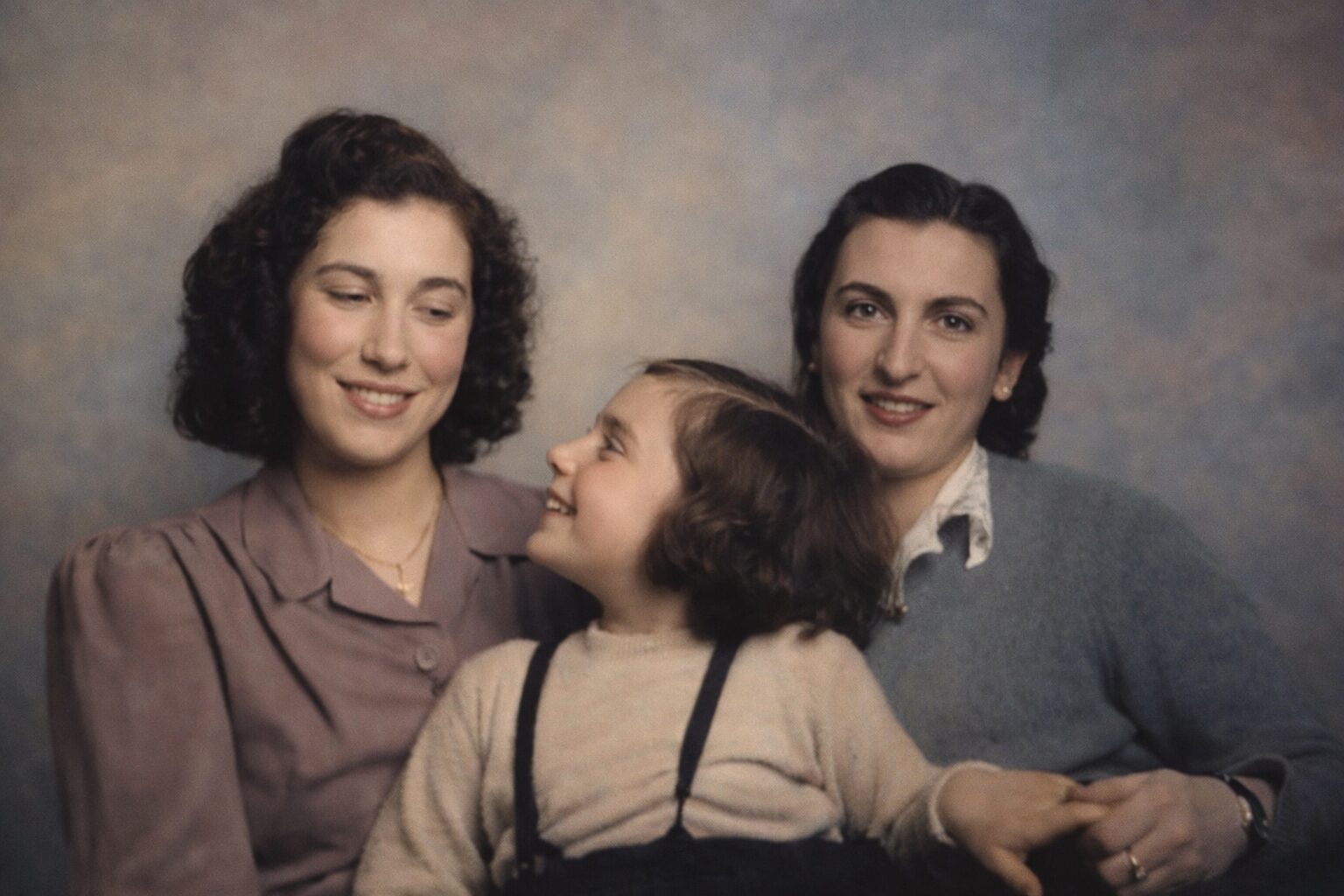
History often remembers the Holocaust through a small number of names that have come to symbolize an unfathomable tragedy. Anne Frank stands at the center of that memory, her diary shaping how generations understand loss, hope, and fear under Nazi persecution. Close to Anne’s story is that of Hannah Pick-Goslar, her childhood friend who survived and later became a key witness to Anne’s final months. Far less known, however, is Gabi Goslar, Hannah’s younger sister, whose life unfolded almost entirely outside the public spotlight.
Gabi Goslar’s story is not preserved in a diary, nor in decades of public lectures. It survives instead through archival records, family histories, and the testimony of those who protected her when she was too young to protect herself. Yet her life matters deeply, because it represents the thousands of Jewish children who endured deportation, camp life, and liberation without ever becoming symbols. Remembering Gabi Goslar is an act of restoring scale to Holocaust history, reminding us that behind every famous narrative stood countless quiet lives.
Birth and Family Background
Gabi Goslar was born on 25 October 1940 in Amsterdam. Her full recorded name in historical archives is Rachel Gabriele Ida Goslar, later appearing as Moses-Goslar in some records. She entered the world at a time when the Netherlands had already been occupied by Nazi Germany, and anti-Jewish measures were steadily intensifying.
Her parents, Hans Goslar and Ruth Judith Goslar-Klee, were German Jews who had fled Nazi Germany earlier in the 1930s. Like many Jewish refugee families, they believed the Netherlands would offer safety. They settled in Amsterdam, where Hans Goslar worked in public service and the family became part of a close-knit German-Jewish refugee community. Within this circle, the Goslar family formed friendships with the Frank family, and the children attended the same schools.
Gabi was the youngest child in the family. Her sister Hannah, born in 1928, was twelve years older and already forming her own friendships, including her close bond with Anne Frank. For Gabi, childhood memories were shaped not by carefree play but by the tension and fear that defined Jewish life under occupation.
Early Loss and a Fractured Childhood
One of the defining tragedies of Gabi Goslar’s early life came in 1942, when her mother Ruth died during childbirth. The baby did not survive. This loss shattered the family at a time when external pressures were already unbearable. Hannah, still a teenager, suddenly carried far more emotional responsibility, while Gabi, barely two years old, lost the central figure of early childhood.
The death of their mother meant that when the full force of Nazi persecution reached the Goslar household, the family was already vulnerable. Jewish children often relied heavily on extended family and community networks for care, but by this point those networks were being systematically dismantled.
As anti-Jewish laws intensified, Jewish children were expelled from public schools, barred from public spaces, and increasingly isolated. For a child like Gabi, these changes were experienced not as political developments but as a world shrinking day by day. The sense of danger was communicated through adult behavior: whispered conversations, hurried movements, and the ever-present fear of arrest.
Arrest and Deportation
In 1943, the Goslar family was arrested by the Nazis. Like thousands of other Dutch Jews, they were first sent to Westerbork, the transit camp in the northeastern Netherlands. Westerbork functioned as a staging point for deportations to the East, and families lived under constant uncertainty, knowing that transport lists meant almost certain death.
For Gabi, who was only three years old at the time, Westerbork was likely her first sustained memory of life behind barbed wire. Conditions were harsh but not yet as deadly as the camps further east. Still, hunger, fear, and separation were daily realities. Children depended entirely on older relatives to shield them from the worst dangers.
Eventually, the Goslar family was deported from Westerbork to Bergen-Belsen, a concentration camp in northern Germany. Bergen-Belsen was not an extermination camp in the same sense as Auschwitz, but it became infamous for starvation, overcrowding, disease, and neglect. Tens of thousands died there, especially in the final months of the war.
The Goslars were placed in a section of the camp that held prisoners considered potentially eligible for exchange. These categories sometimes delayed death, but they offered no real safety. Conditions remained brutal, and disease spread rapidly.
Bergen-Belsen and the Weight of Survival
Bergen-Belsen is remembered today largely because it was where Anne Frank and her sister Margot died in early 1945. It is also where Hannah Pick-Goslar encountered Anne again, separated by a fence dividing different camp sections. Hannah later described shouting to Anne, trying to give her food, and realizing how gravely ill her friend had become.
While these moments have become central to Anne Frank’s legacy, they unfolded alongside another struggle that is less often acknowledged: Hannah was also responsible for her little sister Gabi. Hannah was still a teenager herself, yet she was tasked with keeping a small child alive in conditions that defeated many adults.
Gabi’s survival depended entirely on Hannah’s strength, resourcefulness, and determination. Food was scarce, sanitation nonexistent, and disease rampant. Children were especially vulnerable to starvation and typhus. That Gabi lived through Bergen-Belsen is a testament to the fierce protective bonds that sometimes allowed families to endure even when systems were designed to destroy them.
Evacuation and the Final Chaos of War
As Allied forces advanced in the spring of 1945, the Nazis began evacuating camps, forcing prisoners onto trains in chaotic, deadly transports. Bergen-Belsen was no exception. Hannah and Gabi were placed together on one of these evacuation trains. These journeys were often aimless, with little food or water, and many prisoners died en route.
For Gabi, this was another episode of terror layered onto years of trauma. Liberation did not arrive cleanly or clearly. Survivors emerged sick, malnourished, and deeply traumatized. The war’s end did not mean an immediate return to normal life; it marked the beginning of a long struggle to rebuild bodies, families, and identities.
Hannah and Gabi survived this final ordeal. Their father, Hans Goslar, did not. Like so many survivors, the sisters emerged into a world where survival itself carried the burden of loss.
After the War and a Life of Privacy
Following liberation, Hannah returned to the Netherlands and later became one of the most important witnesses to Anne Frank’s life and death. She spoke publicly, gave interviews, and contributed to historical understanding. Through her voice, much of what we know about the Goslar family’s wartime experience has been preserved.
Gabi Goslar, by contrast, did not become a public figure. Archival records confirm her survival, but they reveal little about her later life. Some sources indicate that she eventually immigrated to Israel, as many Holocaust survivors did, seeking a place to rebuild far from the landscapes of persecution. Details about her adult life, career, and family are not widely published.
This absence of information is not a failure of history. It is a reminder that not every survivor chose—or was able—to tell their story publicly. Privacy itself can be a form of healing. For Gabi, whose childhood was consumed by trauma, a quiet life may have been the most meaningful victory possible.
Why Gabi Goslar’s Story Matters
In the twenty-first century, Holocaust remembrance faces new challenges. As survivors age and pass away, firsthand testimony becomes rarer. At the same time, misinformation and denial find new platforms. In this context, remembering individuals like Gabi Goslar becomes critically important.
Her life expands our understanding of the Holocaust beyond famous narratives. She reminds us that children were not merely witnesses but direct victims, carried through camps and transports without choice or comprehension. She represents the countless survivors whose names appear only in records, not memoirs.
Gabi Goslar’s story also underscores the role of family bonds in survival. Without Hannah’s care, her chances of surviving Bergen-Belsen would have been slim. Their relationship illustrates how love and responsibility could persist even in environments designed to erase humanity.
Memory Beyond Fame
When people search for Gabi Goslar today, they often do so because her name appears near Anne Frank’s. That connection matters, but it should not define her entirely. Gabi was not important because she stood near a famous figure. She was important because she lived through one of history’s darkest chapters as a child and survived.
Her life challenges us to rethink how we remember history. Memory is not only about preserving the loudest voices or the most eloquent words. It is also about honoring the silent endurance of those who lived, suffered, and rebuilt without recognition.
Also Read: Yulen González Reyna: Life, Family, and Eiza González’s Brother
Conclusion
Gabi Goslar’s story is a reminder that history is made not only by those who leave written testimony but also by those whose lives unfold quietly in the aftermath of catastrophe. Born in occupied Amsterdam, orphaned of her mother, deported as a small child, and carried through camps and evacuation trains, Gabi survived a system designed to eliminate her.
Her survival was not symbolic; it was human. It depended on the strength of her sister, the fragile protections of family, and an extraordinary resilience that no child should ever have been required to possess. Remembering Gabi Goslar restores balance to Holocaust memory. It reminds us that behind every well-known story stand many others, equally real and equally deserving of remembrance.
To speak her name is to affirm that survival itself is history, even when it leaves no diary behind.