

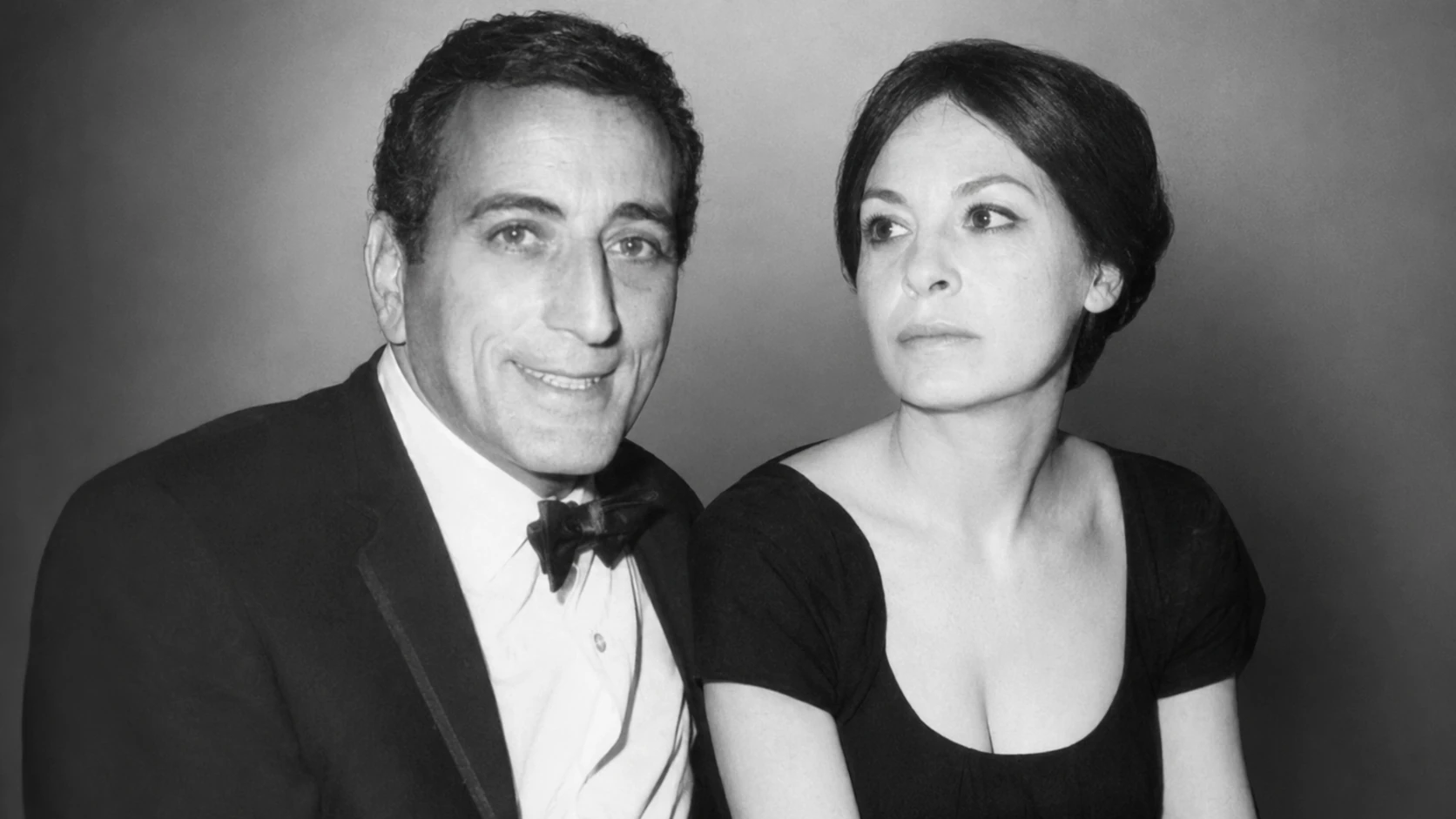
Patricia Beech entered public memory through a scene that belonged almost completely to someone else’s fame. On February 12, 1952, she married Tony Bennett at St. Patrick’s Cathedral in New York, while thousands of young female fans reportedly gathered outside in black, acting as if they were mourning the loss of their favorite singer. It was theatrical, a little strange, and perfectly suited to the feverish celebrity culture of the early 1950s. For Beech, though, that famous wedding was not a performance. It was the start of a marriage, a family, and a life that would later become far more private than the headlines around it.
Patricia Beech is best known as Tony Bennett’s first wife and the mother of his two sons, D’Andrea “Danny” Bennett and Daegal “Dae” Bennett. Her public biography is much smaller than Bennett’s, which is one reason searches for her name often lead to thin summaries and repeated claims. The reliable facts tell a clear but limited story: she met Bennett while he was rising fast, married him during his first wave of fame, raised two children with him, and separated from him before their divorce became final in 1971. After that, she largely withdrew from public attention.
That privacy is part of why Patricia Beech remains interesting. She is not a celebrity in the usual sense, yet she stands at the beginning of one of the great American music lives. Bennett became a beloved singer across generations, from his early pop-idol years to his late duets with Lady Gaga. Beech’s life touched that story at a crucial point, before Bennett became an institution and while he was still a young man learning what fame could give and take away.
Early Life and Background
Patricia Beech is usually described in public accounts as an Ohio-born or Ohio-based art student when she met Tony Bennett. The exact details of her childhood, parents, schools, and early family life have not been widely confirmed in major public sources. That absence is important because it separates her from people who built public careers and left behind a large paper trail. In her case, the public record begins mostly when Bennett entered her life.
What can be said with confidence is that she was connected to the arts before she became part of Bennett’s story. Accounts of their meeting describe her as an art student and a jazz fan in Cleveland, a city with a strong music tradition and a serious nightlife circuit in the postwar years. That detail gives a small but useful glimpse of her world. She was not simply a fan outside a stage door; she appears to have been a young woman with creative interests of her own.
The lack of public detail about her early life should not be mistaken for lack of substance. Many women of her generation, especially those who became known through marriage, were recorded by the press only in relation to husbands and children. Their schooling, ambitions, and private work often went unreported unless they became famous independently. Beech’s early years seem to have remained largely outside that public machinery.
That makes any responsible biography of Patricia Beech different from a standard celebrity profile. There are no long interviews to mine, no memoir under her name, and no long list of public achievements to arrange neatly. Instead, the task is to understand her place in a well-documented public life while respecting the parts of her own life that were not made public. The result is a portrait built from firm facts, careful context, and restraint.
Meeting Tony Bennett in Cleveland
Patricia Beech met Tony Bennett in Cleveland in 1951, during the period when Bennett’s career was starting to move from promise to real fame. Bennett, born Anthony Dominick Benedetto in Queens, New York, had served in the U.S. Army during World War II and returned to pursue music. By the early 1950s, he was being shaped into one of Columbia Records’ major vocal stars. His recording of “Because of You” helped establish him nationally and made him a favorite with young audiences.
The meeting in Cleveland has been described as taking place after one of Bennett’s nightclub appearances. Beech was a young art student, and Bennett was already drawing the kind of attention that could change the atmosphere of a room. The connection between them moved quickly, as many romances did in the show-business world of that era. Within a year, they would be married in one of New York’s most famous churches.
Their courtship unfolded at a moment when Bennett’s public image was being formed. He was handsome, polished, and emotionally direct as a singer, with a voice that could make popular ballads feel personal. Fans responded to him not only as a musician but as a romantic figure. That mattered because Beech was entering a relationship with a man whose public identity was built partly on intimacy with strangers.
For Beech, the romance must have carried both glamour and pressure. Bennett was not yet the elder statesman later generations came to know, but he was already famous enough to attract intense fan interest. The young couple’s private decisions quickly became public material. Their wedding would prove that almost immediately.
The St. Patrick’s Cathedral Wedding
Patricia Beech and Tony Bennett married on February 12, 1952, at St. Patrick’s Cathedral in Manhattan. The location alone made the ceremony stand out, since St. Patrick’s was one of the city’s most visible religious landmarks. But the part that turned the wedding into entertainment history happened outside. Reports from Bennett’s life and later retrospectives describe roughly 2,000 female fans gathering in black, as though grieving that the singer was no longer romantically available.
That image has followed Patricia Beech for more than seven decades. It is often retold because it captures the drama of pre-rock celebrity, when crooners could inspire the same kind of emotional loyalty later associated with rock stars and pop idols. The fans were not mourning Beech herself, of course. They were mourning the fantasy of Bennett as an unattached romantic figure.
The scene also shows how little control Beech had over the meaning of her own wedding in public memory. For her, it was a personal commitment. For reporters and fans, it was a spectacle of fame. That gap between lived experience and public interpretation would become a defining feature of her story.
In hindsight, the wedding reads like a snapshot of a vanished entertainment world. There were no livestreams, no viral clips, and no social media fan armies. Yet the emotional behavior was familiar: devotion, projection, and a sense of personal loss over a celebrity’s private choice. Beech became part of that story simply by marrying the man at its center.
Marriage During Bennett’s Early Fame
The early years of Patricia Beech’s marriage to Tony Bennett coincided with his climb as one of America’s major popular singers. Bennett recorded hit songs, appeared on television, performed in clubs, and built the polished public style that became his trademark. His life demanded travel and constant attention to career momentum. For a young marriage, that schedule could be difficult even without the added strain of fame.
Beech’s own role during these years was far less documented than Bennett’s professional ascent. That is common in mid-century celebrity marriages, where the wife was often portrayed as supportive, domestic, or simply present. The public usually did not ask what she wanted for herself. It asked how she fit into the star’s life.
Still, the marriage was not only a social pairing. It became a family. In 1954, Beech and Bennett welcomed their first son, D’Andrea Bennett, known as Danny. In 1955, their second son, Daegal Bennett, known as Dae, was born.
Those sons would later become important figures in Bennett’s career and legacy. Danny became his father’s manager and helped guide one of the most admired late-career revivals in American music. Dae became a respected recording engineer and producer. Through them, Beech’s connection to Bennett’s life continued long after the marriage itself ended.
Motherhood and Family Life
Patricia Beech became a mother at a young age and during a demanding period in Bennett’s career. Danny Bennett’s birth in 1954 and Dae Bennett’s birth in 1955 placed family responsibilities at the center of her life while Bennett’s public obligations were growing. The two boys were born close together, which meant the household would have been shaped by the intense practical realities of raising small children. At the same time, Bennett was navigating a career that rarely allowed for ordinary routines.
Public accounts do not give a detailed picture of Beech’s home life as a mother. There are no widely known interviews in which she gives her side of those years in depth. That silence can be frustrating for readers, but it also protects against careless storytelling. What is clear is that her sons grew into men who remained deeply tied to music and to their father’s career.
Danny Bennett became especially visible in the public record. He took over management of his father’s career during a difficult period and helped reintroduce Bennett to younger audiences without making him abandon his musical identity. That late-career strategy helped Bennett move from legacy act to cross-generational icon. Danny’s work changed the final decades of Tony Bennett’s public life.
Dae Bennett built his career in the studio. As a producer and engineer, he worked in the technical and creative space where performances become records. His path was less public than Danny’s but still closely linked to the family’s musical history. Together, the two sons show that Beech’s family life had a lasting place in Bennett’s artistic story.
Separation and Divorce
Patricia Beech and Tony Bennett separated in 1965, after more than a decade of marriage and two children together. Their divorce was not finalized until 1971, which means the legal marriage lasted nearly two decades even though the couple had been apart for years. Public accounts often point to Bennett’s long absences and the strain of his career as factors in the breakdown. Beech later sued for divorce on grounds that included adultery.
The timing of the separation matters because Bennett’s life was changing in several directions at once. The music business had shifted sharply since his early success, with rock and roll and youth culture altering what record companies wanted. Bennett remained a gifted and respected singer, but commercial conditions were less friendly to the classic pop style that had made him famous. Personal pressures and professional uncertainty often moved together in his life during this period.
Beech’s side of the marriage’s end has not been preserved in the same public way as Bennett’s career narrative. That creates a familiar imbalance. The famous husband’s struggles, choices, and reinventions are well documented, while the first wife’s experience appears mainly through legal timelines and family references. A fair account should not pretend to know her private feelings.
After the divorce became final, Bennett married actress Sandra Grant in 1971. That second marriage produced two daughters, Johanna and Antonia Bennett. Patricia Beech remained Bennett’s first wife and the mother of his sons, but she no longer occupied the public-facing role beside him. Her life after that point became much less visible.
Life Away From the Spotlight
After her marriage to Bennett ended, Patricia Beech appears to have chosen a private life. There is no widely available record of her pursuing a public entertainment career, publishing a memoir, or becoming a regular presence in interviews. That quietness has become one of the defining facts about her. She is known because of a famous marriage, but she did not seem to seek fame for herself.
This privacy has also created confusion. Many online biographies make confident claims about her later life, current location, age, or finances without offering reliable support. Some may repeat details from other sites rather than from records or interviews. With Beech, that kind of repetition can easily turn uncertainty into apparent fact.
A careful reading of the public record suggests restraint. We know the marriage timeline, the names of her children, and her place in Bennett’s early family life. We know she was tied to one of the most famous singers of the twentieth century. Beyond that, much of her later personal history remains private.
That privacy deserves respect. Not everyone connected to a celebrity becomes a public figure in their own right, and not every former spouse owes the public a full account. In Beech’s case, the lack of later publicity may be one of the most revealing things about her. She seems to have allowed Bennett’s fame to remain Bennett’s fame.
Patricia Beech’s Children and Their Legacy
Danny and Dae Bennett are central to understanding Patricia Beech’s lasting public connection to Tony Bennett. Danny, the elder son, became a major force behind Bennett’s career revival. He recognized that his father did not need to chase trends to remain relevant. Instead, he helped place Bennett in front of audiences who could discover him as a living link to classic American song.
That strategy became one of the great second acts in modern music. Bennett appeared on television programs watched by younger viewers, recorded acclaimed projects, and eventually became a familiar figure to audiences far outside his original fan base. His later collaborations with Lady Gaga introduced him to another generation entirely. Danny’s management helped make that possible.
Dae Bennett’s work added another layer to the family’s musical imprint. As a producer and recording engineer, he was part of the craft behind recorded sound. Studio work is often invisible to casual listeners, but it can shape the emotional feel of an album. Dae’s career placed him within the same musical world that had defined his father’s life.
For Patricia Beech, her sons are the clearest public extension of her family story. She was not onstage with Bennett during his late revival, and she was not the spouse beside him in his final years. Yet her children helped preserve and extend his legacy. That gives her a quiet but real place in the history around him.
Public Image and Misconceptions
Patricia Beech’s public image is unusual because it rests on very few widely known facts. She is remembered as the young woman who married Tony Bennett at the height of his early appeal. She is remembered as the first wife before Sandra Grant and Susan Benedetto. She is remembered as the mother of Bennett’s two sons.
Those descriptions are accurate, but they are also narrow. They do not tell us what she was like in private, how she viewed fame, or how she rebuilt her life after divorce. The temptation is to fill those gaps with romantic assumptions, especially because Bennett’s music was so closely associated with love and longing. But a biography should not turn silence into fiction.
One common misconception is that Beech was a celebrity performer or major public figure before marrying Bennett. The available public record does not support that claim. She was described as an art student and jazz fan, not as an established entertainer. Her public visibility came through the marriage.
Another misconception involves her wealth. Various websites may assign net worth estimates to Patricia Beech, but those figures should be treated with caution. There is no solid public basis for a precise estimate of her personal finances. Unless financial records or reliable reporting support a number, it is better to say that her net worth is not publicly verified.
Net Worth and Financial Questions
Readers often search for Patricia Beech’s net worth, but this is one of the least reliable areas of public information about her. Unlike Tony Bennett, whose career earnings came from recordings, concerts, publishing, television, and later projects, Beech did not have a public career with documented income streams. There is no widely accepted financial disclosure or official estimate tied to her name. Any specific number should be viewed as an unverified estimate unless backed by credible sourcing.
It is possible that divorce arrangements, family finances, or private assets shaped her financial life, but those details are not part of the reliable public record. Celebrity biography sites often publish numbers because readers ask for them, not because the numbers are well sourced. That creates a false sense of certainty. In Beech’s case, the honest answer is that her personal wealth is not publicly known.
Tony Bennett’s estate and later family financial matters have drawn public interest, especially after his death in 2023. That interest sometimes leads readers back to his earlier marriages and children. But Beech herself has not been a central public figure in those later financial stories. Her sons, particularly Danny, have been much more visible in connection with Bennett’s professional and estate-related legacy.
The best way to understand Beech’s financial profile is to avoid pretending there is a clear figure. She was connected to a wealthy and famous entertainer, but connection is not the same as documented personal wealth. Without reliable records, a precise net worth claim would be speculation. That distinction matters in any serious profile.
Where Patricia Beech Is Now
Patricia Beech has remained largely out of public view for many years. There is no consistent, well-confirmed stream of recent public appearances, interviews, or statements from her. Because of that, current details about her residence, health, and day-to-day life should be handled carefully. Public curiosity does not make private information reliable.
Some readers ask whether Patricia Beech is still alive. The available public record does not offer a widely confirmed, major obituary or clear public announcement of her death. That does not prove every current detail about her status, but it does mean claims should be phrased with care. In a profile like this, it is more accurate to say that her current status is not widely documented in reliable public sources.
Her absence from public life contrasts sharply with Bennett’s long farewell in the spotlight. Bennett continued recording and performing deep into old age, even after his Alzheimer’s diagnosis became publicly known. His final years were covered with affection and wide attention. Beech, by contrast, remained mostly outside that public narrative.
That difference may be exactly how she wanted it. Some people step near fame because life brings them there, not because they seek it. Patricia Beech’s later privacy suggests a person who did not try to trade permanently on her connection to one of America’s great singers. That choice deserves to be seen not as a missing chapter but as part of the story.
Why Patricia Beech Still Matters
Patricia Beech matters because she represents the human side of a famous life before the legend hardened into history. Tony Bennett’s story is often told through songs, awards, reinvention, and longevity. Beech’s presence reminds readers that the early years of fame were also years of marriage, parenthood, strain, and private consequence. Behind the smooth voice was a family trying to live with the demands of a public career.
Her story also says something about how celebrity history remembers women. First wives are often treated as prologues, especially when the famous man goes on to have later marriages, public comebacks, and final chapters with other partners. Beech can easily be reduced to the woman before the better-known later story. A more careful view gives her the dignity of being part of the central timeline, not a footnote.
The wedding scene outside St. Patrick’s Cathedral keeps her name alive because it is dramatic and easy to repeat. But the more meaningful part of her life may be quieter. She raised two sons who became tied to music in serious ways. She lived through the pressures of fame without turning herself into a spectacle.
In that sense, Patricia Beech’s life asks for a different kind of attention. It asks readers to accept that some biographies are made of public facts and private boundaries. It asks writers to be exact rather than noisy. Most of all, it asks that a woman connected to a famous man be treated as more than an anecdote.
Frequently Asked Questions
Who is Patricia Beech?
Patricia Beech is best known as the first wife of Tony Bennett. She married the singer in 1952, during the early peak of his fame, and became the mother of his two sons, Danny and Dae Bennett. Her own public profile has remained limited because she did not pursue a long public career or a regular media presence.
She is often described as an Ohio art student and jazz fan when she met Bennett in Cleveland in 1951. Their relationship became part of entertainment history because of the attention surrounding their wedding. After her divorce from Bennett, she largely lived outside the spotlight.
How did Patricia Beech meet Tony Bennett?
Patricia Beech met Tony Bennett in Cleveland in 1951 after one of his performances. Bennett was then becoming one of the most popular young male vocalists in the United States. Beech was described in public accounts as an art student with an interest in jazz.
Their romance developed during a period when Bennett’s fame was accelerating. By February 1952, they were married in New York City. The speed of the relationship reflected both personal attraction and the fast-moving world around Bennett’s early career.
When did Patricia Beech and Tony Bennett get married?
Patricia Beech and Tony Bennett married on February 12, 1952. The ceremony took place at St. Patrick’s Cathedral in Manhattan, one of New York City’s most famous churches. The wedding became widely remembered because thousands of female fans reportedly appeared outside wearing black.
That scene has become one of the most repeated details in accounts of Bennett’s early fame. It showed how strongly fans identified with him as a romantic figure. For Beech, it meant that even her wedding day was partly claimed by public attention.
Did Patricia Beech and Tony Bennett have children?
Yes, Patricia Beech and Tony Bennett had two sons together. Their first son, D’Andrea “Danny” Bennett, was born in 1954. Their second son, Daegal “Dae” Bennett, was born in 1955.
Both sons later built careers connected to music. Danny became Tony Bennett’s longtime manager and helped revive his father’s career for younger audiences. Dae became a producer and recording engineer, working behind the scenes in the music industry.
Why did Patricia Beech and Tony Bennett divorce?
Patricia Beech and Tony Bennett separated in 1965, and their divorce became final in 1971. Public accounts have cited Bennett’s long periods away from home and the pressures of his career as part of the strain on the marriage. Beech also sued for divorce on grounds that included adultery.
The full private story of the marriage’s end is not publicly known. Bennett’s career and later relationships are well documented, but Beech did not give extensive public accounts of her experience. A fair summary is that the marriage ended after years of distance, pressure, and personal conflict.
What is Patricia Beech’s net worth?
Patricia Beech’s net worth is not publicly verified. Some websites may publish estimates, but there is no reliable public financial record that confirms a specific figure. Because she did not have a widely documented public career, income estimates are especially uncertain.
It is more accurate to say that her personal finances remain private. Being married to Tony Bennett connected her to a famous and successful entertainer, but that does not create a clear public estimate of her own wealth. Any exact number should be treated cautiously.
Is Patricia Beech still alive?
Patricia Beech’s current status is not widely documented in reliable public sources. There does not appear to be a major, broadly confirmed public obituary attached to her name. Because she has lived privately for many years, current personal details are limited.
Readers should be careful with websites that claim to know her present location, health, or personal circumstances without strong sourcing. Beech’s later life has been mostly private. That privacy is one of the clearest facts about her public story.
Conclusion
Patricia Beech’s biography is not the story of a woman who chased celebrity. It is the story of someone who became visible because she married a man on the edge of major fame. Her name remains linked to Tony Bennett’s early rise, to a famous cathedral wedding, and to the two sons who later helped carry his legacy forward.
The facts that can be verified are meaningful enough without embellishment. She met Bennett in Cleveland, married him in 1952, became the mother of Danny and Dae Bennett, separated from him in 1965, and saw the divorce finalized in 1971. After that, she stepped away from the public role that fame had briefly assigned her.
There is a quiet lesson in that. Not every life connected to celebrity should be treated as public property, and not every blank space needs to be filled with guesswork. Patricia Beech still matters because she was part of a defining chapter in Tony Bennett’s life, but also because her privacy reminds us where biography should stop and respect should begin.
Her place in music history is real, even if it is understated. She was there before the late-career honors, before the comeback, before Bennett became a cross-generational symbol of American song. To understand the full arc of his life, readers eventually find their way back to Patricia Beech, the first wife whose public story remains brief, human, and quietly enduring.
Also Read: Cynthia Blaise Biography, Career and Personal Life