

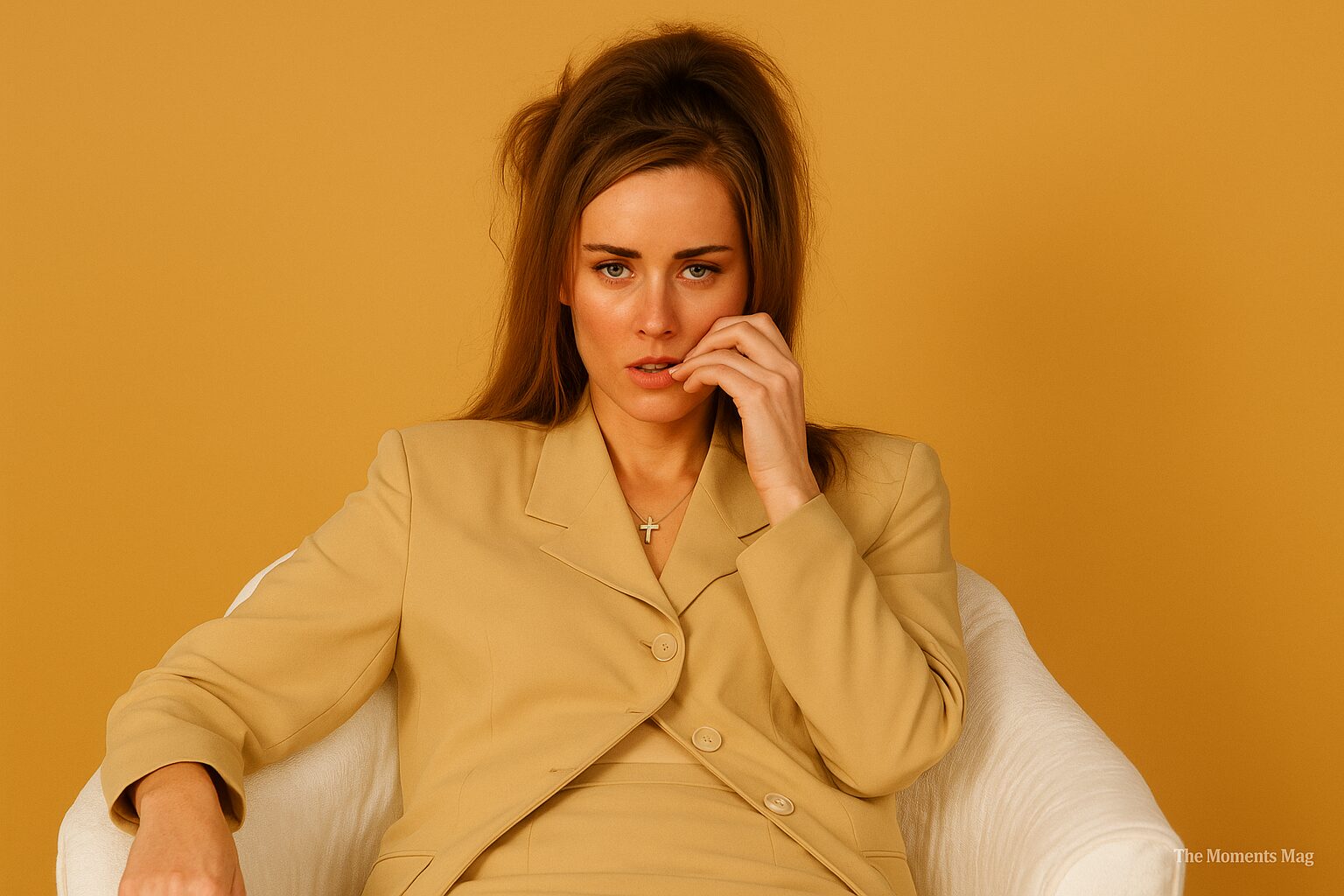
For nearly four decades, the name Eileen Catterson has drifted through Scottish pop culture like a quietly persistent echo. She is the young woman from Renfrewshire who rose to fame as Miss Scotland, the model who filled newspapers and catalogues in the 1990s, the partner who stood beside Wet Wet Wet frontman Marti Pellow during the highest highs and lowest lows of his career, and the cousin of actor Gerard Butler, who once casually called her Marti’s fiancée in an early interview. Yet for someone tied to two globally recognised entertainers, Eileen’s public record remains remarkably thin, almost enigmatic. She appears in snapshots across time—beauty pageants, fashion spreads, courtrooms, film sets—but the person herself has always lived beyond the reach of tabloids and social media.
This article brings together the most complete, human-centred telling of her story: the young girl from Erskine who became Miss Scotland, the model who chose privacy over celebrity, the woman whose loyalty influenced one of Britain’s most famous vocalists, and the figure who still attracts curiosity because she never sought the spotlight others assumed she wanted.
Growing up in Renfrewshire
Eileen Catterson’s story begins in Erskine, a small town settled along the River Clyde. Most accounts place her birth in 1969 or 1970, which means she grew up during a period of modernisation in the area, when new families were moving in and Glasgow was just close enough to feel within reach. She attended school locally, though sources differ on whether she studied at Trinity High School in Renfrew or Park Mains High School in Erskine. What everyone agrees on is that she stood out even as a teenager. She was tall, poised, and already carried the kind of grace that pageant judges often say cannot be taught.
By her mid-teens, her presence alone suggested she might fit into a world larger than the one she lived in. Still, no one in Renfrewshire could have guessed just how quickly that would happen.
Miss Scotland 1987: A Crown and a Scandal
Eileen’s life changed dramatically in 1987, when she stepped into national attention by winning the Miss Scotland title. Photos from the time show a teenager in a bright sash, smiling with the mixture of excitement and disbelief that often marks a young woman’s leap into early adulthood. The coronation took place in Edinburgh, and overnight, Eileen went from a local beauty to a national representative, a symbol of Scottish charm and youthful elegance.
But her year as Miss Scotland is remembered as much for the controversy that followed as for the crown itself. Tradition dictated that the winner would compete in the Miss Universe pageant. Yet in 1987, Scotland did not appear on the Miss Universe stage. The reason was simple and dramatic: Eileen was too young. She was still seventeen and did not meet the pageant’s minimum age requirement. As a result, she was disqualified before ever walking onto an international runway. Scotland received no replacement candidate, creating a rare gap in its pageant history.
Although the incident could have derailed her early career, it did the opposite. Her disqualification made headlines, and headlines magnified her name. Eileen became memorable, talked about, and instantly recognisable. She later represented Scotland in the Miss Europe 1988 competition, and although she did not take home that crown, she had already earned the attention of photographers and agencies eager to shape her into a commercial model.
The Modelling Years: Campaigns, Catalogues, and Quiet Success
The 1990s marked the heart of Eileen Catterson’s modelling career. Unlike supermodels who dominated high-fashion runways, Eileen became a familiar face in the world most people actually interacted with: newspapers, lifestyle features, catalogues, and high-street advertisements. Her beauty was relatable rather than intimidating, and brands saw in her an elegance that could appeal to everyday consumers.
She modelled for British high-street retailers, including the once-popular chain What Everyone Wants, and appeared in a range of promotional campaigns whose images still surface in newspaper archives. Editorial shoots captured her in graceful poses—soft morning pastels, striking evening wear, lifestyle imagery placed against iconic Scottish locations. A memorable set of photographs from the late 1990s shows her beside a BMW Z3 near the Forth Rail Bridge, embodying a blend of modern glamour and Scottish identity.
What made Eileen unusual—not only as a model, but as a public figure—was how consistently she avoided the more performative parts of celebrity life. She appeared in print, but rarely in gossip pages. She never used fame as a stepping stone to notoriety. Her work existed in the images themselves, not in any personal brand she attempted to build around them.
This quiet professionalism would eventually define her more than any single photograph ever could.
A Love Story: Eileen Catterson and Marti Pellow
To understand why so many people still search for Eileen Catterson today, you have to understand her connection to Marti Pellow, the charismatic lead singer of Wet Wet Wet. Their paths crossed around 1990, when Marti was already a rising star and Eileen had established herself as one of Scotland’s most recognisable young models. Their relationship grew quickly and became one of the most enduring partnerships in British pop culture—even though the couple themselves rarely sought publicity.
For decades, Eileen has been described as Marti’s partner, confidante, and muse. Many reports link her to the inspiration behind “Goodnight Girl,” the band’s 1992 chart-topping ballad, a song soaked in tenderness and vulnerability. Fans often note that Marti has spoken about writing from places of deep emotional connection, and the timing aligns with the early years of his relationship with Eileen. Whether or not the song was written directly about her, it has become part of the mythology surrounding their partnership, a melody that listeners still connect to her name.
But the story is not only a romantic one. The 1990s also brought Marti’s highly public struggle with heroin addiction, and this crisis revealed a different side of Eileen—one marked by strength rather than glamour. Articles from the time recount how she delivered an ultimatum that would become a turning point. She told him she could not stay with him if he continued using drugs. The choice, she said, was his alone to make, but she would not risk her own life or integrity because of his addiction. It was a moment that forced Marti to confront the consequences of his habits, and soon after, he sought treatment at The Priory in London.
The couple endured, even through recovery, fame, and the evolving pressures of adulthood. Interviews years later have Marti speaking lovingly about “my woman,” a phrase that appears again and again in his reflections on love and partnership. Although sources differ on whether they ever married—some claim he proposed multiple times—what remains consistent is that they have always kept their private life guarded and sacred.
Whether they have children is also unknown, and the absence of that information reflects something unmistakable about them: they choose silence over speculation, privacy over performance.
A Family Connection to Hollywood
One of the more surprising connections in Eileen Catterson’s life is her family tie to Gerard Butler, the Scottish actor who later rose to international fame. In an early interview, Butler casually mentioned that Eileen was his cousin and that she was engaged to Marti Pellow at the time. The comment, delivered almost offhandedly, revealed a creative thread running through the family.
Butler’s anecdote also hinted at a closeness between Eileen and the world of acting long before she ever stepped onto a film set herself. It created an intriguing parallel: two relatives who made careers in performance and visibility, yet approached fame from very different angles—one leaning toward the big screen, the other guarding her privacy more fiercely with every passing year.
Acting Attempts and the Roles the World Never Saw
Despite her quiet life, Eileen made several attempts to step into acting. She was cast in small background roles around the early 2000s, including a brief part as one of the glamorous ice palace women in the James Bond film “Die Another Day.” It would have been a glamorous addition to her résumé, but the scenes were reportedly removed from the final cut, leaving her with a Bond credit that existed only behind the scenes.
Another acting opportunity emerged a few years later, but an injury forced her to withdraw from the project. Reports describe the incident as painful and career-disrupting, with headlines referencing her “agony on ice,” though details were sparse. These almost-roles paint a picture of a woman whose life repeatedly brushed the edges of cinematic fame without ever fully stepping into it. In a way, these near-misses reinforced the sense that modelling—not acting—was where she felt most at home.
The Court Case That Made Headlines
In the late 1990s, Eileen found herself in an unexpected legal battle when she sued the Scottish confectionery company McCowan’s, claiming that the acidity in their sweets had discoloured her teeth, forcing her to over-brush and harming her modelling prospects. The case made national news, not only because it involved a model but because it highlighted how deeply a model’s livelihood depends on appearance. The company denied responsibility, and the final judgment was not widely reported. Still, the case remains part of her public narrative, a reminder that beauty—despite its glamour—is often a precarious career built on fragile foundations.
Life Away from the Spotlight
In recent years, Eileen Catterson has become almost entirely invisible to the public eye. Marti Pellow has spoken in interviews from his home in Windsor, and many assume the couple live there together, continuing the quiet life they chose long ago. What sets Eileen apart from so many public figures of her generation is that she has never embraced internet culture. She has no confirmed social media accounts, no public statements, no self-curated brand. Her absence is deliberate, elegant, and deeply countercultural in an age of constant self-exposure.
Because of this, people often search for her not because she is everywhere, but because she is nowhere. In a world where almost everyone documents their life, Eileen Catterson remains a mystery—present in the memories of 1980s and 1990s pop culture, but absent from the digital spaces that define public identity today.
The Other Eileens: A Source of Online Confusion
Another reason her name continues to surface is the presence of unrelated people who share it. News stories, obituary notices, and professional profiles sometimes belong to other women entirely, such as the Northern Irish woman whose death notice appeared in 2022 or the American doctor and religious sister celebrated for community work. These individuals have no connection to the Scottish model, yet their names often appear alongside hers, contributing to the myth of Eileen Catterson as a figure with blurred edges and overlapping identities.
Why Her Story Still Matters
What keeps Eileen Catterson culturally relevant is not a constant stream of public appearances or interviews. Instead, it is the combination of early fame, artistic influence, long-term partnership with a major pop figure, and a refusal to turn her life into a spectacle. She embodies a different kind of fame—the kind defined not by visibility but by the lingering curiosity of those who remember her image, her impact, or the songs she helped inspire.
She also represents a rare archetype in modern celebrity culture: the woman who could have chosen a public life but chose a private one instead. Her story stretches from beauty pageants to fashion shoots, from legal headlines to film sets, from a teenage crown to a quiet life in middle age. It is the portrait of a model whose career and love life shaped headlines long ago, but whose silence has allowed her story to settle into something more intriguing than gossip—something closer to folklore.
Also Read: Cashmere Saint Newton: Inside Cam Newton’s Family Story
Final Thoughts
Eileen Catterson is not simply a former Miss Scotland or the long-time partner of Marti Pellow. She is a figure whose presence shaped an era of Scottish pop culture while simultaneously resisting the fame that era tried to impose on her. Her life has been defined by beauty, talent, loyalty, and extraordinary discretion. The reason people still look for her today is not because she is loud, but because she is quiet. She remains the kind of public figure who invites curiosity precisely by refusing to be a public figure at all.
In a world obsessed with visibility, Eileen Catterson remains unforgettable because she chose to disappear.