

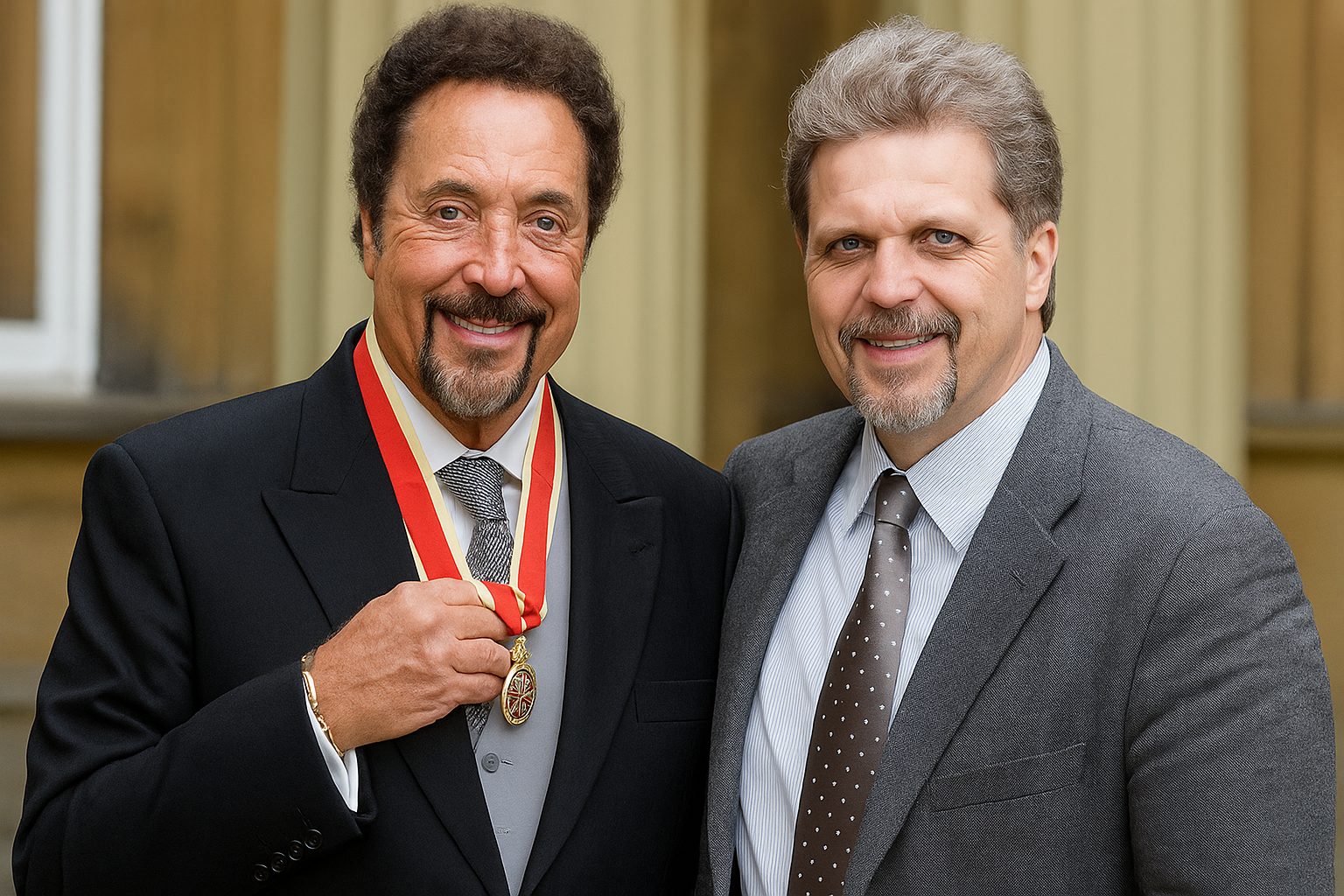
When people think of Tom Jones, images of velvet suits, powerhouse vocals, and decades of hit songs immediately come to mind. What fewer people realize is that behind this legendary performer stands a man who has helped shape, guide, and sustain that remarkable career for nearly four decades — Mark Woodward, Tom Jones’ only son.
Far from simply being the child of a superstar, Mark Woodward has built a reputation as a discreet but formidable music manager, ensuring that his father remains not just relevant, but respected across generations. His story is one of loyalty, business acumen, and emotional intelligence — the behind-the-scenes engine of a legacy that continues to evolve well into the 21st century.
This article dives deep into who Mark Woodward is, how he became his father’s manager, the strategic moves that shaped Tom Jones’ career, and the lasting impact of their partnership on the music industry.
Early Life: Growing Up in the Shadow of a Star
Mark Woodward was born in 1957, the same year his father Tom Jones (born Thomas John Woodward) and his mother Linda Trenchard married as teenagers in South Wales. By the time Mark was a young child, Tom was already climbing the ladder from local pub singer to one of the most electrifying voices of the British Invasion era.
Growing up, Mark experienced both sides of fame — the glamour of his father’s success and the strain that came with being the son of a man constantly on tour. Life as part of a show business family often meant long stretches apart, but it also provided Mark with a front-row seat to the realities of the entertainment world: contracts, touring schedules, media pressures, and constant reinvention.
Unlike many children of celebrities who gravitated toward the spotlight, Mark gravitated away from it. He developed a quiet, observant personality and a natural understanding of people — qualities that would later prove invaluable when managing an artist of his father’s magnitude.
Taking the Reins: Becoming Tom Jones’ Manager
In the mid-1980s, Tom Jones’ career reached a crossroads. The singer had conquered Las Vegas and maintained global recognition, but like many 1960s stars, he was facing changing tastes and a shifting musical landscape.
When Tom’s original manager, Gordon Mills, passed away in 1986, it marked a significant turning point. Mills had been a key figure in shaping Tom’s early image, guiding him through hits like “It’s Not Unusual,” “Delilah,” and “What’s New Pussycat.” His death left both a personal and professional void — one that Mark stepped in to fill.
At just 29 years old, Mark Woodward assumed full responsibility for managing one of the biggest names in show business. This move might have seemed risky from the outside — a young, relatively inexperienced man taking over his father’s complex career — but Tom trusted him completely. That trust, as it turned out, became the cornerstone of a partnership that would endure for decades.
The Strategy: Modernization Without Compromise
When Mark became Tom’s manager, he inherited not just a legacy, but a challenge: how to keep Tom Jones relevant in an era increasingly dominated by new wave, punk, and synth-pop.
Mark’s vision was bold yet simple — don’t chase trends; adapt authentically.
He reimagined Tom’s public persona, steering him away from the lounge-singer stereotype and repositioning him as a soulful, contemporary artist with timeless appeal. This strategy meant updating the sound and image while keeping the essence of what made Tom Jones unique: the voice, the charisma, and the emotional connection with audiences.
1. The Art of the Reinvention
Mark’s first major success as a manager came in 1988 with the release of Tom’s cover of Prince’s “Kiss”, recorded with the avant-garde group Art of Noise. It was a radical choice — unexpected, playful, and sonically fresh. The single became an international hit, proving that Tom could still command the charts and appeal to a younger audience.
This wasn’t a fluke; it was the result of Mark’s understanding of how to blend nostalgia with novelty. He didn’t try to make his father something he wasn’t. Instead, he found a way to reintroduce Tom Jones to the world in a context that made sense both musically and generationally.
2. Building a Legacy Brand
Throughout the 1990s, Mark focused on rebuilding Tom’s recording and touring strategy around longevity rather than trends. He orchestrated collaborations with emerging artists, ensured visibility through television appearances, and maintained a global touring presence that kept Jones in front of loyal fans while capturing new ones.
By the late ’90s, this culminated in the 1999 album “Reload,” a star-studded collection of duets with contemporary artists. Featuring collaborations with younger acts like the Stereophonics and Robbie Williams, Reload topped charts worldwide and became one of Tom Jones’ most successful albums.
Behind the scenes, Mark’s business savvy was evident. He negotiated flexible recording contracts, managed image control, and expanded his father’s digital and live performance footprint — long before legacy artists typically did.
The Father-Son Dynamic
One of the most fascinating aspects of the Tom Jones–Mark Woodward partnership is the blend of family loyalty and professional discipline.
For many, working with a parent or child can be complicated, but for Tom and Mark, the dynamic evolved into one of mutual respect and clear boundaries. Mark understood his father’s temperament and instincts, while Tom trusted his son’s modern sensibilities.
They often disagreed — as any strong creative partnership does — but both shared a deep commitment to the integrity of the work. Mark wasn’t just saying yes to everything; he was known for challenging ideas, protecting Tom’s image, and ensuring that every project aligned with long-term goals rather than short-term publicity.
Their collaboration went beyond business. It was an emotional alliance built on shared experience, mutual pride, and an unspoken understanding that they were not only building a career — they were preserving a legacy.
The 2000s: Evolution Through Artistry
As the new millennium dawned, Tom Jones — now entering his sixties — could easily have rested on nostalgia. Instead, under Mark’s guidance, he entered what many critics consider a third artistic renaissance.
1. A Shift Toward Roots and Authenticity
In the late 2000s and early 2010s, Mark guided his father into a more introspective phase. They collaborated with producer Ethan Johns, creating a trilogy of albums — Praise & Blame (2010), Spirit in the Room (2012), and Long Lost Suitcase (2015).
These records stripped away glamour and glitz, focusing on gospel, blues, and soul — genres that had always influenced Tom but had never fully defined him. Critics praised the raw honesty of these albums, crediting Mark’s direction for giving Tom space to express emotion and experience in a mature, meaningful way.
2. From Vegas to Vitality
What Mark achieved during this period was remarkable: he transformed his father’s public image from a nostalgic Vegas act into an artist of gravitas. That shift wasn’t cosmetic — it was artistic and emotional. By encouraging projects that prioritized authenticity over chart ambition, Mark ensured that Tom Jones’ legacy evolved with dignity.
The 2020s: Continuing to Defy Time
By the time Tom Jones reached his eighties, most artists from his generation had either retired or faded from the mainstream. But in 2021, under Mark’s co-production, Tom released “Surrounded by Time,” an album that debuted at No.1 in the UK — making him the oldest male artist ever to top the UK album chart.
This achievement was more than a statistic. It was the culmination of decades of strategic, careful evolution guided by Mark’s steady hand. The album explored memory, loss, and resilience — themes deeply resonant with both Tom’s life and the times.
Mark’s role in the album extended beyond management; he was part of the creative process, co-producing and curating its repertoire. His instinct for emotional storytelling gave the record a cohesion that connected with fans old and new alike.
Leadership Philosophy: Lessons from Mark Woodward
For anyone studying entertainment management, Mark Woodward offers a masterclass in strategic career longevity. His approach is characterized by several core principles:
1. Authentic Adaptation
He never forced his father into trends; he helped him evolve naturally. Every reinvention felt genuine, reflecting Tom’s personality rather than reacting to the marketplace.
2. Controlled Visibility
Mark understood the value of mystique. Unlike many managers who overexpose their artists, he balanced accessibility with restraint — allowing Tom to remain admired rather than overexposed.
3. Partnership Over Power
The father-son dynamic thrived because it was collaborative, not hierarchical. Mark’s management style is consultative, rooted in trust rather than authority.
4. Business as Legacy
For Mark, management isn’t about profit alone; it’s about continuity. Every decision — from album concepts to interviews — supports a consistent narrative: Tom Jones as a timeless artist, not just a nostalgic act.
The Man Behind the Scenes
While his father commands the spotlight, Mark remains largely private. He rarely grants interviews and prefers to let Tom’s work speak for itself. Those who have worked with him describe a man who is intelligent, pragmatic, and deeply protective — not only of his father but of the music itself.
Mark has also extended his management skills beyond the studio, overseeing touring logistics, television appearances, and brand partnerships. His quiet influence can be seen in Tom’s sustained ability to fill arenas, appear on major television shows, and remain relevant in pop culture without ever feeling like a caricature.
Family and Personal Life
Mark has maintained a stable family life away from the tabloids. Married for many years, he has two children. His son, Alex Woodward, is known to have competed internationally in sports, demonstrating that the Woodward family’s drive for excellence extends beyond music.
This multigenerational commitment to hard work and discipline reflects the same grounded values that have characterized both Tom and Mark throughout their lives — humility, dedication, and pride in craftsmanship.
The Emotional Core: Beyond Business
While much of Mark’s reputation rests on professionalism and vision, the emotional side of his work shouldn’t be overlooked. Managing one’s parent is not a simple task — especially when that parent is a global superstar. Yet Mark has navigated that balance with grace.
He has guided his father through career highs, personal losses, and cultural changes spanning six decades. When Tom’s wife Linda passed away in 2016, Mark was by his father’s side — not only as a manager but as a son. Their bond strengthened in grief, and their work together became a source of healing and purpose.
Why the Tom Jones–Mark Woodward Partnership Endures
In an industry notorious for short-lived alliances, the longevity of Tom and Mark’s partnership is extraordinary. The secret lies in shared values: honesty, work ethic, and adaptability.
Mark’s influence has ensured that Tom Jones’ artistry remains respected rather than recycled, that his career is defined not by nostalgia but by continued relevance. Together, they’ve demonstrated how legacy artists can remain vital — not by clinging to the past, but by embracing the present with authenticity and grace.
Legacy and Impact
Mark Woodward’s story is more than just a chapter in Tom Jones’ career — it’s a blueprint for sustainable artistry in the modern age. In an era where fame often burns bright and fast, he has proven that longevity requires both reinvention and restraint.
His management philosophy has become a quiet model for other family-managed artists and legacy acts navigating the digital age. By combining respect for history with an eye for the future, Mark Woodward has turned what could have been a fading career into a living masterclass in relevance.
Today, as Tom Jones continues to perform globally and record new material, it’s clear that the partnership between father and son remains as strong as ever. Their relationship embodies both business strategy and human connection — a reminder that behind every great artist, there’s often an unsung figure ensuring the music never stops.
Read Also: Sergio Novak – Shirley Bassey’s Ex-Husband & Manager
Conclusion
Mark Woodward’s name may not appear in flashing lights, but his impact resonates through every note of Tom Jones’ enduring career. He is the rare kind of manager who understands that success is not measured solely in chart positions or ticket sales, but in the ability to stay meaningful — decade after decade.
From guiding reinventions to preserving integrity, Mark has done what few in the music industry manage to achieve: he turned management into artistry. His work stands as proof that the truest form of fame is not just being known — it’s being remembered, respected, and relevant.
In the end, the world sees Tom Jones, the icon. But behind him, always steady and unseen, stands Mark Woodward — the architect of continuity, the son who became the strategist, and the reason the legend still sings.